
Formaldehyde emissions are one of the most important safety topics for interior plywood today. CARB-P2, E0 and E1 standards give importers a clear way to specify low-emission plywood for cabinets, furniture and wall panels, but the differences between them are often misunderstood. This guide explains each standard, where it applies and how to verify that your plywood is truly safe for indoor use.
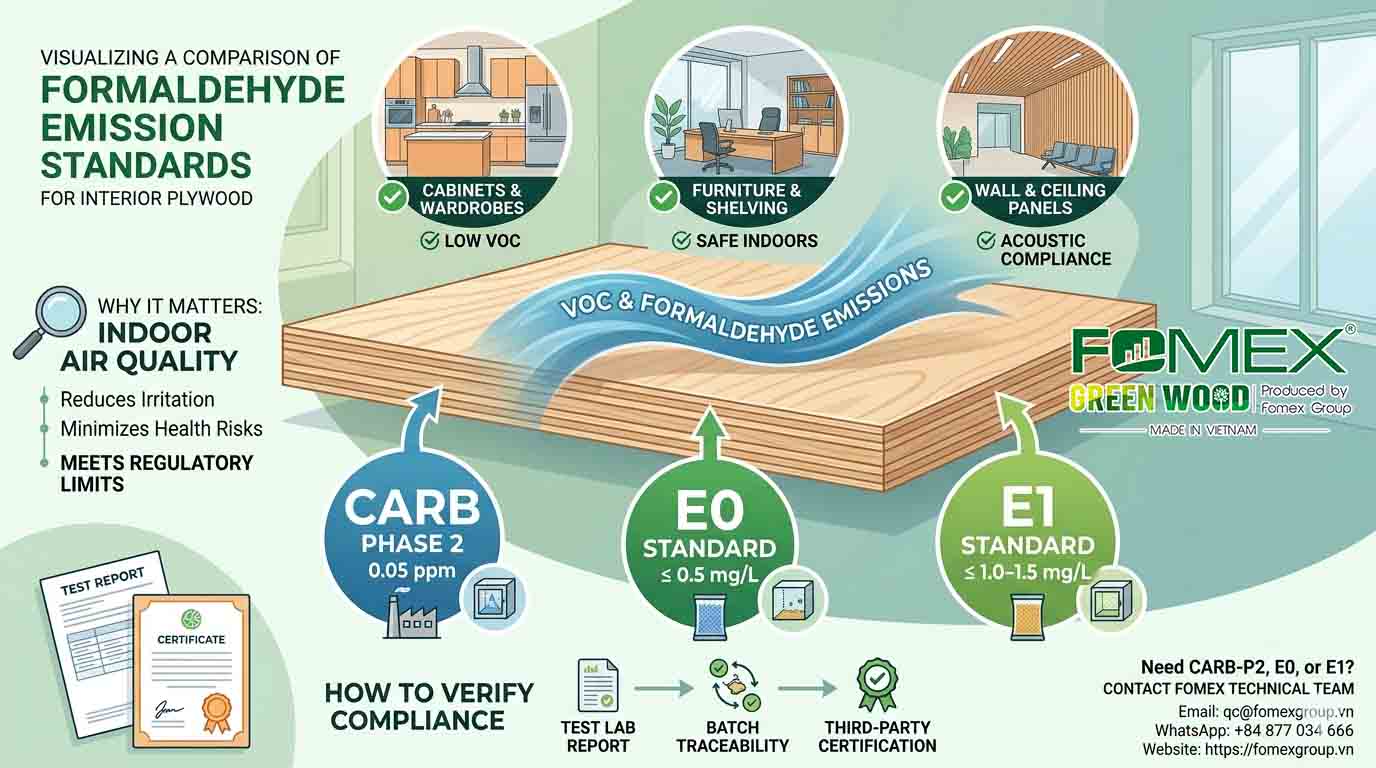
Why Formaldehyde Emissions Matter Indoors
Formaldehyde is a volatile organic compound (VOC) released in small amounts by many composite wood products because of the resins used to bond veneers and particles together. Long-term exposure to elevated formaldehyde levels can cause eye, nose and throat irritation, worsen respiratory conditions and has been linked to increased cancer risk in humans. [web:50][web:53]
As people spend most of their time indoors, regulators in major markets such as the US, EU and Asia have tightened VOC and formaldehyde limits to protect indoor air quality in homes, schools, offices and healthcare buildings. [web:46][web:54]
For plywood importers, this means emission class is no longer optional marketing; it is a compliance requirement and a key part of your brand’s safety promise for interior projects.
Understanding CARB-P2, E0 and E1 Standards
CARB Phase 2 (CARB-P2) and E0/E1 are different but related ways of limiting formaldehyde emissions from wood-based panels. CARB-P2 is a California regulation widely adopted across the US, while E0 and E1 are emission classes commonly used in Asia and Europe for plywood and other wood-based panels. [web:44][web:49][web:52][web:54]
What Is CARB-P2?
CARB Phase 2 is an Airborne Toxic Control Measure from the California Air Resources Board that sets maximum allowable formaldehyde emission limits for composite wood products such as hardwood plywood, MDF and particleboard. [web:44][web:48][web:51]
For hardwood plywood, CARB-P2 limits emissions to 0.05 ppm formaldehyde (measured in a chamber test) for both veneer-core and composite-core products, while other panel types such as particleboard and MDF have slightly higher limits. [web:44][web:48][web:51]
What Are E0 and E1?
E0, E1 and E2 are emission classes used in standards such as Chinese GB and EN 13986 to classify plywood and other panels according to their formaldehyde release in desiccator or chamber tests. [web:49][web:52][web:55][web:58]
- E0: typically ≤ 0.5 mg/L in desiccator tests – very low emissions, suitable for sensitive indoor environments such as bedrooms and schools. [web:49][web:52]
- E1: typically ≤ 1.0–1.5 mg/L in desiccator tests, or about 0.1–0.124 mg/m³ in chamber tests – low emissions accepted for most interior furniture and paneling. [web:49][web:54][web:55]
- E2: up to 5.0 mg/L – higher emissions, increasingly restricted for long-term indoor use in many markets. [web:49][web:52]
In practical terms, E0 demands stricter control than E1 and is often positioned as a premium low-emission option, while CARB-P2 is chamber-based and focuses on ppm limits for products sold in the US. [web:44][web:49][web:52][web:54]
Where CARB-P2, E0 and E1 Plywood Are Used
Low-emission plywood is used anywhere people live, work or spend long periods of time indoors. The closer the panel is to occupants and the larger its exposed surface area, the more important emission class becomes. [web:49][web:53]
- Cabinets and wardrobes: Large surface area and enclosed spaces make CARB-P2 or E0/E1 panels attractive to reduce odours and VOC build-up in bedrooms and kitchens. [web:44][web:48]
- Furniture and shelving: Desks, tables, bookcases and storage units benefit from E0/E1 or CARB-compliant cores, especially in offices and schools. [web:49][web:53]
- Wall and ceiling panels: Decorative plywood and acoustic panels in hotels, offices and public buildings often require low-emission documentation to support green building goals. [web:53]
- Flooring substrates: Plywood underlays beneath carpets or resilient floor coverings are often specified as CARB-P2 or E1 to help keep whole-room VOC levels within recommended ranges. [web:44][web:55]
Residential projects increasingly insist on CARB-P2/E1 as a minimum, while high-end homes, healthcare and education projects may prefer E0 or equivalent ultra-low-emission products. [web:49][web:53][web:55]
Testing and Certification Requirements
Emission classes are not based on declarations alone; they require laboratory testing under defined conditions. Panels are tested in small chambers or desiccator setups that measure how much formaldehyde is released over a set period. [web:44][web:45][web:49]
Lab Testing Procedures
- Chamber tests: Panels are placed in a controlled chamber and air samples are analysed for formaldehyde concentration in ppm or mg/m³ after a specified time. This is used in CARB and many EN-based standards. [web:44][web:45][web:54]
- Desiccator tests: Common in some Asian and Chinese standards; panels are placed above water in a sealed desiccator and released formaldehyde is absorbed and measured as mg/L. [web:49][web:52][web:58]
How Often Panels Must Be Tested
Serious manufacturers implement regular production testing and third-party verification to maintain certification. Under CARB and US TSCA Title VI rules, certified mills follow quality control plans and are audited by third-party certifiers who also conduct periodic independent tests. [web:44][web:47][web:54][web:57]
For E0/E1 products, manufacturers usually combine internal routine checks with external lab reports to prove that typical production stays within the claimed emission class over time. [web:49][web:52][web:54]
How to Verify Compliance as an Importer
Importers cannot “see” emissions, so documentation and traceability are critical. You should be able to connect any claim on a label to a specific test report, production batch and certification body. [web:44][web:47][web:54]
What to Look for in Reports and Certificates
- Standard and method used (e.g., CARB chamber test, EN 717-1, JIS A 1460, desiccator method). [web:49][web:55]
- Measured emission value and the limit it is compared to (for example “0.04 ppm vs limit 0.05 ppm” or “0.4 mg/L vs E0 limit 0.5 mg/L”). [web:44][web:49][web:52]
- Panel type, thickness, substrate and glue system tested, matching the product you plan to buy. [web:44][web:54]
- Testing lab name, accreditation status and test date. [web:44][web:47][web:49]
Traceability to Batch and Production Date
Compliance is only meaningful if you know which batch it applies to. Ask suppliers how test reports are linked to real production: for example, through batch numbers on bundle labels, production dates or lot codes. [web:47][web:54]
For critical projects, consider random spot checks at independent labs in your own market to confirm that delivered goods match the claimed emission class over time. [web:46][web:54]
Low-Emission Plywood Solutions from FOMEX GREENWOOD
FOMEX GREENWOOD develops plywood lines that can be tailored to meet CARB-P2, E0 or E1 emission requirements for international buyers, especially for interior furniture, cabinetry and decorative applications. Low-emission glue systems and controlled veneer drying are used to keep formaldehyde release within target limits while maintaining mechanical performance. [web:49][web:52][web:54]
For each project, specifications can be aligned with the destination market: CARB-P2/TSCA Title VI for the US, E0/E1 for EU and Asia-Pacific, or combined approaches where importers serve multiple regions from a single product range. Supporting documentation such as test reports and certificates can be provided to help buyers pass audits and customer due diligence. [web:44][web:47][web:49][web:54]
Need CARB-P2 or E0/E1-Ready Plywood for Your Interior Projects?
FOMEX GREENWOOD can recommend plywood configurations and emission classes for cabinets, furniture and wall panels, and supply the formaldehyde test reports you need for compliance checks and client tenders.
Contact FOMEX Technical Team →
Email: qc@fomexgroup.vn
☎ WhatsApp: +84 877 034 666
FAQs
Is E0 always better than CARB-P2?
E0 and CARB-P2 use different test methods and units, so they are not directly interchangeable. E0 usually targets ≤ 0.5 mg/L in desiccator tests, whereas CARB-P2 sets chamber limits like 0.05 ppm for hardwood plywood. Both indicate low emissions, but you must compare actual test values and methods rather than assuming one label is automatically “better”. [web:44][web:49][web:52][web:54]
How can I verify that the plywood truly meets CARB-P2?
Check that the product is labeled as CARB Phase 2 or TSCA Title VI compliant, then request chamber test reports showing emission levels below CARB limits for the relevant product type. Confirm that the mill is listed with a CARB-approved third-party certifier and that reports reference the same product, thickness and batch you are purchasing. [web:44][web:47][web:51][web:57]
Are low-emission panels more expensive?
Typically yes: achieving E0, E1 or CARB-P2 compliance requires improved resin systems, process control and regular testing, which add cost. However, the price difference is often small compared with the value of safer indoor air, reduced odour complaints and easier compliance with building and retailer requirements. [web:49][web:52][web:54]
Do export markets outside the US require CARB compliance?
Many markets do not legally require CARB, but they increasingly demand equivalent low-emission performance. The US uses CARB/TSCA Title VI, while other regions use E0/E1, national limits or green building labels that reference formaldehyde thresholds. Importers outside the US may still prefer CARB-P2-compliant products as a clear benchmark their customers recognise. [web:46][web:49][web:53][web:54]