
For project buyers, choosing formwork plywood is rarely just a question of panel thickness. The real decision is whether the board can handle the load, surface demand, reuse target, and handling conditions of the job without creating avoidable cost later.
That is where comparison becomes useful. Flooring, roofing, packaging, and concrete formwork may all use plywood, but they do not ask the same thing from the panel. This guide compares the most important thickness and performance trade-offs so contractors and procurement teams can reduce decision friction before ordering.
What Formwork Plywood Is
Formwork plywood is plywood selected for temporary concrete shuttering and related support work, where the panel must resist wet concrete pressure, hold shape through handling, and support a usable concrete surface finish. In market guides and manufacturer references, common concrete formwork thicknesses are often 15 mm, 18 mm, and 21 mm, with 18 mm widely used as a standard starting point for many slab, wall, and column applications.
Where each option is strongest
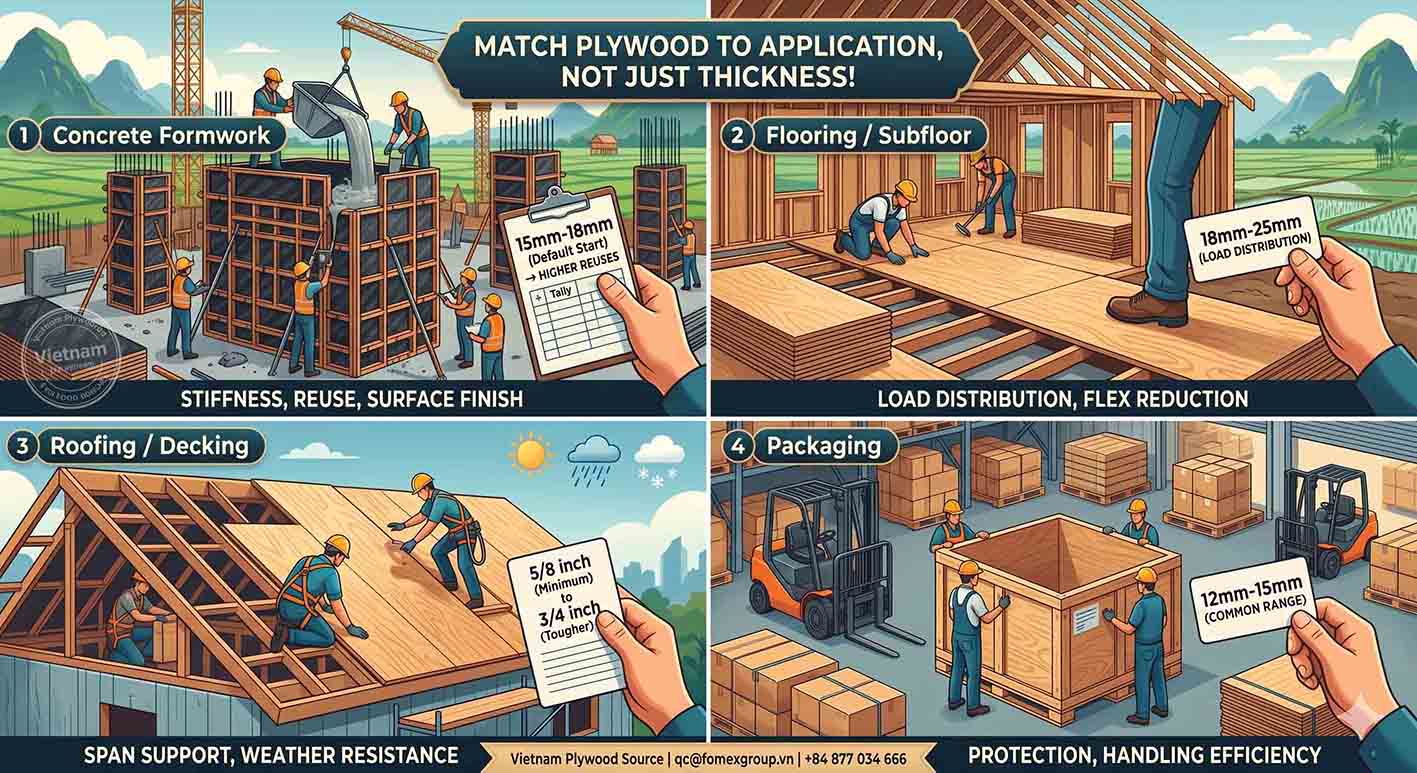
Formwork plywood is strongest when stiffness, surface durability, and jobsite reuse matter more than decorative appearance. Flooring-focused plywood is stronger in subfloor and load-distribution roles, roofing panels are selected around span and weather load, and packaging plywood is usually chosen for protection, containment, and transport efficiency rather than concrete pressure resistance. Typical flooring references place many subfloor uses around 18 mm to 25 mm, while roofing references commonly point to 5/8 inch as a baseline and 3/4 inch for heavier conditions.
When to choose one route over another
Choose formwork plywood when the panel must work inside a concrete forming system and the buying decision depends on stiffness, face durability, and reuse handling. Choose flooring plywood when the panel is part of a floor build-up, roofing plywood when span and roof load control the design, and packaging plywood when shipment protection or crate construction matters more than repeated site reuse. For lighter temporary structures and some packing uses, references commonly show 12 mm to 15 mm panels as a starting zone.
Key Performance Criteria
Thickness only helps when it is matched to the correct use. Buyers should compare thickness together with span, support spacing, surface demand, moisture exposure, handling weight, and replacement risk.
| Application | Common Thickness Starting Point | Main Buying Priority | When to Step Up |
|---|---|---|---|
| Concrete formwork | 15 mm to 18 mm is common for many slab applications, while 18 mm is a common standard and 21 mm is often used for heavier-duty pours or longer spans. | Stiffness, concrete-facing surface, and controlled deflection. | Move up when pour pressure, span, or reuse expectation increases. |
| Flooring / subfloor | 18 mm is commonly used for subflooring, and 22 mm or more is often chosen for heavier-duty areas. | Load distribution, reduced flex, and floor stability. | Move up when traffic load or stiffness expectations are higher. |
| Roofing | 5/8 inch is often treated as a practical minimum for many roof applications, while 3/4 inch is used more often in heavier snow, wider spacing, or commercial conditions. | Span support, wind or snow resistance, and deck stability. | Move up when climate load or framing spacing increases. |
| Packaging | 12 mm to 15 mm is a common starting range in temporary structure and packing-related use cases, depending on load and protection design. | Protection, handling efficiency, and shipping practicality. | Move up when crate strength, impact resistance, or stacking demand increases. |
Where formwork plywood performs best
Among these categories, formwork plywood is the most specialized in balancing stiffness, handling weight, and temporary reuse value. That is why contractor guides and manufacturer references often center on 18 mm as the practical default for many concrete jobs, while 21 mm is reserved for heavier conditions.
When buyers should choose A or B
If the priority is concrete pressure and finish control, formwork plywood should stay at the center of the decision. If the priority is subfloor stiffness, roof deck support, or export packing efficiency, a different thickness logic should apply. The mistake is not choosing a thinner or thicker panel. The mistake is choosing thickness without matching it to the real use case.
Reuse Expectations
Reuse is one of the biggest differences between formwork plywood and other plywood categories. Flooring, roofing, and packaging panels are usually selected for fixed installation or protective use, while formwork procurement often includes questions about how many pours or cycles the panel can support under site handling conditions.
Where each option is strongest
Formwork plywood is stronger than general-use panels when the job requires repeated stripping and reinstallation. Public guidance from Fomex Group notes that standard formwork options in the 9 mm to 15 mm range may be used for about 2 to 5 reuses under good handling, which shows how reuse expectations are tied not just to thickness, but also to grade and jobsite control.
When to choose a higher-spec route
Buyers should step up from thin or basic formwork panels when reuse value matters more than first-cost savings. For higher-pressure pours, wider spans, or projects where replacement causes disruption, thicker concrete formwork plywood and better film-faced grades usually make more sense than low-cost boards that need early replacement.
Common Mistakes
Most thickness mistakes happen because buyers compare plywood as if all categories solve the same problem. They do not. The same panel thickness can behave very differently depending on support spacing, moisture exposure, face construction, and expected service cycle.
Where buyers go wrong
One common mistake is treating 18 mm as automatically correct for every project. It is a common reference point for formwork and subflooring, but that does not make it the right answer for every slab, floor, or roof condition. Another common mistake is comparing concrete formwork plywood with general flooring or packaging panels only on thickness, while ignoring face durability, bond performance, and handling stress. Common references separate these uses for a reason.
When to choose A or B more carefully
If the job is concrete-facing and reuse matters, buyers should not substitute lower-spec panels just because the nominal thickness looks similar. If the application is roofing or flooring, buyers should not overbuy a formwork-style panel when span, load, and installed-use criteria point to a more suitable construction approach.
Buyer Checklist
To reduce decision friction, procurement teams should review thickness in a structured way rather than as a standalone number.
Must-check items before ordering
- Confirm the real application: concrete formwork, flooring, roofing, or packaging.
- Check the support condition: span, joist or rafter spacing, and expected load.
- Review whether reuse is part of the buying decision or not.
- Ask for panel grade, bond type, surface construction, and thickness tolerance where relevant.
- Request product specs or test references when the project depends on repeat performance.
- Compare thickness together with handling weight and replacement risk, not only purchase price.
Warning signs that need follow-up
- The supplier recommends one thickness for every application without asking about span or load.
- The quote lists thickness only, with no explanation of panel build or intended use.
- Reuse expectations are discussed loosely but not tied to grade, handling, or job conditions.
- The buyer is comparing different plywood categories as if they were directly interchangeable.
- The specification ignores whether the job needs concrete-facing durability, subfloor stiffness, roof support, or protective packing strength.
Buyers exploring available panel categories can review FOMEX’s product range and film-faced plywood pages as a starting point for product-fit discussions.
FAQ About Formwork Plywood Thickness
What thickness is most common for formwork plywood?
18 mm is one of the most commonly referenced starting points for many slab, wall, and column formwork applications, while 15 mm and 21 mm are also used depending on span and load.
Is flooring plywood thickness the same as formwork plywood thickness?
Not necessarily. Flooring references often place many subfloor uses around 18 mm to 25 mm, but the buying criteria differ because flooring focuses on installed load performance rather than concrete pressure and reuse.
What roof plywood thickness is commonly used?
Many roofing references treat 5/8 inch as a common minimum starting point, with 3/4 inch used more often for heavier loads, wider spacing, or tougher conditions.
Can packaging plywood use the same thickness as formwork plywood?
Sometimes, but not by default. Packaging-related applications often start thinner, such as 12 mm to 15 mm in lighter-duty or temporary uses, because the performance target is different.
Does thicker always mean better?
No. Thicker panels usually improve stiffness, but the right choice still depends on support spacing, load, reuse target, and the actual application. Buyers get better results when thickness is selected as part of a system, not as a shortcut.
Additional Resources for Buyers
Buyers comparing panel types can explore the main product range here:
Plywood Products from Vietnam
For film-faced options more closely related to concrete formwork use, buyers can also review:
Premium Film Faced Plywood
Request Formwork Plywood Specs or a Project-Fit Recommendation
For contractors and buyers, formwork plywood decisions become easier when thickness is matched to span, reuse target, and project conditions instead of price alone. FOMEX’s public product pages include general plywood and premium film-faced options, and buyers can use the contact page to request product specs, test data, or a project-fit recommendation.
Email: qc@fomexgroup.vn | WhatsApp: +84 877 034 666