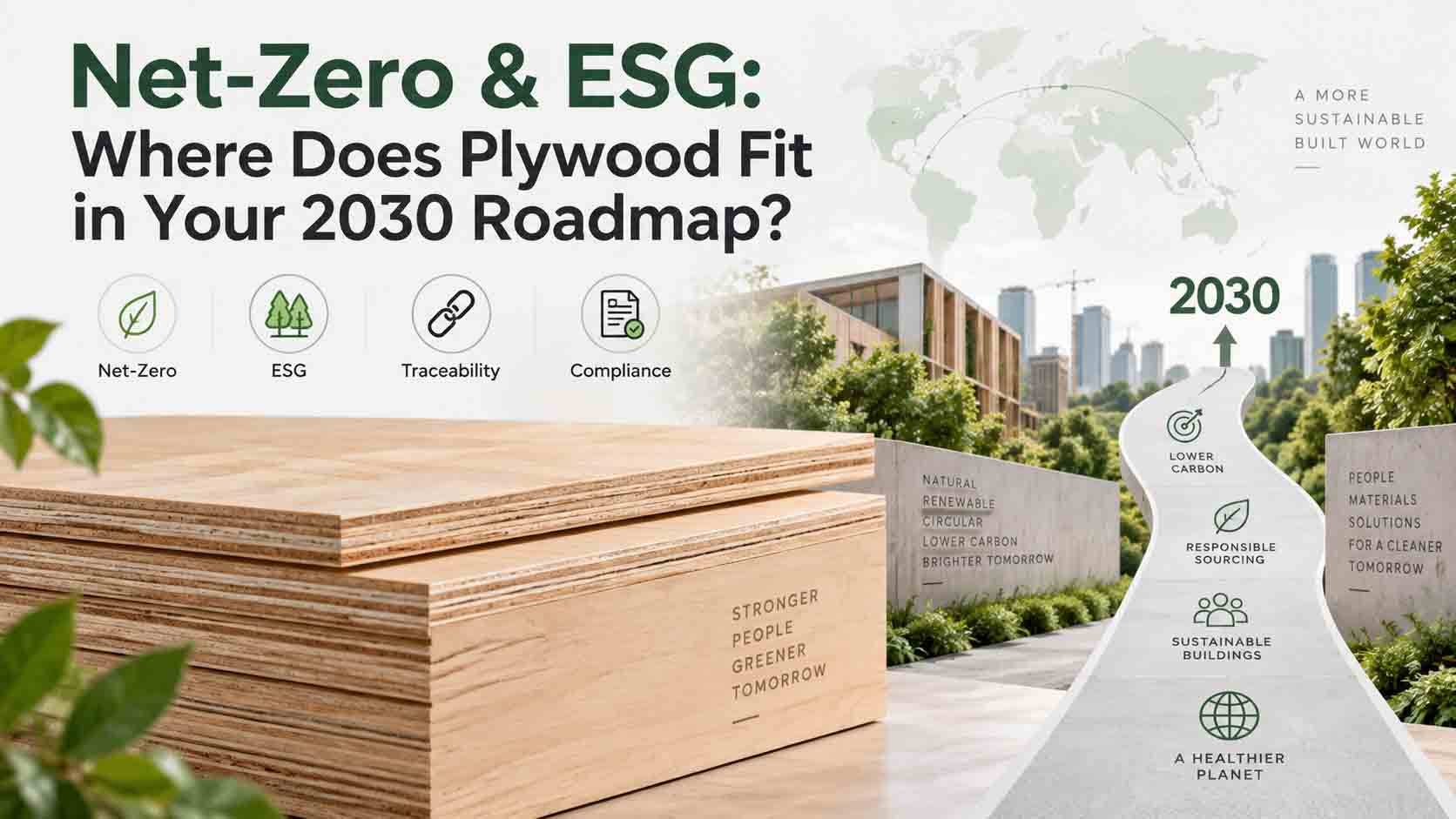
For B2B buyers, importers, and procurement teams, the question is no longer whether sustainability matters. The question is how plywood fits into a credible 2030 Net-Zero and ESG roadmap without creating greenwashing risk, specification confusion, or supply-chain friction.
This guide explains where plywood can contribute to decarbonization and ESG goals, how to evaluate sourcing and documentation, and how to build a practical decision framework that supports both commercial and sustainability targets.
Context and Buyer Problem
Many companies have set 2030 Net-Zero or science-based targets, but their material procurement processes are not yet aligned with those goals. Plywood is often treated as a commodity purchase, even though it can influence carbon footprint, sourcing risk, indoor air quality, and project-level sustainability reporting.
Why plywood matters in ESG roadmaps
Plywood is a wood-based product that can store biogenic carbon, but its overall footprint depends on sourcing, manufacturing energy, glue system, transport, and end-of-life treatment. Buyers asking where is plywood produced or where is plywood made should move from country name to supply-chain evidence that supports carbon and ESG claims.
What buyers should do next
Start by mapping plywood use cases in the portfolio: construction, furniture, cabinetry, packaging, or interior fit-out. This helps define which sustainability attributes matter most for each application.
Key Evaluation Criteria
A credible plywood contribution to Net-Zero and ESG goals should be evaluated across multiple dimensions, not only certification logos or marketing language.
1. Sourcing and forest management
Responsible sourcing can reduce deforestation risk and support long-term carbon storage. Buyers should look for FSC, PEFC, or equivalent chain-of-custody evidence where relevant, while confirming that the certificate scope matches the actual product.
2. Carbon and life-cycle data
Life-cycle assessment (LCA) and environmental product declarations (EPD) can provide product-level carbon data. Some studies report that plywood can store significant biogenic carbon per cubic meter, but the exact value depends on species, density, manufacturing energy, and system boundaries. [119][125]
3. Emissions and indoor air quality
For interior applications, formaldehyde and VOC emissions can affect indoor environmental quality credits. Buyers should request emission test reports that match the exact panel being specified.
4. Durability and service life
Longer service life can reduce replacement frequency and associated embodied carbon. Buyers should consider whether the selected plywood is suitable for the intended exposure and maintenance regime.
5. End-of-life and circularity
Plywood can be reused, recycled, or used for energy recovery depending on local infrastructure and product design. Buyers should evaluate whether the product supports circular-economy goals in their market.
What buyers should do next
Score suppliers across sourcing, carbon data, emissions, durability, and end-of-life options. This creates a more objective comparison than relying only on general sustainability claims.
Evidence and Documentation
Sustainability claims are only as strong as the documentation that supports them. Buyers should request product-specific evidence rather than accepting company-level statements.
Documents buyers should request
- Product specification sheet for the exact plywood item.
- Chain-of-custody certificate (FSC, PEFC, or equivalent) with scope details.
- LCA summary or EPD where available.
- Emission test reports for interior applications.
- Durability and exposure information for the intended use.
- End-of-life guidance or recycling information where relevant.
- Origin and traceability documentation supporting ESG claims.
How to interpret carbon data
Carbon figures should be reviewed with attention to system boundaries, biogenic carbon accounting, manufacturing energy, and transport. A negative carbon balance reported in some LCAs reflects biogenic storage but does not eliminate the need to consider other life-cycle stages. [119][125]
Common documentation mistakes
- Using one general certificate for all products.
- Assuming chain-of-custody certification proves low emissions.
- Comparing carbon data from different system boundaries.
- Accepting marketing language without product-level evidence.
- Ignoring the difference between structural and decorative plywood in sustainability claims.
What buyers should do next
Request a product-specific sustainability pack before final approval. This allows the buyer to verify claims and align them with project or corporate reporting requirements.
Decision Framework
A structured framework helps buyers integrate plywood into their 2030 Net-Zero and ESG roadmap without creating unrealistic expectations.
Step 1: Define the sustainability objective
Decide whether the main objective is carbon reduction, responsible sourcing, indoor air quality, circularity, or a combination. This determines which attributes deserve priority.
Step 2: Classify plywood applications
- Structural applications: Focus on sourcing, durability, and carbon data.
- Interior applications: Focus on emissions, indoor air quality, and finish quality.
- Temporary or packaging use: Focus on responsible sourcing and end-of-life options.
Step 3: Compare total sustainability impact
Do not compare only carbon figures. Include sourcing risk, emissions, durability, maintenance, replacement frequency, and end-of-life treatment.
Step 4: Test supplier readiness
Ask each candidate supplier for the same sustainability documents, product specifications, and application references. This creates a fair comparison and exposes gaps early.
Step 5: Select the operating model
| Sustainability Goal | Plywood Contribution | Key Evidence | Main Risk |
|---|---|---|---|
| Carbon reduction | Biogenic carbon storage and lower embodied carbon in some applications. | LCA, EPD, carbon balance data. | Inconsistent system boundaries and data quality. |
| Responsible sourcing | FSC/PEFC chain-of-custody and traceability. | Certificates, origin documentation. | Certificate scope not matching the product. |
| Indoor environmental quality | Low-emission panels for interior use. | Emission test reports. | Reports not matching the exact panel. |
| Circularity | Reuse, recycling, or energy recovery potential. | End-of-life guidance. | Local infrastructure limitations. |
What buyers should do next
For many importers, a practical starting point is to define one or two priority sustainability goals and align plywood specifications accordingly. This avoids spreading effort too thinly across too many attributes.
FAQ
Where is plywood produced for ESG-compliant projects?
Plywood is produced in many countries, but ESG compliance depends on supply-chain evidence, not only the country name. Buyers should verify sourcing, manufacturing, and documentation for the exact product.
What does RTD plywood mean?
RTD commonly refers to “Rated Sheathing” in APA terminology, indicating a performance classification for structural sheathing. In some contexts, RTD is associated with Resistance Temperature Detector technology used to control bond-line temperature during manufacturing. [112][113][121]
What does CDX plywood mean?
CDX is a trade term for plywood with C-grade face, D-grade back, and Exposure 1 glue. It is commonly used for structural sheathing where appearance is secondary. [112][113]
Can plywood support Net-Zero goals?
Plywood can contribute through biogenic carbon storage, responsible sourcing, and durable applications, but it should be evaluated as part of a broader material strategy.
What is the biggest sustainability mistake buyers make?
Accepting general sustainability claims without product-level evidence. Buyers should request documentation that matches the exact plywood item being specified.
How should buyers use plywood in their 2030 roadmap?
Define priority sustainability goals, align plywood specifications accordingly, and verify claims with product-specific documentation.
Additional Resources for Buyers
Buyers comparing plywood categories, specifications, and sourcing options can review the available range here:
Plywood Products from Vietnam
For sustainability planning, teams should compare product specifications, carbon data, sourcing evidence, and application requirements before confirming a long-term sourcing decision.
Request Product and Specification Support
Whether you are building a 2030 Net-Zero roadmap or strengthening ESG reporting, the right decision starts with a clear product specification and supplier-level evidence. Request product and specification support for your plywood program.
Email: qc@fomexgroup.vn