by admin admin No Comments

Why Plywood Shipments Get Rejected at Customs


Customs rejection is one of the most costly risks in international plywood trade. Even when product quality is acceptable, documentation errors or regulatory mismatches can result in shipment delays, penalties, or refusal of entry. This article explains how plywood customs clearance works, the most common reasons shipments are rejected, and how importers can reduce compliance risk.
How Customs Clearance Works for Plywood

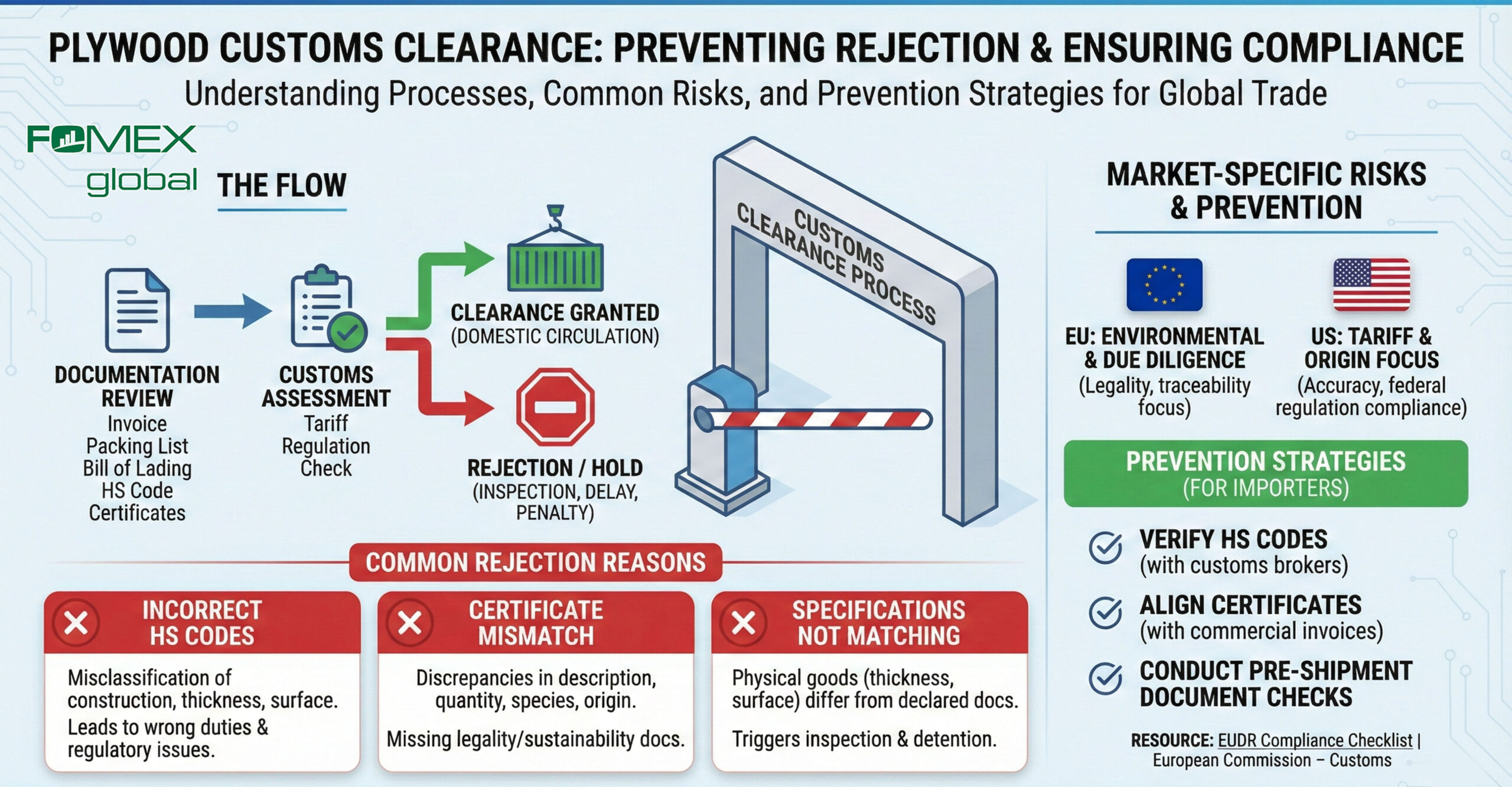
Customs clearance for plywood involves verifying that imported goods comply with tariff classification, product description, and regulatory requirements of the destination market. Authorities assess shipment documentation before releasing cargo for domestic circulation.

For plywood, clearance typically includes review of the commercial invoice, packing list, bill of lading, HS code declaration, and supporting certificates related to origin, legality, and environmental compliance. Any inconsistency between documents or between declared information and the
physical shipment may trigger inspection, delay, or rejection.

Common Reasons for Plywood Shipment Rejection

Incorrect HS Codes

Incorrect or inconsistent HS code classification is one of the most frequent causes of customs rejection. Plywood HS codes vary depending on construction, thickness, surface treatment, and intended use. Misclassification can lead to incorrect duty assessment or regulatory treatment, prompting customs authorities to hold or reject the shipment until discrepancies are resolved.

Certificate Mismatch

Certificate mismatches occur when information on certificates does not align with commercial documents or declared specifications. This includes discrepancies in product description, quantity, wood species, or country of origin. For regulated markets, missing or inconsistent legality and sustainability documentation significantly increases the risk of rejection.

Specifications Not Matching Documents

Customs authorities may inspect shipments to verify that physical goods match declared specifications. Differences in thickness, surface type, or panel construction can raise compliance concerns. Even minor inconsistencies may result in shipment detention while authorities assess whether misdeclaration has occurred.

Market-Specific Risks for Plywood Importers

Compliance requirements differ by market, increasing complexity for importers sourcing plywood internationally. In the European Union, customs clearance is closely linked to environmental and due diligence regulations. Documentation related to legality and traceability must be consistent and verifiable. In the United States, customs authorities focus on tariff classification accuracy, origin declaration, and compliance with federal import regulations. Inconsistent paperwork may trigger audits or extended inspections.

How Importers Can Prevent Customs Issues

Preventing customs rejection starts with structured export preparation rather than reactive problem solving at destination. Importers should ensure that all documents accurately reflect product specifications and regulatory requirements. Key preventive measures include verifying HS codes with customs brokers, aligning certificates with commercial invoices, and conducting pre-shipment document checks. Importers preparing for EU market entry may find this resource helpful:

EUDR Compliance Checklist for Plywood Importers

Official guidance on customs procedures is also available from the

European Commission – Customs

Avoid Customs Risks with FOMEX GLOBAL Export Support

Customs compliance requires experience, accuracy, and coordination between
exporters and importers. FOMEX GLOBAL supports buyers with structured
documentation, export-ready specifications, and compliance-focused processes
to reduce customs-related risks.

Contact FOMEX GLOBAL

Email: qc@fomexgroup.vn
☎ +84 877 034 666

by admin admin No Comments

Formwork Plywood Thickness Selection Guide

Formwork Plywood Thickness Guide: Slab, Wall, Column Selection

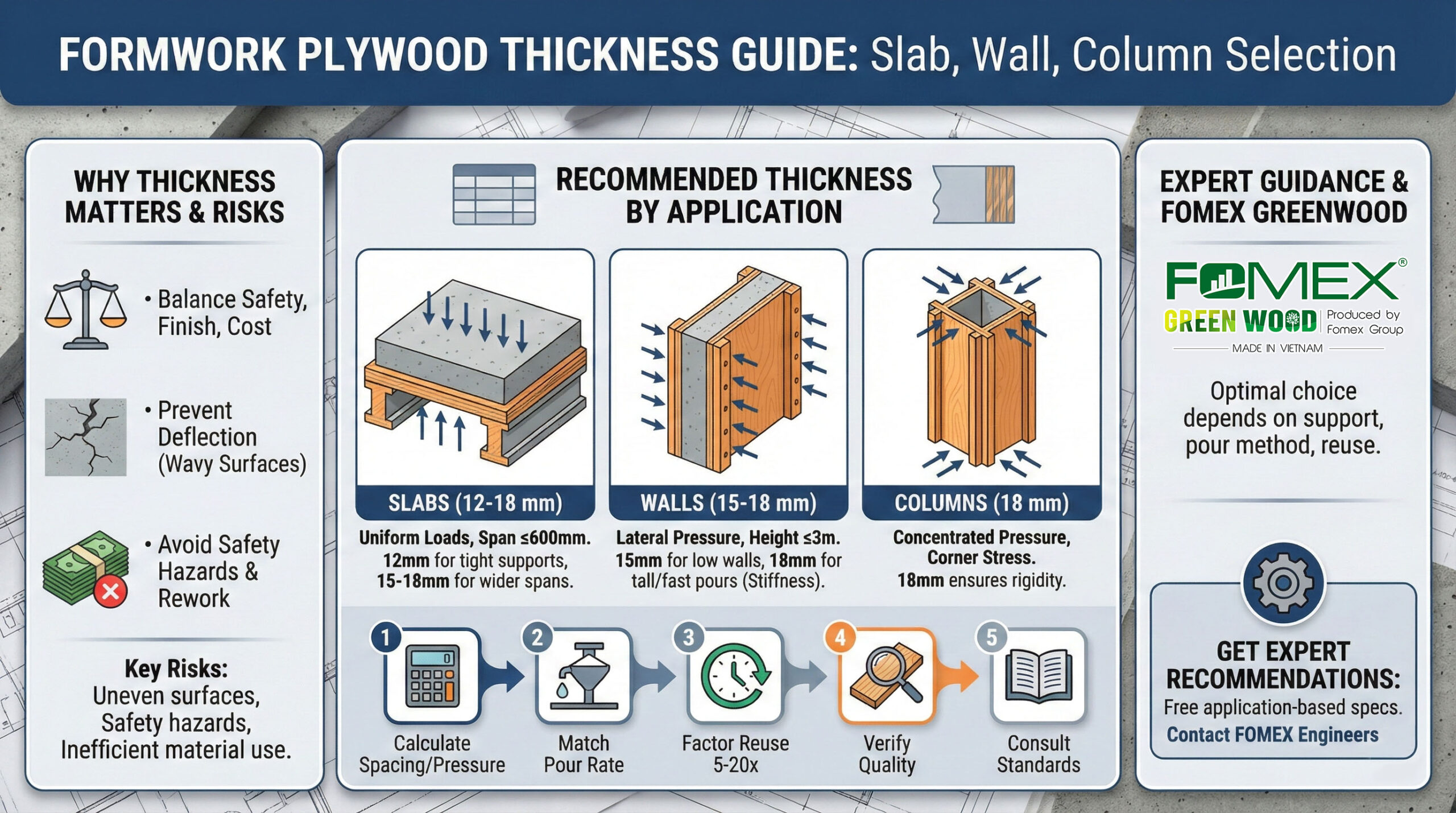
Selecting correct plywood thickness for concrete formwork balances structural safety,
concrete finish quality, and project costs. This technical guide covers slabs, walls,
and columns based on load conditions, spans, and reuse cycles.

Formwork Plywood Thickness Guide

Why Formwork Plywood Thickness Matters

Plywood thickness determines panel response to fresh concrete pressure, vibration,
and repeated pours. Too thin = deflection → poor concrete surfaces. Too thick =
unnecessary costs and handling issues.

Key Risks:
Uneven surfaces, safety hazards, rework costs, inefficient material use.

As Vietnam plywood supplier, FOMEX GREENWOOD sees thickness often
treated as “default spec.” Optimal choice depends on support spacing, pour method,
and reuse targets.

Recommended Thickness by Application

Application Typical Thickness Key Factors Load Conditions
Slabs 12-18 mm Beam span ≤600mm, slab ≤200mm thick Uniform vertical load
Walls 15-18 mm Pour height ≤3m, lateral pressure High stiffness required
Columns 18 mm Corner stress, edge durability Concentrated pressure

Slab Formwork (12-18 mm)

Uniform loads over large areas. Use 12mm for tight supports (≤400mm span),
15-18mm for wider spans or high pours.

Wall Formwork (15-18 mm)

Lateral concrete pressure demands stiffness. 15mm for low walls, 18mm for
tall/fast pours to prevent bulging.

Column Formwork (18 mm)

High edge stress at corners. 18mm ensures rigidity during vibration and stripping.

Risks of Wrong Thickness Specification

  • Under-specify: Deflection → wavy surfaces, panel damage, safety risks
  • Over-specify: +30% material cost, heavier handling, no performance gain
  • Compromised concrete quality requiring grinding/polishing
  • Reduced reuse cycles (from 10→5 uses)

5 Steps to Optimize Thickness Selection

  • Calculate support spacing and concrete head pressure
  • Match pour rate/vibration to thickness capacity
  • Factor in expected reuse cycles (5-20 uses)
  • Verify plywood quality (veneer, glue, edges)
  • Consult formwork design standards

Read more

Get Expert Thickness Recommendations

FOMEX GREENWOOD engineers provide free application-based plywood specs
for your formwork projects worldwide.

Contact FOMEX Engineers →

Email: qc@fomexgroup.vn
☎ +84 877 034 666
 

by admin admin No Comments

Why Vietnam Is Emerging as a Global Plywood Sourcing Hubb

Vietnam is rapidly establishing itself as the premier global plywood sourcing hub for 2026–2030.
Supply chain diversification, regulatory readiness, and manufacturing innovation are positioning Vietnam ahead of traditional markets.

Vietnam’s Strategic Advantages

💰 Competitive Cost Structure

Skilled workforce, automation and timber proximity deliver a superior cost‑to‑performance ratio while maintaining stable quality.

✅ Regulatory Compliance

FSC® certified, E0/E1, CARB Phase 2 and EUDR‑ready factories meet strict EU/US standards through 2030.

⚙️ Manufacturing Flexibility

Customization at scale, private labeling and fast prototyping so Vietnam adapts to your exact requirements.

⚠️ Reality Check: What to Watch

🏭 Factory Capability Variation
Technical sophistication differs widely between suppliers
📊 Quality Systems Maturity
QC processes range from basic to world-class
📋 Specification Precision
Detailed technical docs prevent misunderstandings
🚚 Peak Season Logistics
Plan capacity around Q3/Q4 export peaks

How to Select Your Vietnam Partner

✅ Essential Evaluation Criteria

  • Export track record to your target markets
  • Full certification portfolio (FSC/CARB/EUDR)
  • Transparent QC documentation
  • Capacity matching your volumes
  • Proven responsiveness to specification changes

📚 Strategic Resources

Ready to Secure Your Vietnam Sourcing Strategy?

FOMEX GREENWOOD delivers certified quality, full compliance, and strategic partnership
for importers targeting long-term plywood supply stability.

Partner with FOMEX GLOBAL Now

Email: qc@fomexgroup.vn | WhatsApp: +84 877 034 666

by admin admin No Comments

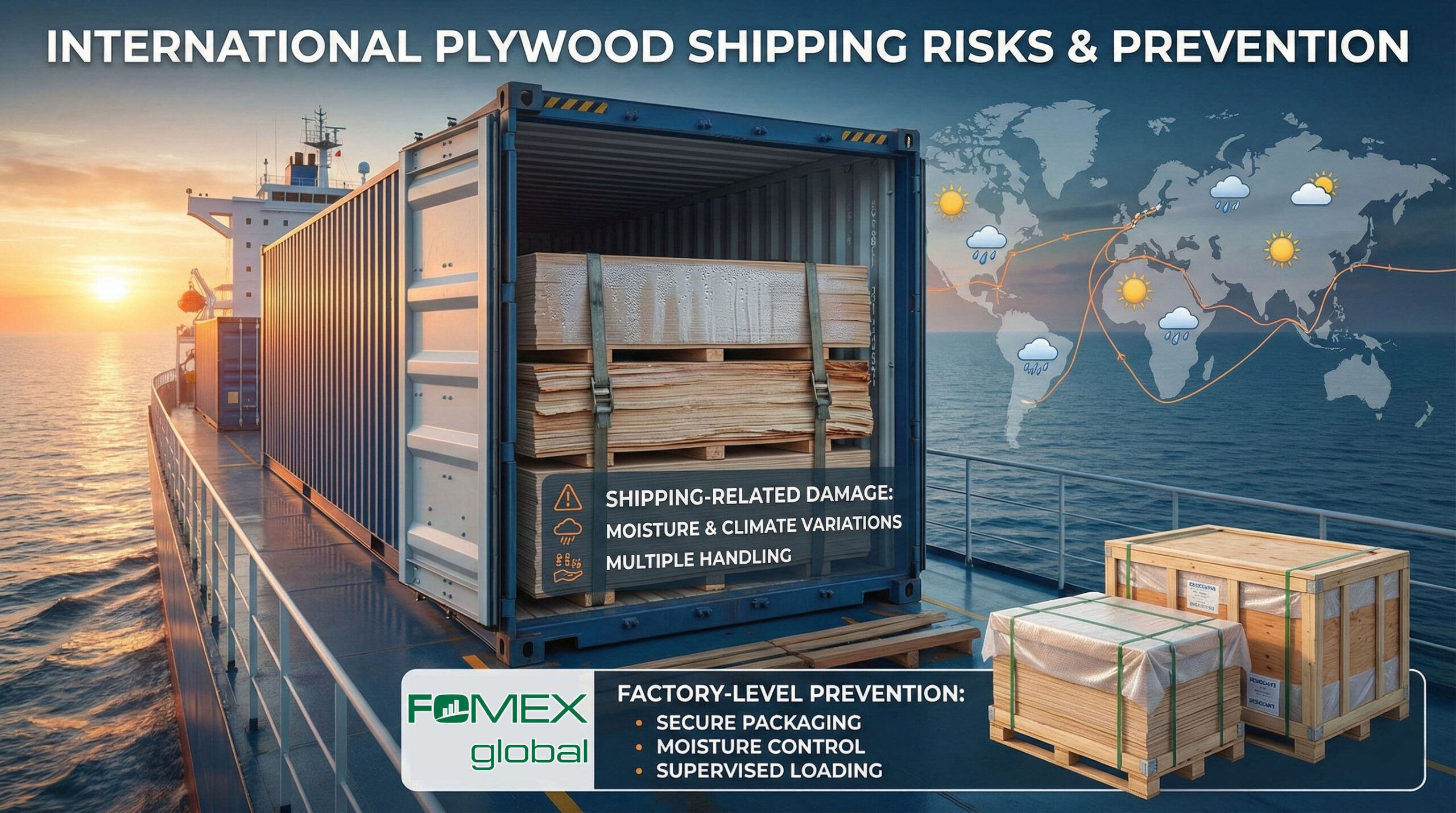
Plywood Damage During International Shipping

International shipping exposes plywood to long transit durations, climate variations,
and multiple handling stages. While plywood may leave the factory in compliant condition,
environmental exposure during transport can still create risks. This article explains
why shipping-related damage occurs — and how responsible manufacturers reduce these risks
before containers are sealed.

Why Shipping Damage Is a Common Issue

Plywood shipping damage is one of the most common concerns for global importers,
not because of manufacturing defects, but due to the complexity of international logistics.
Long sea routes, port dwell time, and climate transitions introduce variables that exist
beyond factory-controlled conditions.

As a Vietnam plywood exporter supplying Europe, the USA, and the Middle East,
FOMEX GLOBAL  frequently assists buyers in differentiating between product quality at
factory release and environmental exposure occurring after shipment.

Understanding this distinction is essential for accurate risk assessment, claim evaluation,
and realistic logistics planning.

Main Causes of Plywood Exposure During International Shipping

Container Moisture & Condensation

Moisture-related exposure during shipping is primarily linked to container environments
rather than manufacturing processes. Once plywood is packed, sealed, and loaded, containers
may pass through multiple climate zones where temperature fluctuations create condensation.

Such moisture accumulation typically develops during long ocean transit, port storage,
or delayed customs clearance. These conditions fall outside factory-controlled production
and inspection stages.

For plywood export from Vietnam, tropical humidity at origin combined with cooling at sea
increases condensation risk if logistics mitigation measures are not applied in advance.

Improper Loading and Weight Distribution

Mechanical stress during transport is often caused by incorrect loading practices rather
than panel quality. Uneven stacking, insufficient support, or unbalanced weight distribution
can lead to deformation or edge damage over time.

During extended voyages, vessel movement amplifies minor loading issues into visible damage
upon arrival.

Early Warning Signs Upon Arrival

Upon container arrival, importers should conduct immediate visual and olfactory inspection
to identify potential shipping-related exposure.

  • Surface discoloration associated with prolonged humidity exposure
  • Edge swelling or thickness variation after transit
  • Warping or panel distortion caused by environmental stress
  • Odor indicating moisture accumulation during transport or port storage

Early identification supports accurate documentation and helps determine whether exposure
occurred during transit or post-arrival handling.

Understanding the Difference Between Factory Quality and Transit Conditions

Many quality-related disputes arise from confusion between manufacturing quality and
logistics exposure. At factory level, plywood is produced, inspected, and packed under
controlled conditions according to export specifications.

Once containers are sealed, factors such as temperature fluctuation, humidity,
port congestion, and storage duration fall outside factory-controlled processes.

As a responsible Vietnam plywood supplier, FOMEX GLOBAL emphasizes
transparency by clearly defining what is controlled at factory level and what depends
on shipping environments.

How Manufacturers Can Minimize Shipping Risks Before Export

While no exporter can control every environmental variable during international shipping,
preventive measures at factory level significantly reduce logistics-related risks.

Controlled Moisture Content Prior to Packing

Plywood is conditioned and inspected to ensure moisture levels are within specified limits
before packing. Stable moisture content helps panels withstand environmental changes during
transit.

Export-Grade Packaging and Protection

Proper export packaging includes pallet bases, protective wrapping, reinforced edges,
and secure strapping to reduce movement and vibration.

Packaging principles and buyer expectations are further explained here:

MOQ, Lead Time & Packaging Standards

Container Inspection and Supervised Loading

Prior to loading, container condition is inspected for cleanliness, dryness, and structural
integrity. Loading is supervised to ensure proper stacking and balanced weight distribution.

These practices align with international shipping safety guidance published by the

International Maritime Organization (IMO)

Why Factory-Level Prevention Matters More Than Post-Arrival Claims

Cargo insurance may provide financial coverage, but it does not eliminate project delays,
handling costs, or reputational impact. Preventive preparation at factory level is more
effective than corrective action after arrival.

As a sustainable plywood exporter, FOMEX GLOBAL treats logistics risk
management as an extension of product quality — not a separate responsibility.

Learn How FOMEX Minimizes Shipping Risks Before Export

While international shipping always involves environmental variables, FOMEX GLOBAL
applies factory-level preventive measures to reduce moisture-related and mechanical risks
before containers are sealed and shipped.

Contact FOMEX GLOBAL

Email: qc@fomexgroup.vn  |   WhatsApp: +84 877 034 666

by admin admin No Comments

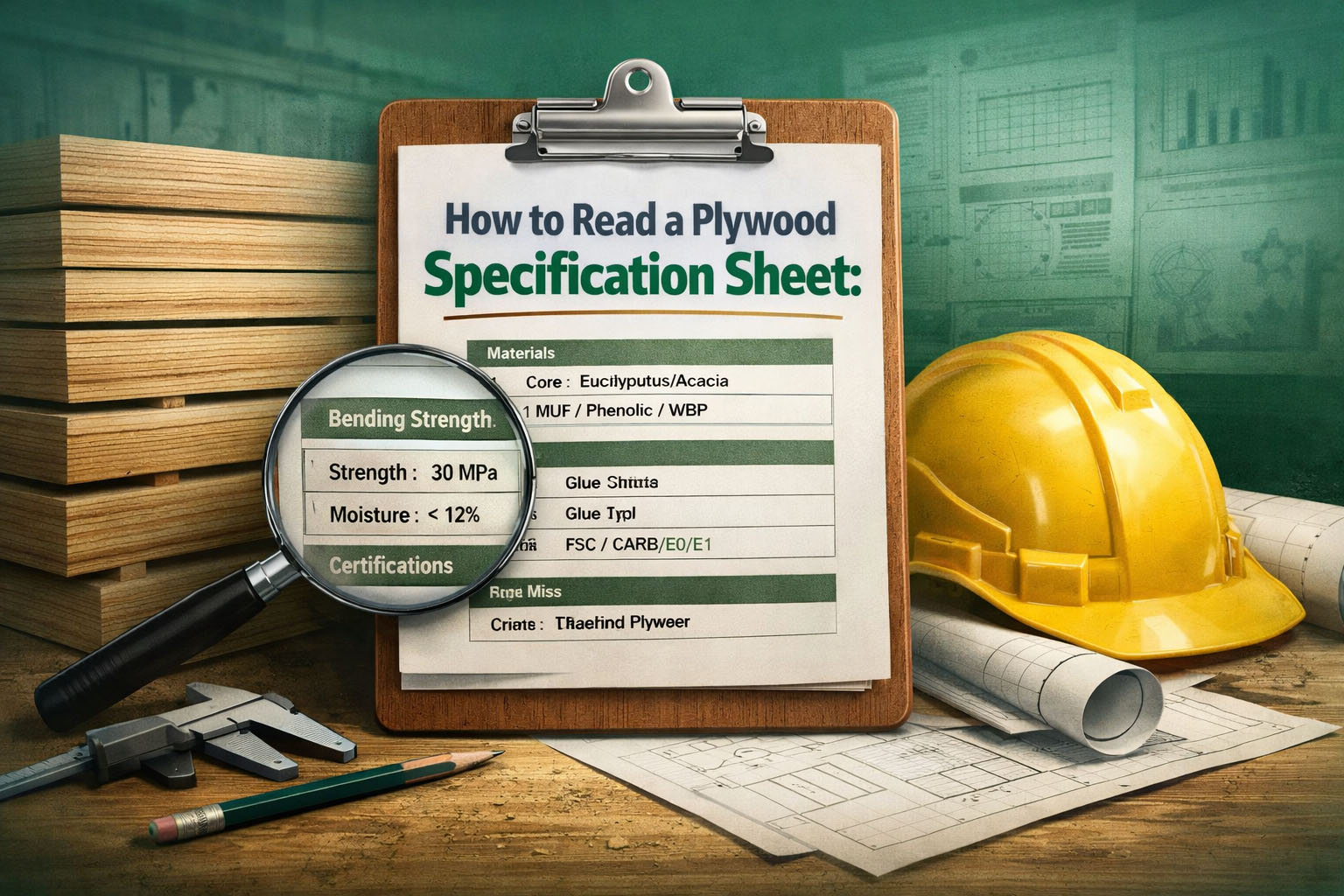
How to Read a Plywood Specification Sheet: Details Importers Often Miss

Learn how to read a plywood specification sheet, avoid common importer mistakes, and understand key plywood technical data clearly.
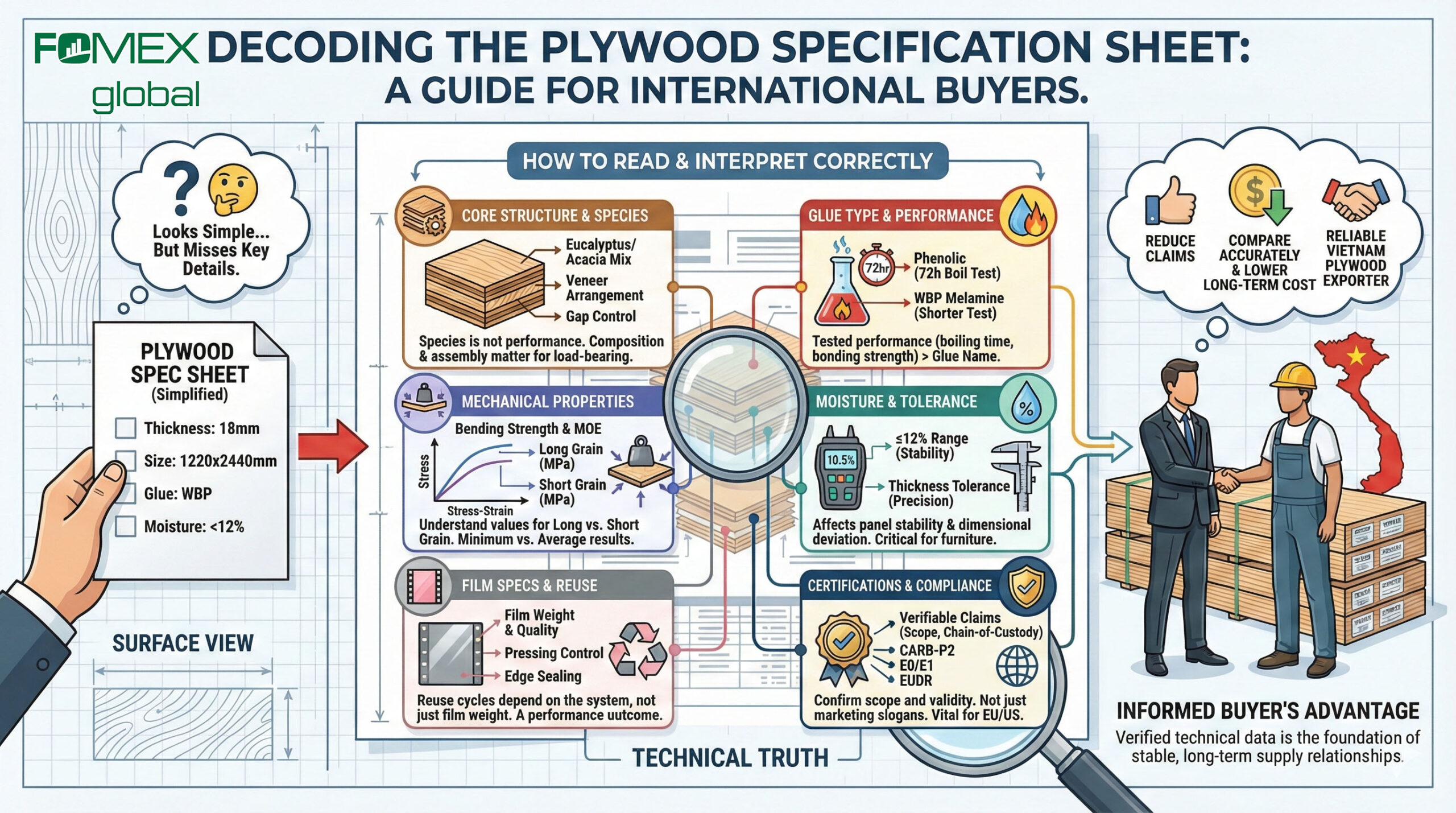
For many international buyers, a plywood specification sheet looks simple at first glance.
Thickness, size, glue type, moisture content – everything seems clearly listed.
However, most disputes in plywood import do not come from price or appearance,
but from misunderstood technical data.This guide explains how to read and interpret a plywood specification sheet correctly,
highlighting the key details importers often overlook.
Understanding plywood technical data helps buyers reduce claims,
compare suppliers accurately, and source from a reliable
Vietnam plywood exporter.

1. Why the Plywood Specification Sheet Matters

A plywood specification sheet is not a marketing document.
It is a technical contract reference that defines performance,
quality limits, and compliance standards.
For global buyers sourcing from a
Vietnam plywood manufacturer,
this document determines whether the product is suitable for furniture,
construction, or structural applications.

Importers who rely only on product photos or sample boards
often miss critical limits stated in the plywood specs explained in the data sheet.
These limits directly affect durability, reuse cycles, and long-term cost.

2. Core Structure and Wood Species

One of the first elements in any plywood technical data sheet is the core material.
Common options from a Vietnam plywood supplier include eucalyptus,
acacia, mixed hardwood, or commercial-grade combinations.

What buyers often miss is that the species listed does not automatically guarantee
mechanical performance.
Core composition, veneer arrangement, and gap control
are equally important.
This is especially relevant for buyers sourcing
high quality plywood Vietnam for load-bearing or repeat-use applications.

For a broader comparison of core structures and grades, see:

Understanding Plywood Grades & Quality Levels
.

3. Glue Type Is Not Just a Name

Glue systems are usually listed as MUF, WBP Melamine, or Phenolic.
Many importers stop reading at the glue name,
but a professional plywood specification sheet goes further.

What matters is the tested performance:
boiling time, bonding strength, and applicable standards.
For example, phenolic glue with a 72-hour boiling test
performs very differently from a melamine system with shorter resistance.

This distinction is critical for buyers sourcing
film faced plywood exporter Vietnam products
or structural panels for construction projects.

For a deeper explanation of glue performance indicators, refer to:
How Boiling Tests Affect Plywood Durability

4. Mechanical Properties: Reading Between the Numbers

Most plywood technical data sheets list bending strength and modulus of elasticity (MOE).
These values are essential for understanding how panels behave under load.

However, buyers often overlook whether values are listed for
long grain and short grain,
or whether the figures represent minimum limits or average test results.
This distinction matters when sourcing plywood for
construction projects or engineered furniture.

A reliable wholesale plywood supplier will clearly state
test methods and quality limits, not just headline numbers.

5. Moisture Content and Dimensional Tolerance

Moisture content is one of the most underestimated lines in a plywood specification sheet.
Values such as ≤12% are common, but buyers should understand
why this range exists and how it affects panel stability.

Thickness tolerance and dimensional deviation also deserve attention.
Small deviations may be acceptable for packaging panels,
but not for furniture manufacturing or calibrated plywood.

This is especially relevant for buyers sourcing
plywood for furniture manufacturers Vietnam
or precision interior applications.

Related reading:
Why Moisture Content Matters for Durability

6. Film Specifications and Reuse Expectations

For film faced plywood, the specification sheet usually lists film weight,
color, and surface type.
Importers often assume film weight alone defines reuse cycles.

In reality, reuse performance depends on the combination of
film quality, glue system, pressing control, and edge sealing.
A professional
sustainable plywood exporter
will treat reuse cycles as a performance outcome, not a promise.

For buyers comparing formwork panels, see:
Phenolic Film Weight & Concrete Finish Quality

7. Certifications and Compliance Statements

Certifications listed on a plywood specification sheet – such as FSC®, CARB-P2, E0/E1, or EUDR compliance – should be read as verifiable claims, not marketing slogans.

Professional importers sourcing from a
FSC certified plywood supplier
should always confirm scope, validity, and chain-of-custody alignment
with shipment documentation.

This is increasingly important for buyers in Europe and the US,
where regulatory scrutiny continues to increase.

Final Thoughts: Reading Specs Like a Professional Buyer

A plywood specification sheet tells a complete technical story – if you know how to read it. Beyond thickness and price, it defines structural behavior, durability, compliance, and long term cost.

For importers sourcing from a trusted Vietnam plywood exporter, understanding plywood specs explained clearly is the foundation of stable, long-term supply relationships.

Email: qc@fomexgroup.vn  |   WhatsApp: +84 877 034 666

by admin admin No Comments

Common Quality Issues in Imported Plywood – And How to Avoid Them

Quality issues in imported plywood rarely come from a single cause. They are usually the result of unclear specifications, inconsistent production control, or mismatched expectations between buyer and supplier. This guide highlights the most common plywood quality issues faced by global importers — and explains how to prevent them before they become costly disputes.

Why Plywood Quality Issues Are a Major Risk for Importers

For international buyers, plywood defects are more than a technical inconvenience — they represent financial risk, project delays, and reputational damage. Once a container arrives at destination, correcting quality problems becomes difficult and expensive.

As a Vietnam plywood exporter supplying Europe, the USA, and the Middle East, FOMEX GREENWOOD has audited hundreds of shipments where disputes originated not from intentional misrepresentation, but from unclear quality benchmarks.

Understanding common plywood quality issues allows importers to proactively manage risk through better specifications, inspections, and supplier selection.

Delamination: The Most Critical Structural Defect

Delamination occurs when veneer layers separate due to inadequate bonding. It is one of the most serious plywood defects because it compromises structural integrity and often worsens after exposure to moisture.

Common causes of delamination plywood include:

  • Insufficient or uneven glue spread
  • Incorrect glue formulation for the intended application
  • Inconsistent hot-press temperature or pressure
  • High moisture content in veneers before pressing

Delamination is frequently discovered only after installation or during use, making prevention at the factory level essential.

Uneven Thickness and Calibration Issues

Thickness inconsistency is a common complaint among importers sourcing plywood for construction, furniture, or formwork applications. Even small deviations can cause problems during installation or machining.

Panels produced in a properly calibrated plywood Vietnam factory maintain tight tolerances, ensuring compatibility with standardized systems such as concrete formwork or cabinet assemblies.

Poor calibration often results from worn sanding belts, insufficient quality checks, or cost-driven production shortcuts.

Surface Defects and Face Veneer Problems

Surface quality issues are among the first defects noticed by buyers. Common face veneer problems include patches, overlaps, open knots, and inconsistent sanding.

While some surface imperfections may be acceptable for structural uses, they become critical for applications such as plywood for furniture manufacturers Vietnam or plywood for kitchen cabinets export.

Clear grading standards and face/back specifications help prevent misunderstandings between buyers and suppliers.

Moisture Content and Warping

Incorrect moisture content is a hidden but serious contributor to plywood defects. Panels that are too wet or too dry during production often warp or twist after shipment.

For plywood export from Vietnam, maintaining moisture content within controlled limits is critical to ensure dimensional stability during long sea transport and storage at destination.

Core Gaps, Overlaps, and Internal Voids

Internal core defects such as gaps, overlaps, and voids weaken plywood panels and reduce load-bearing capacity. These issues are difficult to detect visually without destructive testing.

Reliable structural plywood manufacturer Vietnam operations implement core inspection and veneer grading systems to minimize internal defects before pressing.

Why Many Quality Problems Start with Poor Specifications

Many plywood quality disputes stem from incomplete or ambiguous purchase specifications. Terms like “commercial grade” or “good quality” leave too much room for interpretation.

Importers should define measurable criteria, including veneer structure, glue type, moisture limits, tolerance levels, and acceptable defect thresholds.

A detailed understanding of plywood construction fundamentals can be found here:

From Core to Finish: Understanding Plywood Grades and Quality Levels

How Professional Quality Control Prevents Plywood Defects

Effective quality control is not limited to final inspection. It starts with veneer selection, continues through pressing and sanding, and ends with pre-shipment checks.

As an FSC certified plywood supplier and sustainable plywood exporter, FOMEX GREENWOOD integrates quality checkpoints at every production stage to ensure consistency and traceability.

Industry references from the

APA – Engineered Wood Association

provide additional guidance on structural panel performance and quality expectations.

Reduce Plywood Quality Risks with FOMEX GREENWOOD

Preventing plywood defects starts long before shipment. Working with an experienced Vietnam plywood supplier helps importers avoid quality disputes, protect project timelines, and build long-term supply reliability.

Contact FOMEX GREENWOOD

Email: qc@fomexgroup.vn  |   WhatsApp: +84 877 034 666

by admin admin No Comments

Plywood for Concrete Formwork: How Many Reuse Cycles Can You Expect?

“How many times can formwork plywood be reused?” is one of the most common — and most misunderstood — questions in concrete construction. This guide explains reuse cycles based on real product grades, technical specifications, and on-site conditions, using verified data from FOMEX GREENWOOD film faced plywood.

Plywood for Concrete Formwork: How Many Reuse Cycles Can You Expect?Why Reuse Cycles Are the Real Cost Driver in Concrete Formwork
In concrete construction, plywood is not evaluated by appearance or thickness alone. Its true value is measured by how many reuse cycles it can achieve before replacement. Each additional reuse cycle directly reduces material cost per pour.

As a Vietnam plywood manufacturer supplying formwork materials to global markets, FOMEX GREENWOOD consistently advises buyers to select plywood based on realistic reuse expectations — not generic claims.

Understanding plywood reuse cycles helps contractors, distributors, and importers choose the right product grade for each project duration and budget level.

What Actually Determines Reuse Cycles in Concrete Formwork

Reuse performance is the combined result of structural design, glue system, surface protection, and site handling. Laboratory tests alone cannot fully predict real-world performance.

Core Structure and Veneer Layers

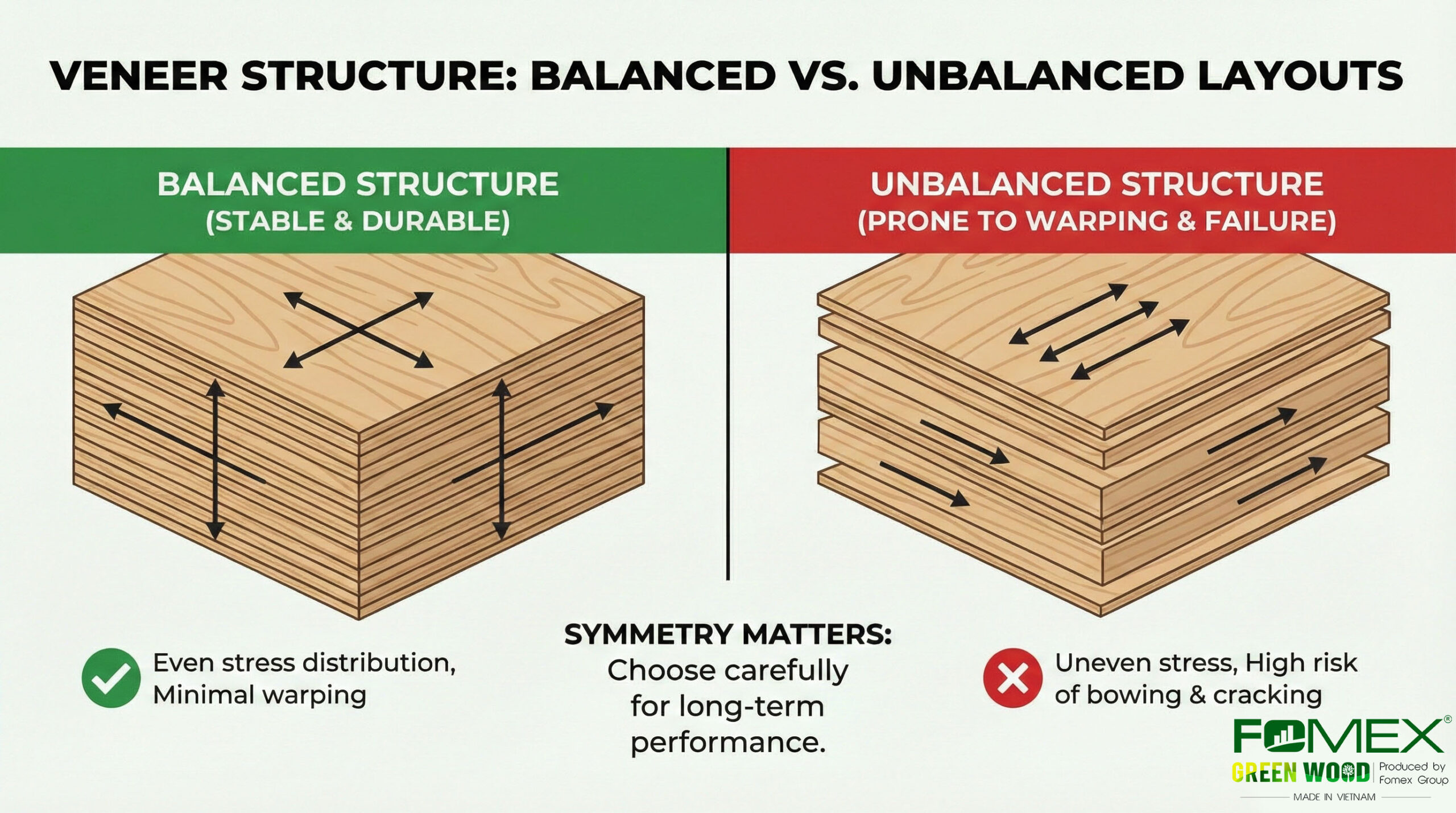
According to FOMEX technical specifications, film faced plywood is produced with eucalyptus, acacia, or mixed hardwood cores using 5–13 veneer layers depending on thickness. Balanced veneer construction helps distribute concrete pressure evenly and prevents early deformation.

Glue System and Bonding Stability

All FOMEX formwork plywood uses WBP Melamine or WBP Phenolic glue, selected based on product grade. Glue type directly influences bonding durability under wet concrete exposure and repeated stripping cycles.

Film Surface and Edge Sealing

Phenolic film (135–185 g/m²) protects the surface from abrasion and moisture penetration, while water-resistant edge sealing paint reduces edge damage — a common failure point in formwork plywood.

Reuse Cycles by Product Grade (Based on FOMEX Technical Data)

One of the most important distinctions buyers should understand is that reuse cycles vary significantly by product grade. The following reuse ranges are based on FOMEX GREENWOOD film faced plywood technical data sheet.

  • Standard Form:
    WBP Melamine 12% glue, 2-side film 165 g/m²
    Typical reuse cycles: 4–6 times
  • Premium Form:
    WBP Melamine 15–18% glue, 2-side film 135–145 g/m²
    Typical reuse cycles: 8–10 times
  • Promax Form:
    WBP Melamine 25% glue, reinforced bonding quality
    Typical reuse cycles: 15–20 times
  • Phenolic Form:
    Full phenolic glue system, structural-grade bonding
    Typical reuse cycles: up to 25 times

These reuse ranges assume proper handling, correct application, and normal site conditions. Actual results may vary depending on concrete mix and workmanship.

How Site Conditions Influence Formwork Plywood Lifespan

Concrete Pouring and Vibration

High vibration intensity, aggressive concrete mixes, and excessive pour height increase stress on plywood panels, accelerating surface wear and edge damage.

Stripping and Release Practices

Improper stripping methods — such as prying panels aggressively — are a major cause of early plywood failure. Using suitable release agents improves surface preservation and reuse consistency.

Cleaning, Storage, and Handling

Based on FOMEX handling guidelines, panels should be cleaned immediately after use, stored flat in dry, ventilated areas, and protected from direct sunlight and standing water to maximize formwork plywood lifespan.

Why Reuse Expectations Often Do Not Match Reality

Many disputes occur because buyers expect high reuse cycles from products not specified for long-term formwork use. Selecting Standard Form plywood for long-duration projects inevitably leads to disappointment.

Matching project requirements with the correct product grade is more effective than overpaying or under-specifying.

How Importers Can Specify Plywood for Reliable Reuse Performance

To achieve predictable reuse cycles, importers should specify plywood based on technical parameters rather than general descriptions.

  • Clearly define expected reuse cycles
  • Select product grade (Standard, Premium, Promax, Phenolic)
  • Confirm glue type and film weight
  • Align specification with project duration and exposure conditions

A broader understanding of plywood construction can be found here:

From Core to Finish: Understanding Plywood Grades and Quality Levels

For general structural panel principles, buyers may also refer to:

APA – Engineered Wood Association

Request Formwork Plywood Recommendations from FOMEX GREENWOOD

Selecting the right plywood grade is the key to predictable reuse performance. As a trusted Vietnam plywood supplier and sustainable plywood exporter, FOMEX GREENWOOD provides transparent technical data and application-based recommendations.

Contact FOMEX GREENWOOD

Email: qc@fomexgroup.vn  |   WhatsApp: +84 877 034 666


by admin admin No Comments

How Veneer Structure Affects Plywood Strength and Durability

For global buyers sourcing plywood export from Vietnam, veneer structure is one of the most decisive — yet often underestimated — factors affecting real plywood performance. Beyond thickness and surface appearance, the way veneers are arranged, bonded, and balanced determines whether plywood delivers long-term strength, durability, and dimensional stability in real-world applications.

Why Veneer Structure Matters More Than Thickness

In international plywood trade, thickness is often treated as a primary quality indicator. However, two plywood panels with identical thickness can perform very differently under load, moisture, and repeated use. From the perspective of a Vietnam plywood manufacturer supplying global construction and furniture markets, veneer structure consistently proves to be a more reliable predictor of performance than thickness alone.

Veneer structure determines how internal stresses are distributed across the panel, how the board reacts to humidity changes during shipping, and how well it maintains flatness during installation. For importers purchasing bulk plywood Vietnam container loads, overlooking veneer construction often leads to higher claim rates, inconsistent quality, and reduced customer confidence.

High-quality plywood relies on engineered veneer layouts rather than simply increasing panel thickness. This is especially critical for structural plywood manufacturer Vietnam products used in construction, formwork, and load-bearing applications.

Veneer Layout and Cross-Grain Orientation

Parallel vs Cross-Grain Layers

The fundamental principle behind plywood strength lies in cross-grain construction. In properly engineered plywood, adjacent veneer layers are laid with alternating grain directions — typically perpendicular to each other. This cross-grain orientation neutralizes internal stresses and dramatically improves panel stability.

Low-quality plywood often uses repeated parallel grain layers to reduce manufacturing costs. While this approach may increase short-term yield, it significantly weakens bending resistance and makes panels more prone to warping and cracking. For Vietnam plywood exporter to Europe and Vietnam plywood exporter to USA markets, such shortcuts are unacceptable due to strict performance and compliance requirements.

Balanced cross-grain veneer layouts allow plywood to perform consistently under changing environmental conditions, making them essential for wholesale plywood supplier operations serving professional buyers.

Number of Veneer Layers and Load Distribution

The number of veneer layers directly influences how loads are distributed across a plywood panel. Rather than concentrating stress in a few thick layers, high-quality plywood spreads forces evenly across multiple thin veneers.

For example, an 18mm plywood supplier Vietnam specification intended for construction or formwork applications typically includes 11 to 13 evenly pressed veneer layers. This configuration improves bending strength, impact resistance, and fatigue performance during repeated use.

As a sustainable plywood exporter, FOMEX GREENWOOD prioritizes balanced layer counts to ensure long service life and reduced material waste across global supply chains.

Veneer Thickness Consistency and Bonding Quality

Veneer thickness consistency plays a critical role in bonding performance. Uniform veneers allow even adhesive distribution during hot pressing, resulting in stronger internal bonds and reduced delamination risk.

In calibrated production environments, such as a calibrated plywood Vietnam factory, tight veneer tolerances support stable bonding — a key requirement for CARB P2 plywood Vietnam, E0 E1 plywood supplier Vietnam, and other regulated export markets.

  • Consistent glue line thickness
  • Improved resistance to moisture penetration
  • Stronger screw-holding and nail-holding capacity
  • Better performance in boiling and soak tests

Poor bonding quality is one of the most common causes of import disputes, especially for container load plywood price Vietnam contracts where inspection occurs only after arrival.

Common Structural Mistakes in Low-Quality Plywood

Structural shortcuts are frequently observed in low-grade plywood intended for price-driven markets. Common issues include uneven veneer thickness, unbalanced core construction, mixed species layering, and insufficient adhesive penetration.

These defects may not be visible at first glance but often result in premature failure during installation or use. For buyers sourcing from a private label plywood manufacturer Vietnam, structural integrity should always be verified beyond surface appearance.

From an environmental standpoint, structurally weak plywood undermines sustainability goals by shortening product life cycles and increasing material waste — contradicting the objectives of an eco-friendly plywood manufacturer Vietnam.

How Importers Can Specify Veneer Structure Correctly

Clear veneer structure specifications are essential for consistent quality. Importers should define veneer layout, layer count, veneer thickness tolerance, and bonding standards directly in purchase contracts.

Working with an experienced FSC certified plywood supplier and EUDR compliant plywood supplier ensures these technical requirements are integrated throughout production, inspection, and export processes.

To better understand how veneer structure fits into overall plywood quality, importers can also refer to our detailed guide:

From Core to Finish: Understanding Plywood Grades and Quality Levels

For further technical reference, industry standards published by the

APA – Engineered Wood Association

provide authoritative guidance on structural plywood performance.

Request Veneer Structure Specifications from FOMEX GREENWOOD

Veneer structure defines real plywood quality. Partnering with a trusted Vietnam plywood exporter helps ensure structural consistency, regulatory compliance, and long-term performance across global projects.

Contact FOMEX GREENWOOD

Email: qc@fomexgroup.vn  |   WhatsApp: +84 877 034 666

by admin admin No Comments

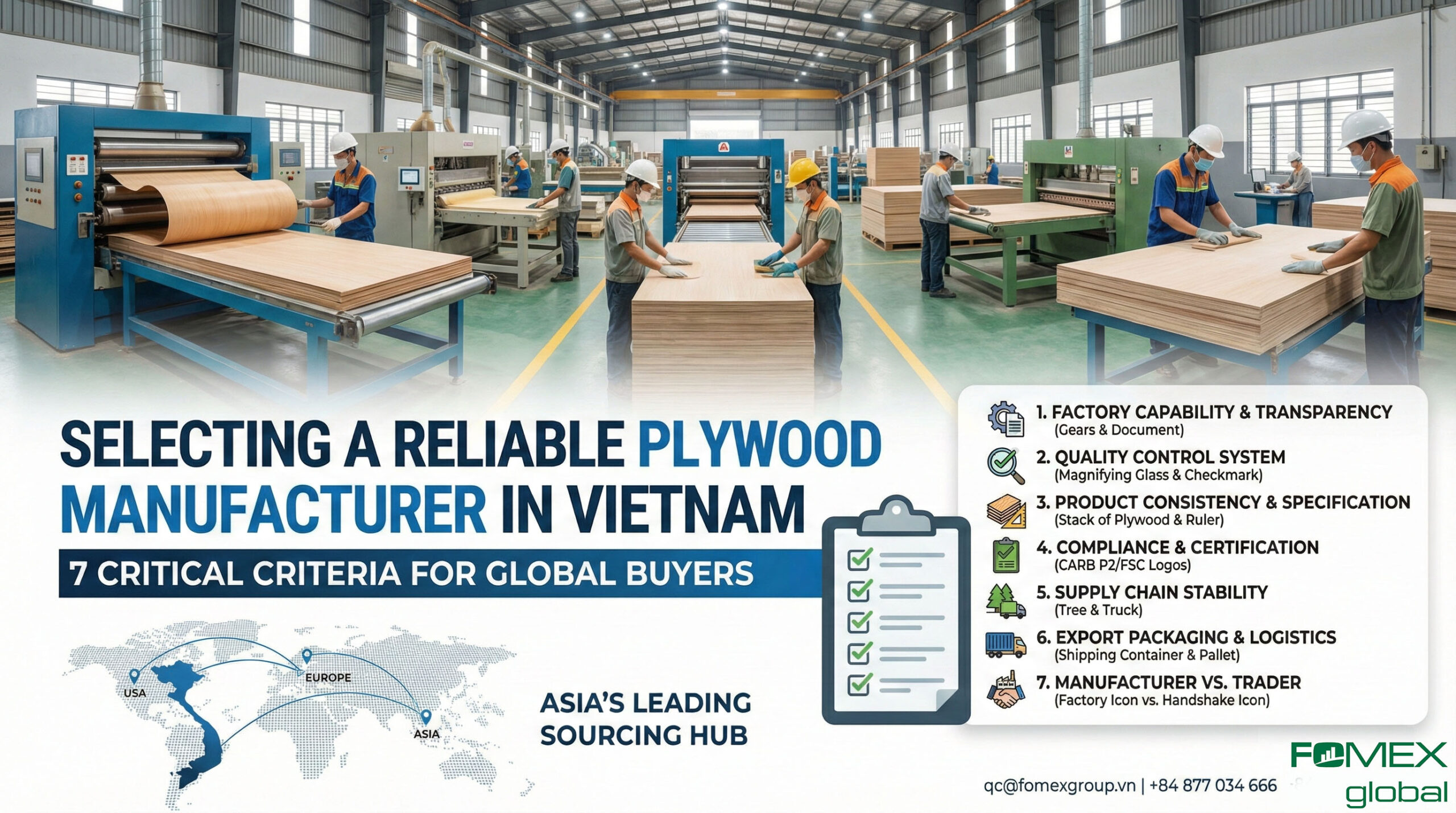
How to Evaluate a Reliable Plywood Manufacturer in Vietnam: 7 Must-Check Criteria for Importers

Selecting a reliable plywood manufacturer in Vietnam is a critical decision for importers,
furniture producers, and construction companies. Beyond price, long-term success depends on production consistency,
quality control systems, compliance capability, and transparent supply operations.

Vietnam is now one of Asia’s leading plywood sourcing hubs.
However, supplier capabilities vary significantly.
For global buyers, knowing how to evaluate a trusted plywood supplier Vietnam
based on objective criteria is essential to reduce risk and protect project timelines.

This guide outlines 7 must-check criteria that importers should use
when assessing plywood manufacturers in Vietnam—based on real export practices,
not marketing claims.

1. Factory Capability & Production Transparency

A reliable plywood manufacturer should demonstrate clear and verifiable production capability.
This includes not only installed machinery, but also process stability and production planning.

  • Visible production lines and defined manufacturing stages
  • Clear product scope (commercial plywood, film faced plywood, LVL, etc.)
  • Documented production flow from veneer preparation to packing
  • Ability to explain capacity in realistic, shipment-based terms

Factories that understand and communicate their own limitations are often more reliable
than those making unrealistic capacity claims.

For insight into factory-level plywood production, see:

Inside a Vietnamese Plywood Factory

2. Quality Control System (Process-Based, Not Final Check Only)

A reliable plywood manufacturer in Vietnam applies quality control
throughout the production process—not only at final inspection.

  • Incoming veneer and core material inspection
  • Moisture content and density monitoring
  • Glue-line bonding strength testing
  • Thickness calibration and sanding accuracy checks
  • Batch-level traceability

Consistent QC reduces variability between shipments and protects downstream manufacturing.

Related technical reference:

The Science of Boiling Tests for Plywood Strength

3. Product Consistency & Specification Control

Consistency is one of the strongest indicators of a trusted plywood supplier.
Importers should evaluate whether the supplier can reproduce the same specification
across multiple orders.

  • Stable veneer grading and core construction
  • Controlled thickness tolerance
  • Repeatable surface quality and flatness
  • Clear product data sheets and specifications

For buyers unfamiliar with plywood grading systems, review:

Understanding Plywood Grades and Quality Levels

4. Compliance, Certification & Market Readiness

Export-ready manufacturers understand that compliance is part of product quality.
Different markets impose different regulatory and safety requirements.

  • CARB-P2 / E0 / E1 emission compliance for interior use
  • FSC® chain-of-custody for responsible sourcing
  • Clear export documentation and labeling
  • Awareness of evolving regulations such as EUDR

Manufacturers who proactively support compliance reduce risk for importers.

Further reference:

EUDR Compliance Checklist for Plywood Importers

5. Supply Chain Stability & Raw Material Control

Reliable plywood manufacturers maintain stable access to raw materials
and manage seasonal or market-driven fluctuations.

  • Controlled hardwood sourcing programs
  • Material planning aligned with production schedules
  • Buffer strategies for peak demand periods
  • Transparent communication during shortages

Supply stability is essential for long-term contracts and repeat orders.

For sustainability context:

Sustainable Plywood from Vietnam

6. Export Packaging & Logistics Experience

Export experience is reflected in how plywood is packed and shipped.
Poor packaging causes more disputes than product defects.

  • Heavy-duty pallets and balanced stacking
  • Edge protection and secure strapping
  • Moisture barriers and desiccants
  • Professional container loading procedures

For moisture risk management:

Why Moisture Content Matters for Long-Term Durability

7. Distinguishing a Manufacturer from a Trading Operation

Importers often ask how to distinguish a production-based manufacturer
from a trading-oriented supplier—without relying on assumptions.

Objective indicators include:

  • Ability to explain production processes in detail
  • Consistent technical answers across multiple discussions
  • Clear linkage between specifications, QC, and lead time
  • Factory-level documentation and audit readiness

The key is not the business model itself, but whether the supplier
demonstrates direct control over quality, consistency, and delivery.

📩 For export-grade plywood sourcing, factory-level consultation, and long-term supply planning:
qc@fomexgroup.vn | +84 877 034 666
Visit FOMEX GROUP
Request Quotation

by admin admin No Comments

Plywood vs LVL vs OSB: Which Engineered Wood Is Best for Your Project

Plywood vs LVL vs OSB is not a “one-material-wins” debate. Each engineered wood product is optimized for different
structural needs, finishing requirements, and cost priorities. This engineered wood comparison helps builders and
furniture factories choose the right panel for performance, stability, and budget – without overpaying or under-specifying.

Global projects often require a practical decision: plywood vs LVL vs OSB.
While these materials can overlap in use, they behave very differently in stiffness, fastener holding, moisture tolerance,
and finishing quality. Selecting the right engineered wood reduces rework, improves performance, and protects project timelines.

Below is a decision-focused engineered wood comparison, including a technical + cost table, clear “choose / don’t choose”
guidance, and practical recommendations for both builders and furniture manufacturers.

1) Quick Definitions: What Are Plywood, LVL, and OSB?

  • Plywood – Cross-laminated veneer layers bonded with glue. Strong, stable, and versatile for furniture,
    interiors, construction panels, and formwork (when film faced and specified correctly).
  • LVL (Laminated Veneer Lumber) – Veneer layers bonded with fibers generally aligned in the same direction,
    engineered for high strength and consistency in structural members (beams, headers, scaffolding components, etc.).
  • OSB (Oriented Strand Board) – Compressed wood strands with resin, optimized for sheathing and structural uses
    where appearance/finish quality is not the priority.

If you want a deeper look into how plywood layers, core quality, and grading affect performance, see:
From Core to Finish: Understanding Plywood Grades and Quality Levels

2) Engineered Wood Comparison Table (Technical & Cost)

Use this table as a decision starting point. Actual performance depends on specification:
glue system, density, moisture content, thickness tolerance, and quality control.

Criteria Plywood LVL OSB
Best use Panels, furniture, interior, general construction, formwork (film faced) Structural members, beams, headers, consistent load-bearing parts Sheathing, subfloor, roof decking (appearance not critical)
Stiffness / strength direction Balanced strength due to cross-lamination Very high along grain direction (engineered consistency) Good for sheathing; less refined structural consistency
Surface finish quality High (grade-dependent), suitable for furniture & lamination Moderate; often used where finish isn’t the main requirement Low; textured strand surface (not ideal for furniture finishing)
Fastener holding Strong (quality-dependent); excellent for cabinetry and fixtures Strong; consistent in engineered structural use Moderate; edges can be less stable than plywood
Moisture tolerance Can be high with correct glue system (e.g., WBP/phenolic) Varies by spec; typically designed for structural stability Can swell at edges if exposed; depends on OSB grade
Typical cost position Mid-range (spec/grade driven) Mid-to-high for structural performance Often cost-efficient for sheathing applications

3) When to Choose Plywood (and When Not to)

Choose plywood when you need:

  • Better surface quality for furniture, cabinetry, and interior panels
  • Balanced stability from cross-laminated construction
  • Versatility across many applications (from interior to construction)
  • Formwork performance when using film faced plywood specified for reuse cycles

Avoid plywood (or re-spec it) when:

  • You are buying a panel grade for a structural member application (consider LVL instead)
  • Moisture exposure is high but glue system is not specified correctly (WBP/phenolic may be required)
  • You need ultra-low cost sheathing and appearance/finish doesn’t matter (OSB may be more economical)

For glue systems used in export plywood (critical for moisture resistance), see:
Choosing the Right Glue Type: MUF vs WBP Melamine vs Phenolic

4) Builder Recommendations: Formwork, Sheathing, and Structural Work

For builders, the best choice depends on whether you need panel performance, formwork reuse,
or structural member strength.

  • Concrete formwork: film faced plywood is often preferred when reuse cycles and surface finish matter.
    Learn how phenolic film improves durability:
    Phenolic Film Faced Plywood Reuse Cycles
  • Structural members: LVL is typically selected for engineered, consistent load-bearing applications.
    See: Top 5 Applications of Vietnamese LVL in Construction
  • General sheathing: OSB is frequently used when the goal is structural sheathing efficiency
    and appearance is not a key requirement.

5) Furniture Factory Recommendations: Finish Quality, Stability, and Safety

Furniture manufacturers typically prioritize surface uniformity, finishing compatibility, and indoor safety compliance.
In many cases, plywood is the preferred engineered wood—if it is specified correctly for grade, moisture, and emissions.

  • Visible furniture components: choose higher veneer grades and stable cores
  • Laminated panels: ensure flatness, calibration, and consistent thickness tolerance
  • Indoor applications: confirm compliance such as CARB-P2 / E0 / E1 where required

For indoor safety compliance guidance:
CARB-P2 Certified Plywood: Ensuring Safe Indoor Applications

CARB-P2 & E0/E1 Plywood for Interior Use

6) A Simple Decision Checklist (AI Overview-Friendly)

  • Need panels with better finishing? → Choose plywood
  • Need engineered structural members? → Choose LVL
  • Need cost-efficient sheathing? → Consider OSB
  • Moisture exposure is high? → Specify the correct glue system and moisture control
  • Reuse cycles matter (formwork)? → Use film faced plywood with proven QC

For moisture stability and durability context:
Moisture Content in Plywood: Why It Matters

7) Next Steps for Global Buyers

If your project requires export-grade plywood, it’s important to define the correct specification:
thickness, grade, glue system, moisture target, and quality control requirements.
For a factory process overview that helps buyers understand what drives consistency, see:
Inside a Vietnamese Plywood Factory: Step-by-Step Manufacturing Process

Visit FOMEX GROUP
📩 For export plywood consultation and sourcing support:
qc@fomexgroup.vn | +84 877 034 666
Request Quotation