
For many buyers, moisture content becomes a problem only after plywood starts warping, swelling, delaminating, or arriving in unstable condition after shipment. That is why moisture control should not be treated as a factory detail. It is a procurement issue that affects storage, installation, and long-term performance.
This topic also matters for buyers asking what type of wood is plywood, because plywood is not one solid piece of timber. It is an engineered panel made from bonded veneers, so moisture moves through the board differently and can affect both the face and the glue line. This guide explains the main testing methods, what each method can and cannot tell you, and how buyers should use moisture data before approving orders.
Context and Buyer Problem
Moisture content is one of the easiest plywood quality indicators to overlook and one of the hardest to correct after delivery. A panel may look flat and acceptable during inspection, then change shape after container transit, warehouse storage, or installation into a different climate. For importers and procurement teams, that means moisture content is not only a production number. It is a risk factor that can affect claims, usability, and customer confidence.
Why plywood moisture content matters technically
Plywood responds to moisture through both the wood veneers and the bond lines between them. If moisture content is too high, panels may show swelling, surface instability, fungal risk, or reduced dimensional control. If moisture content is too low for the destination environment, the panel may later absorb moisture quickly and move out of tolerance after arrival. This is why questions around plywood water resistance, is plywood water resistant, and moisture proof plywood should not be confused with moisture content testing. Moisture resistance and moisture content are related, but they are not the same thing.
What buyers should do next
Before approving production or shipment, buyers should ask how moisture content is measured, where it is measured, and whether the result reflects only the surface or the full panel condition. That simple step often reveals whether the supplier is controlling the process carefully or only giving a general assurance.
Key Evaluation Criteria
Moisture content data is only useful when the buyer understands the method behind the number. Different test methods serve different purposes, and each one has limits.
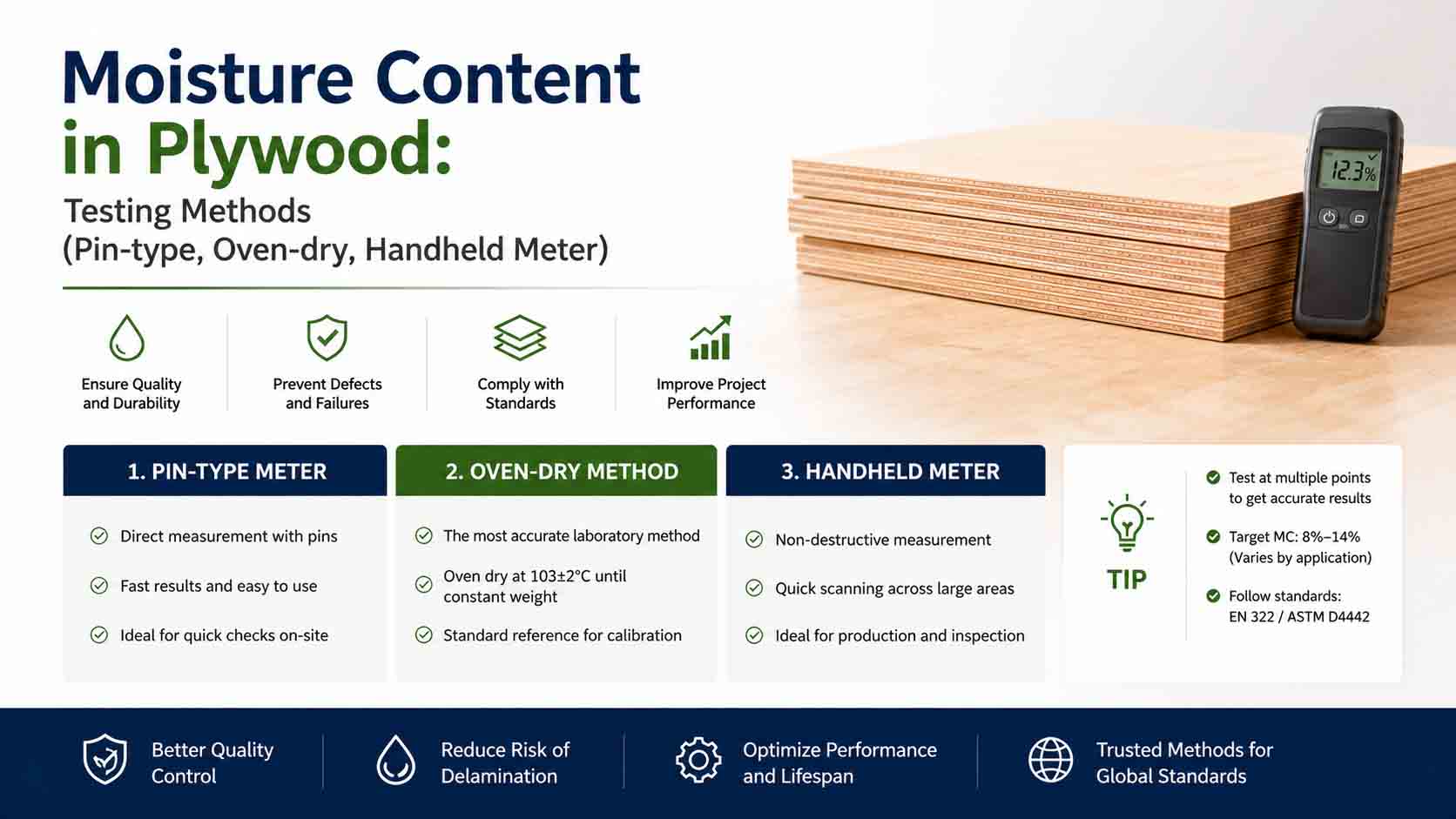
Pin-type moisture meter
A pin-type meter uses probes inserted into the wood-based panel to estimate moisture content through electrical resistance. This method is practical for quick factory checks and incoming inspection because it is portable and relatively fast. However, the reading can be influenced by veneer species, panel density, glue lines, probe depth, and where the operator places the pins. For plywood, that means a pin reading is useful for screening but should not be treated as a full laboratory conclusion on its own.
Handheld surface meter
A handheld non-invasive meter is even faster because it reads from the surface without penetrating the board. This can be useful when buyers want quick checks across many sheets, especially during warehouse review or pre-shipment inspection. The trade-off is that surface readings may reflect only near-surface condition and may not fully represent internal moisture distribution. For thicker panels or panels with coated faces, the buyer should be careful not to overinterpret a simple handheld reading.
Oven-dry method
The oven-dry method is the most technical reference approach because it compares the sample weight before and after controlled drying to calculate actual moisture loss. This is slower and destructive, so it is less convenient for routine field checks. But it is the most useful method when a buyer needs a benchmark result, wants to confirm disputed readings, or needs stronger evidence for quality review.
How buyers should compare the methods
Pin-type and handheld meters are useful for speed, trend checking, and screening. Oven-dry testing is more useful when the buyer needs a reference result with stronger technical credibility. In procurement terms, the right method depends on the decision. Quick acceptance checks may rely on portable meters, while dispute resolution or deeper technical confirmation may require oven-dry verification.
Evidence and Documentation
Moisture numbers become meaningful when they are supported by clear records. Without that context, even a reasonable reading can be difficult to evaluate or compare between suppliers.
What buyers should request
- Moisture test records showing the method used.
- Sampling location and sampling frequency across the lot.
- Date of testing and production or shipment stage when testing was done.
- Panel type, thickness, and face condition related to the result.
- Any explanation of acceptable internal moisture range for the product category.
Why method transparency matters
A statement such as “moisture checked” is too vague for real buyer evaluation. Procurement teams should know whether the supplier used a pin-type device, a handheld surface meter, or an oven-dry lab method. They should also know whether the reading came from a surface-coated board, a freshly cut section, or a finished production bundle. These details matter because they affect how useful the number is in a sourcing decision.
What this means for product claims
Buyers should be careful when moisture content is used indirectly to support broader product claims such as weather proof plywood or advice on how can I waterproof plywood. Waterproofing treatment, exterior coating, glue type, and moisture content are different issues. A stable moisture reading does not automatically mean the panel is protected for wet service, and a waterproofed surface does not guarantee correct internal moisture balance.
Decision Framework
Moisture testing is most useful when buyers link it to actual project conditions rather than treating it as an isolated factory check. A simple review framework can make that easier.
Step 1: Start with end use
Define whether the panel will be used for furniture, interior applications, transport packing, concrete work, subfloor, or other structural use. Moisture sensitivity and tolerance can differ depending on the application. This matters when buyers ask questions like what type of plywood for flooring, type of plywood for subfloor, or what type of plywood for subfloor, because installation environment matters as much as panel type.
Step 2: Match test method to decision level
Use handheld or pin-type readings for rapid screening and lot-level checking. Use oven-dry testing when a more defensible technical answer is needed or when the reading may affect claim handling, specification approval, or a dispute between parties.
Step 3: Compare moisture data with destination conditions
A panel that is stable in one climate may behave differently in another. Buyers should compare factory moisture condition with the likely shipping and installation environment rather than assuming one number is automatically correct for every market.
Step 4: Approve based on total context
- Proceed when the method is clear, the readings are credible, and the result fits the intended application.
- Clarify when the numbers look acceptable but the test method or sampling details are weak.
- Pause when moisture claims are vague, inconsistent, or disconnected from actual product use.
FAQ About Moisture Content in Plywood
What is the most accurate method for testing plywood moisture content?
The oven-dry method is generally the strongest reference method because it measures actual weight loss after controlled drying. It is slower and destructive, but it gives a more reliable benchmark than a quick handheld reading.
Are handheld moisture meters enough for buyer inspection?
They are useful for fast screening, especially across many sheets, but they should not be treated as the only technical evidence when a decision depends on deeper moisture accuracy.
Does moisture proof plywood mean the panel has low moisture content?
No. Moisture-proof performance and current moisture content are different things. One refers to how the product resists moisture in service, while the other describes how much moisture is in the panel at the time of testing.
Is plywood water resistant by default?
Not all plywood is. Water resistance depends on panel construction, glue type, surface treatment, and intended application. Buyers should avoid assuming that all plywood performs the same way under moisture exposure.
Why should buyers care about moisture content before shipment?
Because container transit, climate change, and storage conditions can amplify moisture-related instability. Early testing helps buyers reduce the risk of warping, swelling, and post-delivery claims.
Additional Resources for Buyers
Buyers reviewing plywood categories and application-fit options can explore the available product range here:
Plywood Products from Vietnam
This topic is especially useful when combined with specification review, bond performance checks, and climate-related handling requirements before shipment approval.
Request Product and Specification Support
For buyers evaluating plywood moisture performance, a reading is only useful when it is matched to the right test method, product type, and destination conditions. Use the contact page to request product and specification support for your next sourcing review.
Explore product categories: https://www.fomexgreenwood.com/products/
Email: qc@fomexgroup.vn
☎ +84 877 034 666