by admin admin No Comments

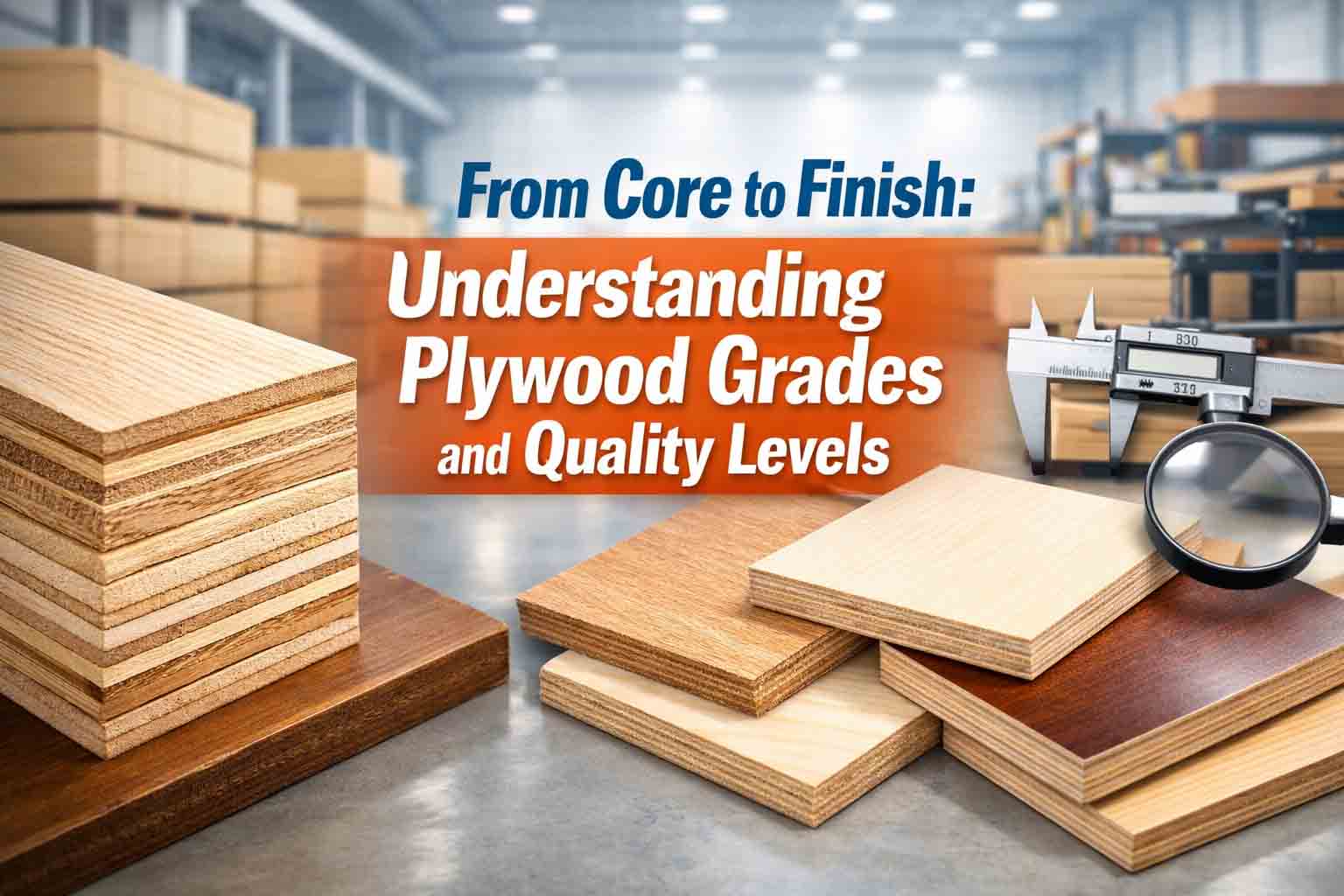
From Core to Finish: Understanding Plywood Grades and Quality Levels

Plywood grades are defined by veneer quality (A/B/C), core construction, and mechanical strength. Grade A uses clean, high-quality veneers for furniture; Grade B balances cost and appearance; Grade C is for packing and industrial use. FOMEX GREENWOOD applies double QC and sustainable hardwood sourcing to deliver stable, export-grade plywood for furniture, construction, and logistics applications.

Global buyers are shifting toward consistent, clearly graded plywood—especially for furniture, interior panels, construction and packaging. This guide explains how veneer grades and core quality affect performance, and how a high-quality plywood supplier like FOMEX GREENWOOD ensures reliability from raw core to final finish.
From Core to Finish: Understanding Plywood Grades and Quality Levels

Understanding Veneer Grades (A/B/C)

Plywood grading begins with the face and back veneers. Vietnam’s export market typically uses three levels:

  • Grade A – Smooth, clean, minimal defects. Ideal for premium furniture plywood and visible decorative surfaces.
  • Grade B – Small repairs allowed; suitable for cabinetry, interior applications and balanced performance.
  • Grade C – Visible knots/defects; often used in packing plywood and non-visible layers.

Core Grades: A / B / C – Comparison Table

Core Grade Characteristics Best Applications
A-Core
Premium Strength
• Uniform layers
• Zero gaps
• Highest stability
• Premium furniture
• High-precision joinery
• Architectural interior panels
B-Core
Balanced Quality
• Small gaps allowed
• Good structural balance
• Cost–performance optimized
• Cabinets
• Furniture frames
• General manufacturing
C-Core
Cost-Efficient
• More visible gaps
• Functional structure
• Economical option
• Crates & pallets
• Export packaging
• Industrial panels

For comparison with other plywood types, reference:
Film Faced vs. Commercial Plywood 

Mechanical Properties That Define Quality

Mechanical performance determines long-term stability in furniture or construction lines.

  • Density ≥550 kg/m³ → higher stability and durability.
  • Glue Options: MR, E0, WBP phenolic for moisture/heat resistance.
  • Moisture Content: <15% to prevent warping.
  • Thickness Tolerance: Precision calibration supports smooth finishing.

For formwork-specific mechanical properties, see:
Phenolic Film Faced Plywood Reuse Cycles

How FOMEX GREENWOOD Ensures Consistent Export-Grade Quality

FOMEX GREENWOOD applies a strict QC framework across all plywood types to ensure stable, repeatable quality for importers, wholesalers and manufacturers worldwide.

  • Core gap inspection and layer alignment
  • Moisture and density testing
  • Calibrated sanding for thickness accuracy
  • Glue-line bonding strength checks (MR, WBP, E0)
  • Sustainable hardwood sourcing aligned with FSC® & EUDR

More on our sustainability and compliance approach:
EUDR Compliance Checklist for Importers
Sustainable Plywood from Vietnam

For full technical specs, refer to our dedicated sheet:
Commercial Plywood Data Sheet

To compare price and logistics before ordering, see:
Cost of Importing Plywood from Vietnam 

📩 For export quotes and technical support:
qc@fomexgroup.vn+84 877 034 666

by admin admin No Comments

How FOMEX GREENWOOD Supports Green Building Projects Worldwide

Direct Answer:
FOMEX GREENWOOD supports global green building projects by supplying green building plywood and sustainable plywood Vietnam that meet FSC® sourcing, EUDR legality, and low-emission standards such as CARB-P2 and E0. These certified plywood lines- Film Faced, Commercial, Furniture, Packing, and LVL- are suitable for LEED-oriented eco construction, offering durability, traceability, and reduced carbon impact.

Green building is defining the future of the construction industry and all stakeholders in the world are gravitating towards the use of environmentally friendly materials. With developers, architects and contractors adapting the concepts of eco construction and also working on LEED-certified projects, the need to have green building plywood and sustainable plywood Vietnam is increasing.

Film faced factory

All lines of plywood- Film Faced, Commercial, Furniture, Packing Plywood and LVL- are tailored to promote sustainable infrastructure at FOMEX GREENWOOD with certified sourcing, low emissions and fully traceable supply chains.
To explore how our FSC® supply chain works, read:
Inside the Lifecycle of FSC® Certified Plywood →

1. The Reasons Green Building Requires Sustainable Plywood

Green buildings focus on materials that minimise carbon footprint, safeguard air quality, and deliver long-term environmental responsibility. Eco construction projects demand wood products that are sustainably produced, low-emission and compliant with international environmental frameworks.

The ways in which FOMEX GREENWOOD plywood promotes these objectives are:

  • Chain of Custody FSC® sourcing of legally harvested raw materials.
  • Supply chain aligned with EUDR requirements for deforestation-free origins.
  • CARB-P2 / E0 adhesives that ensure safe indoor air quality.
  • High durability and long service life reducing wastage at construction sites.

For deeper insights into low-emission adhesives, see:
CARB-P2 & E0/E1 Plywood: Safe Choices →
Learn about Sustainable Plywood →

2. Real Certified International Green Standards

One of the central requirements of global green building models is verified responsible sourcing. FOMEX GREENWOOD delivers this through complete traceable documentation from plantation to export.

  • FSC® Certified Veneers sourced from responsibly managed forests.
  • EUDR compliance with 100% land-use declarations and legality checks.
  • CARB-P2 / E0 low-emission glue systems for healthier indoor environments.
  • Rigorous QC systems ensuring stability, moisture balance and bonding durability.

These certifications increase buyer confidence, reduce customs risks and match environmental requirements in the EU, USA, Korea, and Middle East.
Read Market Report →

3. Applications of Plywood in LEED and Eco-Construction Projects

Thanks to consistent performance and low environmental impact, FOMEX GREENWOOD plywood is used in several major green construction segments:

  • Formwork & Shuttering: Film Faced Plywood reduces waste with multiple reuse cycles.

    See Film Faced Plywood →

  • Furniture: E0/E1 Furniture Plywood supports healthier indoor environments.
  • Structural Components: LVL beams for long-span, high-load structures.

    Top 5 Applications of LVL →

  • Export Packaging: Sustainable Packing Plywood reduces carbon footprint in logistics.

4. Green Business at FOMEX GREENWOOD: Sustainable Manufacturing

FOMEX GREENWOOD incorporates sustainability into every manufacturing phase to ensure plywood deliveries align with international green-building models.

  • Energy-efficient veneer drying.
  • Optimized wood recovery with minimum waste.
  • Low-emission glue systems and high-precision hot-pressing.
  • Waterproofing for long lifecycle performance.
  • Digital traceability across export supply chains.

These practices strengthen our position as one of Vietnam’s most reliable sustainable plywood suppliers for eco-focused global markets.

5. Why Global Builders Prefer FOMEX GREENWOOD for Green Projects

Developers worldwide prefer FOMEX GREENWOOD plywood because of:

  • Transparent sourcing & recorded documentation.
  • Consistent mechanical performance.
  • EUDR-ready export profiles.
  • Lower carbon footprint than many alternatives.
  • Long-term partnership value.

Our plywood is widely used in residential projects, industrial complexes and large eco-infrastructure developments.

Conclusion: Green Construction Future -The Reliable Plywood

FOMEX GREENWOOD supports the global green-building movement by providing plywood that meets high standards of sustainability, safety and performance. Our plywood is LEED-ready, eco-infrastructure ready, and built on FSC-sourced, EUDR-compliant and low-emission foundations.

Whether your work involves residential projects, civic facilities or large-scale eco-developments, sustainable plywood Vietnam by FOMEX GREENWOOD delivers measurable environmental and structural benefits.

Reliable Quality – Efficient Solutions – Long-term Partnership

Ask Sustainable Plywood Solutions →

Email: qc@fomexgroup.vn
+84 877 034 666

by admin admin No Comments

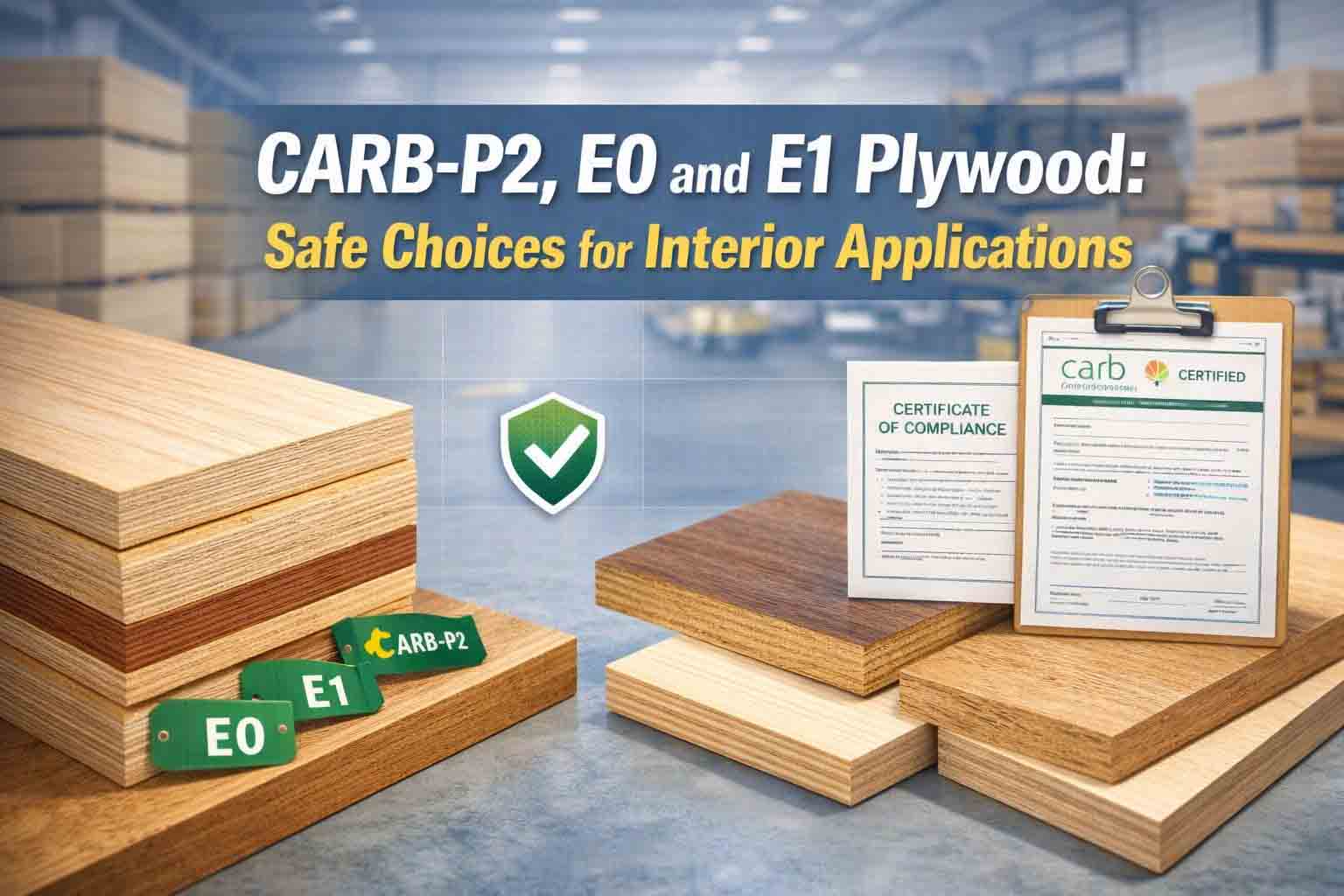
Formaldehyde Emission in Plywood: Meeting CARB-P2 and E0 Standards

Formaldehyde emissionFormaldehyde Emission in Plywood: Meeting CARB-P2 and E0 Standards

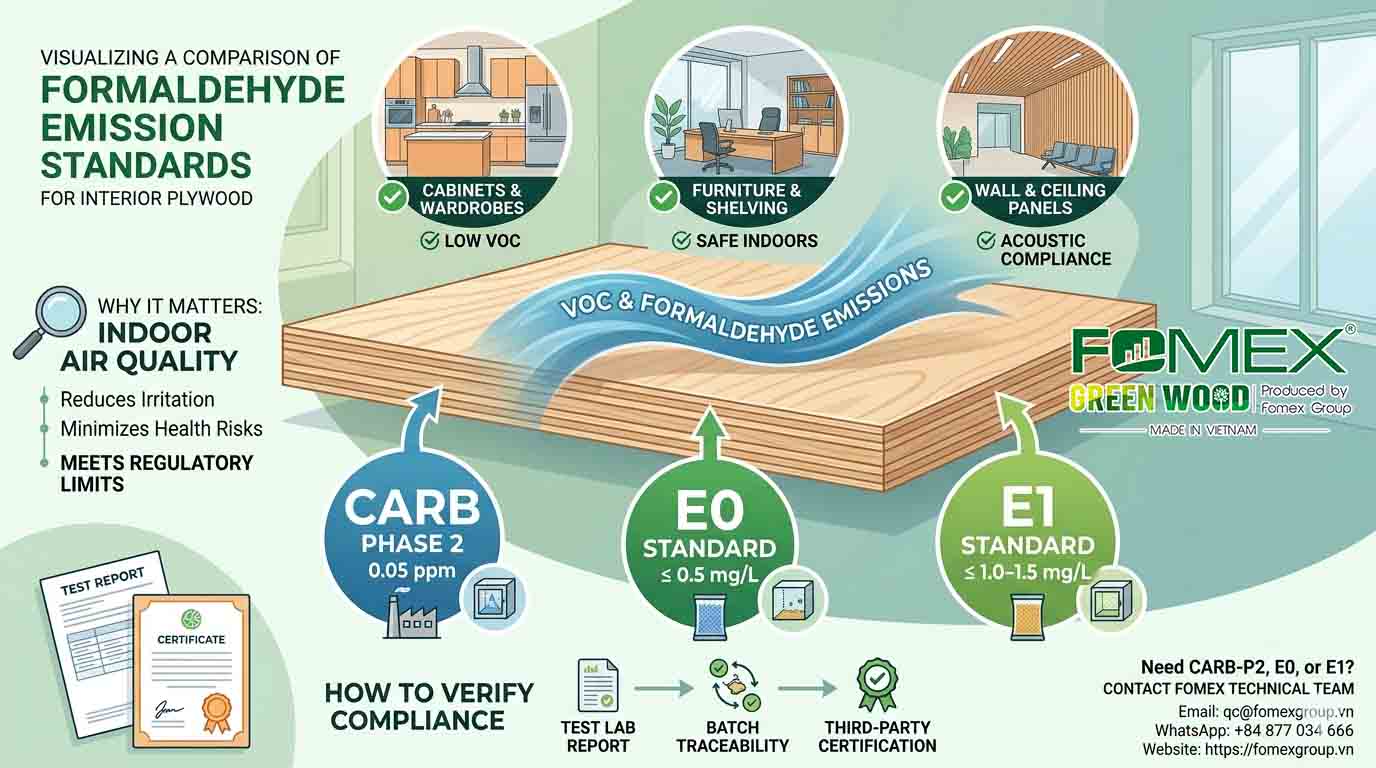
Formaldehyde emission is now one of the most important factors of safety in the plywood sector particularly in the areas of indoor use like furniture, flooring and interior panels. With the tightening of global laws, importers are placing more and more orders on CARB-P2 plywood, E0 plywood, and materials that have undergone rigorous emission test systems. These requirements have made formaldehyde-free plywood Vietnam and low-emission plywood essential in many global supply chains.

In FOMEX GREENWOOD, the lines of Commercial, Furniture and LVL plywood are all manufactured to controlled levels of emission to meet standards of CARB-P2 (USA) and E0 (international low-emission). This provides consistent performance, safety to users and durable compliance to indoor air quality for buyers seeking sustainable plywood Vietnam.

1. What Is Formaldehyde Emission in Plywood?

In the production of plywood, formaldehyde is present in numerous organic substances, although in this case, it is primarily in adhesive systems. Otherwise, it can leak into the indoor spaces, impacting the air quality.

Recognized testing methods of measuring formaldehyde emission would be in the form of:

  • JIS/JAS Desiccator Method (Japan)
  • ASTM E1333/ D6007 ( USA large chamber testing)
  • EN 717-1 (European chamber method)

Such tests define either a panel qualifies as E0 plywood, E1 plywood or CARB-P2 plywood, the most used requirements of global indoor furniture and building works.

2. The CARB-P2 and E0 Standards

Both CARB-P2 and E0 control the amount of formaldehyde that can be emitted by a wood product, but because of their origin and methods of testing.

CARB-P2 (USA)

The California Air Resources Board regulates a phase 2 of CARB under Airborne Toxic Control Measure (ATCM). It requires:

  • Hardwood plywood emission limit: 0.05 ppm.
  • There is third-party certification (TPC) which is obligatory.
  • Constant quality checking at the factory.
  • Random product sampling and verification testing.

E0 Plywood (International Low-Emission Grade)

E0 is a more rigid voluntary guideline, which is common in furniture and products in children. It requires:

  • Emission limit: ≤ 0.5 mg/L (JIS/JAS)
  • Usually less emission than CARB-P2 based on glue system.
  • Popular in EU, Korea, Japan, Australia.

To go into greater details, consult our guide:

Safe Choice CARB-P2 and E0/E1 Plywood: Uses in Indoor Applications

3. Glue Systems and Production Control of FOMEX GREENWOOD

The level of emission depends mostly on the adhesive system that is taken. In FOMEX GREENWOOD, the manufacture of all plywood is done with glue systems that are low emitting and international certified:

  • E0/E1 glue (Furniture Plywood) melamine.
  • Low-formaldehyde WBP phenolic glue (Film Faced and Industrial Plywood)
  • UF glue with controlled release of emission of select packing grades.

These systems support stable production of formaldehyde-free plywood Vietnam and indoor-safe engineered wood products.

4. The Importance of Low-Emission Plywood to the Importers

Low-formaldehyde plywood is a must-have condition among the importers in the USA, EU, Korea, and Australia. It is evident that the benefits of using CARB-P2 plywood or E0 plywood are the following:

  • Indoor safety: Healthier homes, offices, schools, and hospitals.
  • Market access: A number of the large retailers demand CARB-P2 or E0 documentation.
  • Sustainability compliance: Compliant with FSC®, EUDR, and green-building certification.
  • Increased product value: Furniture using E0 plywood will sell at a high price.

In case of project that needs very low emission, formaldehyde-free plywood Vietnam (zero-added formaldehyde resins) can be also requested.

5. The Process of Certified and Safe Plywood at FOMEX GREENWOOD

All the types of plywood products produced under FOMEX GREENWOOD and FOMEX Promax are subject to a recorded compliance procedure:

  • Tracing of each glue mix and lot of veneers used in batches.
  • Export documentation such as CARB-P2 certificate of TPC, E0 / E1 test tower.
  • Internal humidity control in order to facilitate glue drying and consistent emissions.
  • Continued auditing by identified international labs.

This assures the buyers that all shipment is in accordance with the market regulations and their clearance is without hitches. These controls also align with practices used for low-emission plywood suppliers globally.

Conclusion: Indoor-Ready, Certified and Safe Plywood

The increasing significance of indoor air quality implies that CARB-P2 plywood and E0 plywood became the necessity of the global importers. FOMEX GREENWOOD has a system of controlled glues, certified production lines and rigorous testing regimes that guarantee that every supply will be of the highest quality in terms of emission requirements by the world.

Regardless of the type of furniture material, construction plywood, and LVL, the selection of formaldehyde-free plywood Vietnam and low-emission will guarantee compliance, safety, and long-term value.

Reliability – Quality – Workable Solutions – Long-term Relationship

Inquire CARB-P2 and E0 Plywood SPECS at FOMEX GREENWOOD →

Email: qc@fomexgroup.vn
· ☎ +84 877 034 666

by admin admin No Comments

Why LVL Is Replacing Solid Wood in Modern Projects

Laminated Veneer Lumber (LVL) is currently taking a lead in the popularity of modern construction.
With the global markets moving towards engineered wood and sustainable sourcing, LVL Vietnam can be very helpful
as one of the alternatives to solid wood due to its high performance and reliability. Having a steady strength, great stability,
and reliable mechanical behavior, LVL will now be commonly used in structural, industrial and building architecture.
What is the difference between LVL and Solid Wood?In FOMEX GREENWOOD LVL, quality control and sustainability are highly maintained to deliver importers with
reliability in performance at long term projects. This production philosophy is aligned with our approach in other certified product lines such as
FSC® Certified Plywood.

1. What is the difference between LVL and Solid Wood?

LVL (Laminated Veneer Lumber) is a manufactured engineered wood product that is created through bonding long thin
layers of veneer under heat and pressure. LVL also has consistent and predictable performance compared to solid wood which varies
according to species, and moisture.

  • Even strength: LVL has done away with knots, grain defects and internal weaknesses of various solid wood species.
  • Top load-bearing capacity: LVL has a high bending strength when parallel veneer alignment is applied, unlike the normal sawn lumber.
  • Dimensional stability: Engineered layers reduce warping, twisting, cupping or shrinkage.
  • Efficiency in resource utilization: LVL maximizes the yield of every log which promotes sustainable forestry and minimization of waste.

Due to these structural benefits, LVL plywood is proposed to be a promising structural plywood Vietnam solution
in construction and industrial related uses, similar to engineered materials highlighted in
Film Faced vs Commercial Plywood.

2. The Benefits of LVL in Modern Construction Structure

The Benefits of LVL

In all the international construction industries, LVL is replacing solid wood due to a variety of structural reasons. It delivers:

  • High quality of bending strength of the beam, truss and joists.
  • Large stiffness to produce long spans and be heavy.
  • Mechanical properties that are predictable and fit the modern engineering requirements.
  • Strong fastener-holding capacity as compared to most of the softwood species.
  • Low moisture reaction, which helps to maintain the same performance in wet or changing climates.

This is why LVL is a perfect solution that is offered to builders interested in engineered materials that can be used
in various geographical areas and even in varying climatic conditions — the same logic explored in our article.

3. The Question of LVL Vietnam: Why Global Buyers Like It

The combination of good supply of veneers, modern manufacturing lines, and export oriented quality control have turned
Vietnam into a major producer of engineered wood. LVL manufactured in Vietnam is preferred because of:

  • Solid sources of hardwood veneer (acacia, eucalyptus).
  • Hot-press production of mechanical consistency.
  • Global CSR such as FSC, EUDR, sourcing and source with low formaldehyde emissions.
  • Affordable prices relative to its competitors in the EU, New Zealand and North America.

To the importers, LVL Vietnam offers a combination of quality, sustainability and cost effectiveness
that cannot be achieved by solid wood. These benefits are consistent with findings from our export research:
Vietnamese Plywood Market Report.

4. Global Demand Trends for LVL (2024–2025)

The LVL demand is still increasing all over the world as the builders shift towards engineered wood. Key trends include:

  • Abandon solid wood because of inconsistency of supply and sustainability issues.
  • Increased modular and prefabricated building in need of standardized predictable materials.
  • Raising penetration in Asia, Middle East and EU of beams, scaffold boards and formwork.
  • Good demand of materials that meet the EUDR requirements that compel buyers to traceable LVL supply chains.
  • Emergence of green buildings with engineered wood lowering carbon footprint.

This makes the laminated veneer lumber the building material of the future that will be utilized instead
of the traditional solid wood in big markets. Buyers interested in EUDR alignment may also review our article
EUDR Compliance Checklist.

5. LVL Applications: Where It Beats Solid Wood

LVL is now commonly used in:

  • Structural beams & joists
  • Scaffolding planks
  • Door frames & window frames
  • Furniture components
  • Formwork supports

See more in:

The 5 best uses of Vietnamese LVL

Findings: LVL – The Future of Modern Wood Engineering

Having a very good structural performance, material efficiency and sustainability benefits, LVL Vietnam
is becoming the choice over solid wood. Laminated veneer lumber is uniform, durable, and compliant in the
long-term needs of project sourcing, whether it is construction, furniture, or industrial sourcing.

Trustworthiness – Quality – Effective Solutions – Long-term Relationship

To Request a Quotation, Contact FOMEX GLOBAL →

Contact Us: qc@fomexgroup.vn ·
+84 877 034 666

by admin admin No Comments

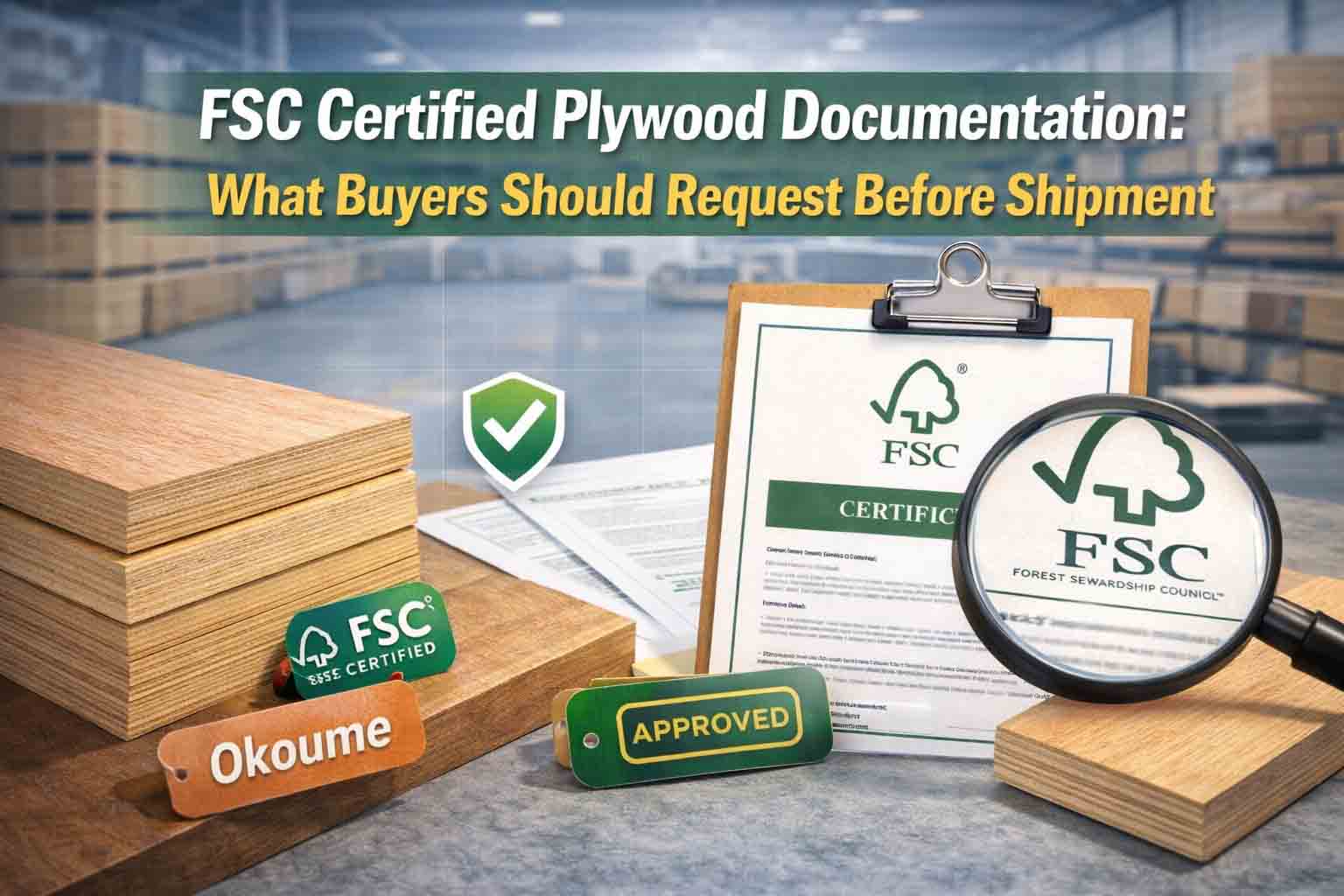
Inside the Lifecycle of FSC® Certified Plywood

When you are purchasing FSC Certified Plywood, you buy not only a high-quality product but also a supply chain that is based on responsibility and traceability. In the case of manufacturers like FOMEX GREENWOOD, a reputable Vietnam plywood supplier, the lifecycle of the plywood is extended, beginning with the plantation up to the manufacturing and export of the product and making sure that every step adheres to the desires of the modern day builders and importers, which necessitate EUDR compliant plywood and sustainable wood sourcing.

Inside the Lifecycle of FSC® Certified Plywood: From Plantation to Export

1. Sustainable Underwoodling and Planting

The FSC Certified Plywood system revolves around responsibility in the management of forests. The Forest Stewardship Council (FSC®) Chain of Custody (CoC) standard enables ensuring that the wood is sourced in a certified forest which is sustainable to extract, protective of biodiversity, and respects community rights.

To importers that procure in Vietnam, this implies that the veneers in eco-friendly plywood are traced back to plantations or forestlands of strict standards. These will include no illegal logging, conservation of high-conservation-value areas, and documentation that will associate each log with the ultimate Vietnam plywood export shipment.

2. Production Manufacturing – Traceability

The second most important stage after harvesting the raw material is the manufacturing. In this case, the lifecycle of FSC Certified Plywood will be included in the production chain of the FOMEX GREENWOOD Plywood plant. Key elements include:

  • Chain of Custody (CoC): This is the process through which certified material is designated, traced, and separated from non-certified material in the manufacturing and logistical process. This ensures sustainable plywood compliance with international standards.
  • Digital traceability: Contemporary manufacturers add batch codes, QR tracking and export-ready documentation to demonstrate origin and legality. As an illustration, the full traceability systems applied to FSC® and EUDR are implemented in leading plywood manufacturers in Vietnam.
  • Compliance wrapping: FSC Certified panels come with FSC CoC certificates, country-of-origin documentation, and EUDR compliant plywood declarations, which allows easy export to the EU, USA, and other regulated markets.

The practices incorporated in FOMEX GREENWOOD mean that every consignment of plywood ships with the integrity demanded by buyers all over the world who want sustainable plywood and legally obtained timber. Each panel reflects High-Quality Plywood Vietnam craftsmanship and transparent traceability.

3. Export & International Alignment of Markets

With the rapid shift in the world toward stricter regulations like the EU Deforestation Regulation (EUDR), Australian, US, and Korean standards, importers are now more demanding product lines certified as deforestation-free. The plywood industry in Vietnam is reacting to these demands by matching certified supply chains and promoting FSC Certified Plywood for sustainable wood sourcing.

Practically to the buyer: when you purchase FSC Certified Plywood from a supplier with full CoC, traceability, and EUDR compliant plywood certification, there will be less risk of customs delay, higher acceptance in green-building projects, and stronger brand positioning for your business.

4. Why This Is Important to You – Importers and Builders

A number of tangible benefits can be achieved by sourcing FSC Certified Plywood such as FOMEX GREENWOOD:

  • Guarantee of legality: The product can be tracked back to the forest and factory to guarantee that it is sourced in a certified and sustainable plywood manner.
  • Market access: Certified products are favored (or mandatory) in green building certifications (LEED, BREEAM) and controlled regions.
  • Sustainable impact: FSC-chain products help sustain forests globally, aligning with EUDR compliant plywood sourcing and reducing supply-risk exposure.
  • Brand value: When you advertise that you use FSC Certified Plywood, you are regarded as a responsible importer, which helps build credibility and long-term partnership trust.

5. How to Check and Select the Proper FSC® Plywood

In the event of certified plywood selection, the following checklist should be used when making a choice:

  • Valid FSC® CoC certificate number and export documentation (confirm authenticity on connect.fsc.org).
  • Traceability from plantation/forest to mill to export shipment.
  • Producer compliant with EUDR standards for plywood and able to provide due-diligence documentation.
  • Uniformity in technical data: veneer type, glue system, plywood grade, and certification claims consistent with Sustainable Plywood requirements.

Summary: Traceability Cultivates Trust and Long-Term Alliances

The FSC Certified Plywood lifecycle — including plantation, manufacturing, logistics, and export — is not just a certification. It promises quality, sustainability, and trusted collaboration. By partnering with a supplier like FOMEX GREENWOOD, you adopt not only a plywood product but also a clear and certified supply chain that aligns with your business objectives of sustainable wood sourcing and international EUDR compliance.

To Request a Quotation, Contact FOMEX GLOBAL →

FOMEX GLOBAL 2025 | Vietnam Trusted Plywood Exporter

Contact Us: qc@fomexgroup.vn · ☎ +84 877 034 666

by admin admin No Comments

Premium vs. Promax Plywood: Which Grade Fits Your Construction Needs?

When you’re sourcing construction-grade plywood from a trusted Vietnam plywood supplier, the decision between “premium” and “promax” grades can significantly impact your project costs, durability and long-term performance. At FOMEX GLOBAL we provide both the Premium plywood and the upgraded Promax plywood lines — and this guide will help you understand reuse cycles, glue systems and moisture resistance so you can make the right choice.

1. Understanding Premium and Promax Grades

The “Premium plywood” grade typically refers to panels manufactured with high-grade veneers, quality hardwood cores, a robust glue system and consistent finishing. In contrast, “Promax plywood” is engineered for demanding construction applications — higher density cores, upgraded glue and film systems, and enhanced durability for heavy use.

Our Premium line uses certified hardwood, WBP or phenolic glue, surface finish calibrated for structural use. Our Promax line steps further with higher solids phenolic resin adhesive, tighter layering tolerance and edge sealing — supporting extended reuse cycles for construction formwork or modular builds.

2. Reuse Cycles: What the Numbers Reveal

One of the most critical differentiators between Premium and Promax lies in **reuse cycles** — how many times a sheet can be used before replacement. A recent FOMEX GROUP article shows that for our Premium Form line, reuse cycles may fall into the “8–10 times” category, whereas the Promax Form line is engineered for “15–20 times” reuse.

In practical terms:

  • If you use a Premium grade panel ~8–10 times, your cost per use will be higher than a Promax panel that can achieve 15–20 uses.
  • The savings achieved through fewer panel replacements, less downtime and better finish quality translate into real cost-efficiency for large scale construction and formwork projects.

3. Glue Type & Moisture Resistance: Why They Matter

Construction-grade plywood must handle moisture, load, and frequent reuse. At FOMEX GLOBAL:

  • The Premium line uses WBP (Water-Boil-Proof) glue or standard phenolic glue, sufficient for many structural tasks.
  • The Promax line uses high-solids phenolic adhesive and enhanced edge sealing to better resist moisture ingress, delamination and warping — especially in humid or outdoor conditions.

Industry guidance supports this differentiation: as described in a plywood grades guide, durability and suitability for exterior or structural use depend heavily on adhesive type and core/ply thickness.

4. Which Grade Should You Choose?

Here’s a quick decision framework:

  • Choose Premium plywood when your project involves moderate reuse, indoor or semi-protected environment, and budget matters.
  • Choose Promax plywood when your project is heavy duty (formwork, modular construction, heavy reuse), moisture-challenged, or when lower life-cycle cost is a priority.

At FOMEX GREENWOOD we invite you to compare both lines side by side, review technical data sheets and evaluate your project’s reuse potential.

5. Cost Efficiency and Long-Term Partnership

Choosing the correct grade means less waste, fewer replacements and more predictable supply. With FOMEX GREENWOOD you also benefit from certified sourcing (FSC®, CARB-P2, EUDR) and transparent logistics — reinforcing our commitment to “Stable Quality – Sustainable for the Green Life – Long-Term Partnership”.

Importers get consistent quality, import-ready documentation, and reliable delivery schedules — whether you choose Premium or Promax. The right choice ensures you’re not just buying plywood — you’re investing in project success.

Conclusion: Fit the Grade to Your Need

In your sourcing strategy, remember: Premium and Promax aren’t just labels — they reflect engineered performance, reuse potential, and life-cycle value. If you need a trusted Vietnam plywood supplier that delivers both quality and compliance, turn to FOMEX GREENWOOD.

Contact FOMEX GLOBAL to Request a Quotation →

qc@fomexgroup.vn · ☎ +84 877 034 666


© 2025 FOMEX GLOBAL | Vietnam Trusted Plywood Exporter


by admin admin No Comments

How Phenolic Film Faced Plywood Extends Reuse Cycles in Concrete Formwork

In the contemporary construction, the formwork materials should perform and should be economical. Phenolic Film Faced Plywood is a viable solution to the importers and contractors who require sustainable plywood solutions particularly when they are produced by a reliable Vietnam Plywood Supplier such as FOMEX GLOBAL. The article examines the use of phenolic film facing, high quality core, and glue system to make plywood provide longevity, lower pour costs, and long-term collaboration in eco-friendly plywood applications.

1. What is the Difference between Phenolic Film Faced Plywood?

Film Faced Plywood used is plywood which is covered on both sides with a film that prevents moisture, abrasion, and concrete-release demands on the surface and core. Film Faced Plywood is coated on both sides with a film, usually a phenolic resin impregnated paper.

Key differentiators:

  • Phenolic resin bonding: This type of glue and film bond provides a layer that is thermostet, resistant to water, chemical and heavy load attack. It meets WBP (Water Boil Proof) and CARB-P2 emission standards.
  • Quality hardwood core: The plywood core (usually acacia, eucalyptus or mixed hardwood) is used to give stability and be able to use several times for high-quality plywood Vietnam production.
  • Surface finish: The film layer allows easy finishing a concrete surface and reduces inter-use repairing/cleaning, supporting eco-friendly plywood reuse.

Due to these characteristics, the Phenolic Film Faced Plywood in Vietnam is becoming the best product to export into the markets that require certified and high-performance panels like FOMEX GREENWOOD Plywood, compliant with FSC® standards and EUDR requirements.

2. Long Reuse Cycles: What the Data Shows

A Film Faced Plywood has a unique advantage; that is, it can be reused many times—i.e. it is cheaper to use, less waste and more sustainable in Vietnam Plywood Export.

The industry sources:

  • A guide gives standard film faced plywood as reusable with a stated lifetime of up to 20–25 times when well taken care of.
  • Other manufacturers state 30–50 applications (in ideal conditions).

Based on this data we can make useful comparison: with high-grade core + thick phenolic film + edge-sealed premium phenolic film you can reasonably expect 15–30 reuse cycles, whereas conventional core phenolic film can only offer 3–8 reuse cycles. Such dissimilarity contributes greatly to cost reduction and the long-term partnership philosophy of our FOMEX GLOBAL brand.

3. The way FOMEX GLOBAL Constructs to be of High Reuse

In FOMEX GLOBAL we combine production and quality control facilities that accommodate high-reuse Film Faced Plywood following FSC Certified Plywood and CARB-P2 standards.

  • Premium core sourcing: We construct using hardwood veneers and cross-laminated wood to minimize warping and be able to last as long as possible.
  • WBP/phenolic glue systems: Our adhesives are water-boil proof performing and conforming to formaldehyde emission requirements of the world standards and chart against CARB-P2 Plywood specifications.
  • Film thickness and edge sealing: We apply quality phenolic film and seal edges to resist moisture ingress and abrasion which is the key to 15+ cycles.
  • Export compliance and traceability: The panels are all traceable, meet the requirements of the FSC® Chain-of-Custody and are used in sustainable building applications. This is associated with our patented plywood promise which is environmentally friendly to customers worldwide.

Through these aspects, FOMEX GLOBAL can guarantee that every order of Film Faced Plywood can serve not only one project, but multiple projects, giving your business consistent and measurable value.

4. Importers and Contractors Benefits

By selecting high-quality phenolic film, one gets plywood from a long-term partner such as FOMEX GLOBAL, which offers several benefits to importers seeking Vietnam Plywood Export reliability:

  • Reduced total cost: More cycles would result in less frequent replacement—less downtime, cost and logistics of materials per pour.
  • Quick turnaround of formwork: Smooth surface ensures less complicated release of concrete and time savings between pours in cleaning/maintenance.
  • Better quality of finish: Smooth film finish levels fair-faced concrete with little patching or finishing needed.
  • Sustainability credentials: Multi-reuse promotes less waste and is consistent with the objectives of green building-crucial when finding eco-friendly plywood to supply EU/USA markets under EUDR Compliant Plywood rules.
  • Stable supply chain: As a business partner of FOMEX GLOBAL, you obtain transparency, compliance (FSC®, CARB-P2, EUDR) and stability in the long term, not only single shipments.

5. The Choice of the Right Film Faced Plywood: Major Requirements

In assessing Film Faced Plywood for reuse and export, the following considerations should be made:

  • Core material/density: Hardwood cores (acacia, eucalyptus, mix hardwood ) are continuously better than softwood cores.
  • Film coating quality and grammage: Phenolic films with higher thickness (200 gsm and more) can be reused more often.
  • Glue system: Use WBP/phenolic glue (not merely MR glue) that is resistant to moisture and boil conditions.
  • Surface finish / edge sealing: Proper sealing reduces moisture ingress and increases lifespan for High-Quality Plywood Vietnam.
  • Maintenance and handling: Even normal sheets become bad unless they are handled, cleaned, or stored in a proper way.

With these requirements in place, you will have optimized the reuse potential and the overall value of your plywood purchase with FOMEX GREENWOOD Plywood.

Conclusion: Sustainable Partnerships, Durable Plywood

In the current competitive world market, the choice of the proper formwork panel is not only cost per sheet but lifecycle value, performance and sustainability. Premium Phenolic Film Faced Plywood by FOMEX GLOBAL satisfies the following requirements: high reuse cycles, stable quality, worldwide compliance and cost-effectiveness.

When you need a reliable Vietnam Plywood Export partner who not only comes through in a single transaction, but also project after project, then it is time to consider what FOMEX GLOBAL can bring to you.

Request a Quotation with FOMEX GLOBAL →

Email: qc@fomexgroup.vn · ☎ +84 877 034 666


© 2025 FOMEX GLOBAL | Vietnam Trusted Plywood Exporter |


by admin admin No Comments

Vietnamese Plywood Market Report: Export Destinations and Trends (EU, USA, Korea, ME)

Vietnam has also developed very fast to become one of the best exporters of plywood in the whole world, with a wide customer base that requires quality products as well as conformity.

The industry is steadily expanding in 2025 due to the impact of international sustainability policies and rising demand of eco-friendly plywood products.
This report will provide the top export destinations, certification and trends that will influence the market environment in the Vietnam plywood export.

1. The Export Performance of Vietnam 2020 – 2024.

In 2020-2024, plywood exports grew by 8.3 per year on average in Vietnam due to the recovery in the construction sector after the pandemic and the transition towards green materials in the world.
Based on the data provided in the industry, the total export volume was more than 1.5 million m3 in 2024, which ranks Vietnam as one of the top five suppliers of plywood in the world.

Key Highlights:

  • Consistent production foundation: Sustainable Plywood and Film Faced Plywood are manufactured in more than 300 factories in Northern and Southern Vietnam to be sold to the export market.
  • Low cost competitiveness: Vietnam has a 10-15 per cent lower price than Indonesia and Malaysia because of streamlined veneer supply and logistics.
  • Growth that is driven by compliance: FSC 2, EUDR and CARB-P2 certifications have emerged as critical distinguishing factors in ensuring EU and US marketplace access.

The plywood export industry still remains in the center stage of the Vietnam wood industry as it records about a quarter of all wood product exportation in terms of value.
This is enhanced by the traceability systems and digitized compliance tracking that are funded privately.

2. Top Import Markets 2025

The exports of plywood in Vietnam will reach over USD 1.1 billion in 2025 and four key markets will control the demand.

European Union (EU)

One of the major growth driving forces is the EU and this is more so following the implementation of the EU Deforestation Regulation (EUDR).
The demand of suppliers that provide FSC Certified Plywood with proven origin and complete chain-of-custody is growing among the importers.
Germany, the Netherlands and France are the popular places where FOMEX GLOBAL is actively providing Commercial and Furniture-grade Plywood.

United States

Carb-P2 Plywood is still compulsory in the US in terms of indoors use.
The manufacturers in Vietnam such as FOMEX GREENWOOD produce hardwood and eucalyptus-core plywood, which pass the EPA Title VI TSCA standards.
The US imports volume in Vietnam grew by almost 9% in the year-on-year because the prices were stable and the products were of better quality.

Korea

Vietnam plywood manufacturers still use Korea as a strategic regional partner.
Its importers treasure moisture-regulated and equal-thickness plywood to use in furniture and buildings.
The most imported type is a high-grade Film Faced Plywood that is primarily used in the formwork and interior decoration works.

Middle East (ME)

Middle East is an area with an increasing demand especially in UAE, Saudi Arabia and Qatar.
The customers prefer Film Faced Plywood and LVL (Laminated Veneer Lumber) to be used in infrastructure and real estates.
Durability and heavy usage cycles are among the important considerations in the decision making process making Vietnam a cost effective but dependable supplier.

3. Significant Certifications Building momentum.

The Vietnamese plywood exporters have been forced to rely on certifications as the basis of the international trade. Not only they imply the legality but also establish trust and long-term associations.

  • FSC 2 ( Forest Stewardship Council): Ensures responsible sourcing of wood and complete traceability of supply chains.
  • CARB-P2: Regulates the formaldehyde emissions in order to safeguard the indoor air quality, which is mandatory in the USA and Canada.
  • EUDR Compliance: Commits to deforestation-free sourcing of all the plywood that is exported to the EU.
  • EPA TSCA Title VI: compatible with the U.S. environment safety standards of composite wood.

In the case of FOMEX GLOBAL all plywood lines, such as Commercial Plywood to Film Faced Plywood are certified to these international standards.
This code of compliance can assist in ensuring open export practices and assure the importers of uniform quality.

4. Trends: Sustainability and Digital Documentation.

The plywood sector all around the world is in the process of digital transformation that does not just limit to production but also to documentation and traceability.
The exporters in Vietnam are rapidly embracing these trends in order to fulfil the expectation of the international market.

  • First sustainability: Sustainable Plywood with FSC is becoming a more and more popular demand by importers with EUDR alignment, as the consumers demand sustainability in sourcing.
  • Digital traceability: EU and US buyers find it easy to comply with the use of QR-coded invoices, digital chain-of-custody reports, and an online document sharing.
  • Added value plywood: Interior furniture markets have high demands on value added plywood with their finishes, moisture control and low emitting adhesives.
  • Long-term relationships: Customers would like to work with suppliers who have stable prices, who provide clear communication and shipment tracking, these are values that are at the core of the FOMEX GLOBAL brand proposition.

All these tendencies repackage Vietnam as a supplier but as a strategic manufacturing partner of certified and sustainable plywood solutions.

5. Strategic Position of FOMEX GLOBAL.

Being one of the major Vietnam Plywood Suppliers, FOMEX GLOBAL has developed its reputation based on the principles of quality, compliance, and partnership.
As the producer of certified, traceable and sustainable plywood solutions, the company has its production bases under the FOMEX GREENWOOD and FOMEX PROMAX name and has the importers in more than 25 countries.

  • Consistent Quality: Veneer sourcing and moisture control are some of the activities that are executed in ISO and FSCuiso-compliant practices.
  • Sustainable to the Green Life: The factories are EUDR and CARB-P2 compliant to encourage production of plywood that is environmentally friendly.
  • Long-term Partnership: The open pricing and regular correspondence with the importers would provide credibility and recurrent business.

FOMEX engages in investments in digital export documentation, the new high-tech coordination of logistics, and traceability systems, as well, which places it in the position of a technologic manufacturer of the wood industry in the global market.

Learn more about how we are responsible in our production in the Market Guides.

Conclusion: Plywood Industry in Vietnam is Still on the increase.

The Vietnam export projection is also portending an increased role of the country as a global supplier of goods.
With the FSC Certified Plywood, EUDR compliance and high performance on the Vietnam Plywood Export, the country will become a reliable sourcing destination of sustainable and high quality plywood.

To request a Quotation with FOMEX GLOBAL, contact it and send a request.

Email: qc@fomexgroup.vn
Call: 877034666

by admin admin No Comments

Moisture Content in Plywood: Why It Matters for Long-Term Durability

The moisture content of plywood may seem like a small technical detail, but it has a powerful impact on the product’s strength, stability, and long-term performance.
For importers, furniture manufacturers, and builders, understanding this factor is essential to avoid warping, delamination, and structural failure.
At FOMEX GREENWOOD, we ensure that every plywood panel—whether for furniture, construction, or packing—is produced with carefully controlled moisture content to guarantee long-term durability and export consistency.
Moisture Content in Plywood: Why It Matters for Long-Term Durability

1. What Is Moisture Content in Plywood?

Moisture content refers to the percentage of water retained in the wood fibers of a plywood sheet. It directly affects the material’s dimensional stability and bonding quality.
In sustainable plywood production, moisture levels are carefully measured during each manufacturing stage—from veneer drying to hot pressing and final inspection.

For export-grade Vietnam plywood, the optimal moisture content is typically maintained between 8% and 12%.
This range provides the perfect balance: dry enough to prevent fungal growth or shrinkage, yet moist enough to ensure flexibility and bonding integrity when used in various climates.

To achieve this balance, FOMEX GREENWOOD employs calibrated moisture meters and industrial hot-air dryers to monitor every batch.
This process ensures compliance with FSC® standards and CARB-P2 regulations, both of which prioritize safe and eco-friendly production practices.

2. Why Moisture Control Matters for Durability

Plywood durability is not only about density or core type—it largely depends on how well the panel can resist moisture changes during shipping, storage, and usage.
If the moisture level is too high, the board may expand and lose structural stability.
If it’s too low, internal cracks or glue line separation may occur.

Dimensional stability: Balanced moisture content prevents warping or swelling when exposed to humidity variations.
Adhesion strength: Proper drying ensures the WBP glue or melamine glue can bond veneers tightly without delamination.
Formaldehyde emission control: Consistent drying reduces the risk of formaldehyde release, ensuring CARB-P2 Plywood and E0/E1 compliance.
Longevity: Correct moisture levels maintain product integrity for years, even in fluctuating environments such as Europe and the Middle East.

As part of our Sustainable Plywood approach, moisture management helps prolong product life, reduces waste, and contributes to eco-friendly plywood applications in furniture and green construction.

3. How FOMEX GREENWOOD Controls Moisture Content

At FOMEX GLOBAL, moisture control is integrated into every production phase to meet international standards such as FSC®, EUDR, and EPA TSCA Title VI.

Veneer Drying

Fresh veneers are first passed through automated drying lines until they reach a moisture level of 8–10%. This step ensures the layers are consistent before gluing and pressing.

Pressing

During hot pressing, WBP phenolic glue or melamine glue bonds layers under controlled temperature and humidity, ensuring proper curing.
The panels are then in ambient air for 24–48 hours to stabilize internal moisture distribution.

Final Moisture Inspection

Every plywood panel undergoes a final moisture content check before packaging. This ensures it meets export specifications for Vietnam Plywood Export markets in the EU, USA, and Middle East.

For specialized projects—such as Film Faced Plywood specs used in concrete formwork—FOMEX offers customized moisture levels to ensure higher reuse cycles and reduced surface cracking.

4. Effects of Improper Moisture Content

Improper moisture levels can lead to costly issues that affect the performance and appearance of the finished product:

Warping & twisting: Over-dried or uneven panels may bend during storage or installation.
Delamination: Excess moisture weakens the glue line, causing separation between veneer layers.
Mold & decay: High moisture creates an environment conducive to fungus and bacterial growth.
Dimensional mismatch: When plywood with high moisture is used in dry indoor conditions, it may shrink or crack.

By keeping plywood moisture content stable and consistent, FOMEX GLOBAL minimizes these risks and ensures reliable performance for importers and end-users alike.

5. Standards and Compliance in Moisture Regulation

Moisture content control aligns directly with international quality and sustainability standards.
FOMEX products meet all major certification requirements, ensuring durability and traceability for global buyers.

FSC® Certification: Confirms responsible wood sourcing and traceability through the Chain of Custody.
CARB-P2 Compliance: Ensures low formaldehyde emission levels for indoor safety.
EUDR Compliance: Verifies deforestation-free and legally sourced materials in line with EU import regulations.

Our strict internal Quality Control (QC) and export documentation systems include recorded moisture levels on every packing list and inspection report.
This transparency gives partners the confidence they need for long-term cooperation.

Conclusion: Stable Moisture, Stable Partnership

Maintaining ideal moisture content in plywood is not just about production—it’s about protecting quality and building trust across the supply chain.
With precise control, certified compliance, and open communication, FOMEX GLOBAL helps importers secure reliable and FOMEX GREENWOOD Plywood for every application.

Contact us: qc@fomexgroup.vn
Call: 877034666

Contact FOMEX GLOBAL to Request a Quotation →


© 2025 FOMEX GLOBAL | Vietnam Trusted Plywood Exporter | fomexgroup.vn


by admin admin No Comments

Cost of Importing Plywood from Vietnam: 2025 Price Insights and Logistics Tips

Since the global construction and furniture sector requires certified and eco-friendly products, the importation of sustainable plywood from Vietnam has proved to be a strategic step among most importers within the EU, USA, and the Middle East. Knowing cost structures, freight terms and container use would make your sourcing efficiency and overall landed cost very effective. We consider transparency and logistical expertise to be the basis of a long-term plywood relationship at FOMEX GREENWOOD, a trusted Vietnam Plywood Supplier.
Price Insights and Logistics Tips

1. Factors That Will Affect the Price of Plywood in 2025

The price of Vietnam plywood in 2025 is based on a set of interactions between the dynamics of raw materials, the conditions of logistics, as well as its compliance norms. The knowledge of such variables assists importers to plan effectively and prevent unrealized costs.

  • Veneer supply and quality: The supply of veneer in Vietnam is stable (acacia, eucalyptus, and hardwood) and can be used to ensure steady production. Q1–Q2 might be affected by seasonal price variation because of various harvesting seasons.
  • Glue and compliance: WBP phenolic and melamine glues that comply with CARB-P2 plywood and EPA TSCA Title VI emission regulations provide safety to the material at a small cost of raising the cost of production.
  • Freight and container rates: Ocean freight rates have been stable since 2024 and are a major variable when it comes to CIF quotations. To importers, a slight variation with routes to either EU or U.S. ports should be expected.
  • Certification and Compliance: FSC Certified Plywood and FSC Chain of Custody certification as well as EUDR compliance make sure that legal sourcing and traceability are guaranteed, which is critical to responsible importers seeking sustainable plywood.

At FOMEX GREENWOOD, all types of plywood — Film Faced, Commercial, Furniture-grade, Packing Plywood, and LVL — are manufactured as per FSC®, EUDR, and CARB-P2 standards, which offer both performance and integrity in every order delivered. This makes FOMEX one of the most reliable Vietnam plywood manufacturers for global buyers.

2. The Use of FOB and CIF: Which One Is More Effective?

When you have to include or exclude FOB (Free on Board) or CIF (Cost, Insurance, Freight), it can make or break your overall landed cost by 5–10 percent, depending on the destination and logistics plans for importing eco-friendly plywood from Vietnam.

FOB – Flexibility and Control

Shipment of the product is made by the buyer through Vietnamese port under FOB terms. This provides a superior ability to control freight choice, possible cost benefits to frequent importers, and logistic planning transparency. It is best suited to buyers having favorable freight forwarders or consolidated shipments.

CIF – Predictability and Convenience

In the CIF model, FOMEX GLOBAL takes care of the whole shipping business including the ocean freight and insurance. CIF is also predictable in terms of prices, particularly to importers who are new to the processes of exporting from Vietnam or those who have many suppliers. It reduces administration and eases the process of cost comparison for high-quality plywood Vietnam shipments.

Suggestion: CIF is suitable for first-time importers; FOB is more flexible and can save money when dealing with a partner who has regular volume. Both are available from FOMEX GREENWOOD Plywood export services.

3. Container Optimization Tips

Optimization of cubic meter (CBM) can save up to 10–12% on shipping expenses. Some of the important optimization techniques applied by the logistics teams of FOMEX GREENWOOD include:

  • Standard pallet arrangement: Stacking of sustainable plywood to ~45–50 CBM per 40-foot high container with different thickness and grade.
  • Combination and thickness of mixes: Using 12mm + 18mm plywood for balance of volume and weight without reaching container capacity.
  • Plan per destination: In EU markets, the control of humidity and pallet fumigation is needed. In Middle East markets, high humidity is addressed with plastic wrapping.
  • Label and documentation: Add HS code, moisture content (8–12%), batch code, and FSC certificate reference number for easy customs clearance.

The logistics department of FOMEX GROUP is fully supportive in terms of packing arrangements, loading images, and shipping documents to ensure efficiency and compliance throughout the process of Vietnam plywood export.

4. Import Cost Examples (EU, USA)

Prices will be based on grade (A/B/C), core material (hardwood, eucalyptus, mixed), and order volume. For precise quotes, contact our sales team at FOMEX GREENWOOD.

5. The Way FOMEX GLOBAL Provides Cost Transparency

FOMEX GLOBAL combines production and logistics management to enable importers to retain complete clarity of cost structure. Our model guarantees stable performance and cooperation on a long-term basis:

  • Constant Quality: Tight QC system that starts with the selection of veneers up to pressing and final inspection.
  • Green Life: All plywood lines are FSC Certified and EUDR Compliant.
  • Long-Term Partnership: Pricing is transparent, delivery is punctual (95%+), and shipment traceability reports are provided for every eco-friendly plywood shipment.

Conclusion: Better Plan, Better Import

The market position of importing plywood from Vietnam in 2025 will offer strong opportunities to buyers who seek certified quality, competitive prices, and sustainability. You are likely to save both time and cost using an appropriate Incoterm, optimized loading, and effective communication.

FOMEX GLOBAL is the reliable partner in exporting sustainable plywood — certified production, reliable logistics, and transparent pricing mean that each delivery will meet your expectations.
qc@fomexgroup.vn · ☎ +84 877 034 666

Request a Quotation →


© 2025 FOMEX GLOBAL | Vietnam trusted plywood exporter | fomexgroup.vn