
by admin admin No Comments

Film Faced Plywood from Vietnam — Durable, FSC®-Ready, Double-QC

Film faced plywood is a durable engineered plywood coated with phenolic film for concrete formwork. FOMEX GREENWOOD offers high-quality panels that are FSC®-ready, EUDR-compliant, and CARB-P2 certified, manufactured with Double QC to ensure flatness, tight tolerance, and 25+ reuse cycles to save cost for global contractors.

  • Size: 1220×2440mm | Thickness: 12 / 15 / 18mm
  • Core: Poplar / Eucalyptus | Glue: WBP phenolic
  • Compliance: FSC® (on request), EUDR, CARB-P2
  • Lead time: 21–25 days (EU/US)
  • Trusted by contractors in 30+ countries

📖 See our EUDR-Compliant Plywood Guide

What Is Film Faced Plywood and Why Quality Counts

Film faced plywood is plywood covered with a waterproof phenolic film. It’s widely used for concrete formwork thanks to its smooth surface, strength, and high reusability.

However, low-grade panels often face swelling, warping, and surface defects due to inconsistent thickness, weak bonding, or poor cores — causing delays and high costs.

How FOMEX Ensures Quality

  • Selected low-moisture core veneers (poplar/eucalyptus)
  • WBP phenolic glue under controlled temperature & pressure
  • Two-stage QC (incoming veneer QC + finished panel inspection)
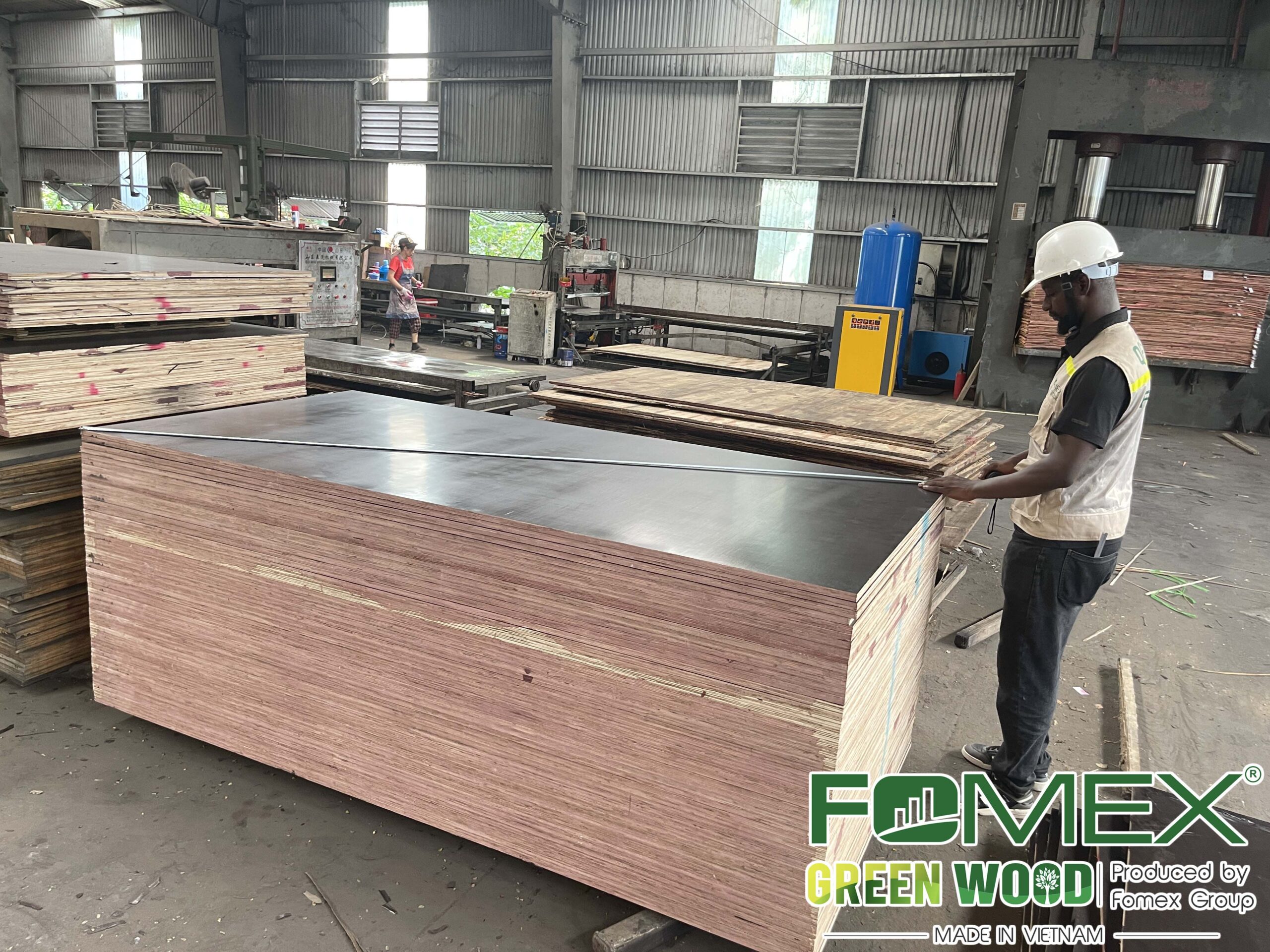
FOMEX double-QC process for film faced plywood
18mm | FSC® option | 20+ reuse cycles — Film Faced Plywood. © FOMEX GREENWOOD

The Impact of the FOMEX Double-QC Process

QC Stage Key Checkpoints Result
Stage 1 — Veneer QC Moisture ≤ 12%; thickness tolerance ≤ 0.3 mm; core gap ≤ 1 mm Stable bonding; no delamination
Stage 2 — Final QC Thickness, flatness, edge sealing, film adhesion 20+ reuse cycles in formwork

Our Double QC system has lowered the rate of surface defects by 38% compared to industry average (internal QC data 2024).

 FOMEX GREENWOOD Manufacturing Network

All panels are manufactured under our Double QC system across six factories in Vietnam:

  • 🏭 Film Faced Plywood Factory 1 — Hoa Binh Province
  • 🏭 Film Faced Plywood Factory 2 — Bac Giang Province
  • 🏭 Commercial Plywood Factory — Phu Tho Province
  • 🏭 Packing Plywood Factory — Soc Son District, Hanoi
  • 🏭 LVL Factory — Hung Yen Province
  • 🏭 Birch Plywood Factory — Thanh Hoa Province

Global Compliance: FSC®, EUDR, CARB-P2

  • FSC® CoC (on request): verified chain of custody traceability
  • EUDR preparedness: species & geolocation data, risk assessment, legality statements
  • CARB-P2 & E0/E1: certified low-formaldehyde emission for US/EU interiors

📖 Key Certifications for Sustainable Plywood

Product Specifications — FOMEX GREENWOOD Film Faced Plywood

Size 1220×2440mm (custom available)
Thickness 12 / 15 / 18mm
Core Poplar / Eucalyptus / Mixed hardwood
Glue WBP phenolic / MR
Film Brown/Black phenolic, 120–220 g/m²
Certifications FSC® (on request), CARB-P2, E0/E1
Lead Time 21–25 days (EU), 25–30 days (US/ME)
Market Focus EU, US, Korea, Middle East

FAQ

How many times can FOMEX film faced plywood be reused?

Usually 25–30 pours with proper cleaning, oiling, and correct stripping.

Is the plywood FSC® certified?

Yes. FSC® Chain of Custody is provided on demand to suit your purchase order.

Is it CARB-P2 compliant?

Yes. Each batch is supplied with CARB-P2 or E0/E1 emission reports to the customs.

 Prepared to Buy Stable-Quality Film Faced Plywood?

FSC® certified • Double-QC manufactured • Timely delivery • Trusted globally

Internal reading:
Maximizing Value with CARB-P2 Plywood ·
Strength & Durability of Film Faced Plywood in 2025 ·
FOMEX Global: Top Plywood Supplier in Vietnam

© FOMEX GREENWOOD

by admin admin No Comments

Veneer Drying For Plywood Sheets

Drying Veneers will make the size of the wood stable, free from pests, easy storage, and the finishing and processing process of the plywood sheets will also achieve higher quality. Good veneer drying practice is essential for making good quality plywood sheets. In particular, the drying of veneers will reduce its weight, thereby reducing transportation costs.

Problems with Wet Veneers

The over amount of moisture in the veneer can affect the spread of glue on the veneer surface of plywood sheets. Wrong material can cause blister, glue penetration, glue peeling, etc.

High moisture veneer is not suitable for hot-press process of plywood manufacturing. It will prolong the hot press time and discount the quality of wood panels.

There are two popular veneer drying methods: air-drying and forced drying.

1. Air-drying

Air-drying is a natural way of drying veneers. The sun provides energy (heat) for the evaporation of water in the veneers.

Using the air-drying method, veneers can be dried to a moisture content of 12 – 20% depending on weather conditions. The drying time can vary greatly from 10-30 days. This depends on the species and the size of the veneers.

2. Forced drying

Veneers, before being used for making plywood sheets or for some other use … it is usually dried to the required moisture content. In order to achieve this goal quickly and accurately, the veneers are dried in a kiln. Unlike the drying process, the temperature, relative humidity, and air circulation in the kiln are controlled during the drying process.

The temperature in the drying process can be up to 100 degrees Celsius. However, drying with high temperature is not common because it is difficult to limit defects that araise in the drying process.

 Advantages And Disadvantages Of Two Method

1. Air-dying

Compared to drying by forced drying, air-drying requires little investment and no energy costs. However, air-drying has the following disadvantages:

  • Long drying time.
  • Veneers cannot be dried to moisture below 12%. Lower humidity is often required for products exported to countries with mild climates.
  • Need a large area for stacking and drying.

2. Forced drying

The advantages of drying wood by forced drying method:

  • The drying process is controlled, and defects are limited
  • Achieve lower humidity compared to air-drying
  • The drying time is shorter than that of air-drying
  • The kiln is used for many different types of wood
  • Achieve the exact humidity required
  • The veneers fungus pests are destroyed during the drying process

Disadvantages of wood drying by forced drying:

  • Requires bigger investment than air-drying
  • Required cost for energy
  • It is required that the operator must have skills in oven operation and maintenance.

Currently, most factories in developed countries are usually natural methods (air-drying) to dry in order to save energy costs.

Understanding these limitations, FOMEX’s factories have invested in machinery and equipment for forced drying. We aim to have a long-term business strategy, ensuring stable quality in plywood sheets. We hope we can contribute to bringing Vietnam’s plywood to reach extreme quality.

Rosie

FOMEX GROUP