by Admin Admin No Comments

Sustainable Plywood Criteria for Green Building Procurement

For buyers, specifiers, and sustainability teams, choosing sustainable plywood is no longer just about finding a panel that looks acceptable on paper. The harder part is deciding whether the product can support green building procurement with documentation, emissions-related evidence, and specification details that stand up to internal review.

That challenge matters more now because procurement teams are often asked to compare technical suitability and sustainability criteria at the same time. This guide sets out a practical way to evaluate plywood from a buyer’s perspective, so decisions are based on usable evidence rather than broad environmental claims.

Why Sustainable Plywood Has Become a Procurement Question

In many projects, plywood selection is no longer a simple commercial decision. Buyers may need to answer questions from consultants, contractors, or internal sustainability teams about sourcing, emissions, intended application, and what evidence supports the product claim. If those questions are addressed too late, even a commercially viable material can become difficult to approve.

Where buyers usually face problems

A common issue is that suppliers present sustainability language at a broad level, while buyers need product-level clarity. Terms such as responsible sourcing, low emissions, or green material may sound useful, but they do not help much unless they connect clearly to the exact panel being quoted, the intended application, and the documents available for review.

What this means for the next step

Buyers should define their evaluation criteria before requesting final quotations. That allows the sourcing process to compare suppliers on the same basis, including specification fit, documentation readiness, and support for project review.

Key Criteria for Evaluating Sustainable Plywood

To assess sustainable plywood properly, buyers should focus on criteria that can be reviewed in a commercial setting. The goal is not to collect every possible file. The goal is to verify whether the plywood can meet project expectations in a practical and defensible way.

Responsible sourcing and material origin

The first area is sourcing. Buyers should understand how the supplier describes material origin and what records are available to support that description. This is an important part of plywood sustainability, especially when a project team wants assurance that procurement decisions are tied to documented supply flow rather than general brand messaging.

Emissions-related suitability for the intended use

For interior fit-out, furniture, and joinery, emissions-related information often matters as much as sourcing. That is particularly relevant for plywood for cabinet building, where the product may be used in enclosed or occupied spaces and buyers need clearer evidence for specification review. A supplier should be able to explain what test data or declarations are available and how they relate to the quoted panel.

Application fit in real construction use

Plywood sustainability should not be separated from performance. A panel that is unsuitable for the intended application can lead to replacement, rework, or waste, which weakens the overall procurement outcome. For teams buying plywood in building construction, that means reviewing bond type, panel structure, thickness range, and exposure conditions alongside any sustainability-related criteria.

End-of-life language should be treated carefully

The term plywood recyclable is often used too broadly in sales communication. In practice, end-of-life outcomes depend on how the panel is used, whether it is coated or contaminated, and what waste handling systems exist in the destination market. Buyers should treat recyclability as a qualified discussion point, not as an automatic blanket claim.

Evidence and Documentation Buyers Should Request

Once a supplier appears suitable, the next step is to request the documents that support the specification and sustainability discussion. A useful document pack does not need to be excessive, but it should be consistent and relevant to the project.

Core files worth requesting

  • Product specification sheet with panel type, thickness, size, and intended use.
  • Technical information related to bonding, construction, or application suitability.
  • Available emissions test reports, declarations, or market-relevant compliance documents.
  • Sourcing-related documents where responsible procurement is part of the buyer requirement.
  • Commercial product description that matches the quotation and expected shipment paperwork.

What buyers should check inside those files

The key check is alignment. The product named in the quotation should be the same product described in the technical sheet and the same product that later appears in commercial documents. If the specification language changes from one file to another, the buyer may struggle to support internal approval even when the product itself looks workable.

Practical implication for procurement teams

It is better to request draft supporting documents during supplier evaluation than after commercial terms are already agreed. This helps buyers compare not only pricing, but also how well each supplier can support a real project approval process.

A Decision Framework for Green Building Procurement

To simplify supplier comparison, buyers can use a structured review model before issuing a purchase order. This keeps the conversation focused on application, evidence, and decision clarity rather than broad environmental language.

Step 1: Start with the application

Define whether the plywood is intended for cabinetry, interior fit-out, furniture, general construction, or another use. The right evaluation criteria depend on the application, so procurement should begin with how the panel will be used rather than with a marketing description alone.

Step 2: Match each claim to a document

If a supplier makes a sourcing, emissions, or sustainability-related claim, ask what document supports it. A claim without a usable supporting record should be treated as unverified until clarified.

Step 3: Review sustainability and technical fit together

Do not separate environmental review from product suitability. A panel can look strong on sustainability language but still be the wrong fit if bonding, thickness tolerance, or structural build do not match the application.

Step 4: Use a simple approval logic

  • Approve: The application is clear, documents support the claims, and the specification fits the project.
  • Clarify: The product may be suitable, but file gaps or wording inconsistencies still need to be resolved.
  • Pause: Claims are too broad, evidence is missing, or the panel description does not align with the intended use.

This framework helps teams make commercially practical decisions while keeping procurement standards clear. It also improves coordination between buyers, technical reviewers, and sustainability stakeholders.

FAQ About Sustainable Plywood Procurement

What makes plywood sustainable from a buyer perspective?

It usually comes down to documented sourcing, relevant emissions-related information, and a specification that fits the intended use. Buyers need a product they can evaluate with evidence, not only with environmental language.

Is all plywood suitable for green building procurement?

No. Suitability depends on the application, the evidence available, and whether the panel meets the project’s technical and procurement requirements.

Why is emissions data important for plywood?

Because interior and joinery applications often require stronger documentation on what the panel is suitable for. Without usable emissions-related information, internal approval can become more difficult.

Can buyers treat plywood as recyclable by default?

No. End-of-life outcomes depend on coatings, contamination, local waste systems, and how the plywood is used in the project. Recyclability should be discussed carefully rather than assumed.

What is the most effective way to compare suppliers?

Use one checklist for all suppliers: intended application, technical fit, sustainability claim, supporting documents, and consistency across the document set. That creates a clearer and more defensible buying decision.

Additional Resources for Buyers

Buyers reviewing product categories and application fit can explore the available range here:
Plywood Products from Vietnam

For the broader topic cluster around green building support and specification discussion, this article can also sit alongside:
How FOMEX GLOBAL Supports Green Building Projects Worldwide

Request Project References and Specification Support

When evaluating sustainable plywood for a project, buyers often need more than a quotation. Clear specification discussion, relevant supporting files, and practical review of application fit can help reduce approval delays and improve sourcing confidence. Buyers can use the FOMEX contact page to request project references or specification support, and the site also provides access to its product pages for further review. [web:8][web:16]

Request Specification Support

Email: qc@fomexgroup.vn | WhatsApp: +84 877 034 666

by Admin Admin No Comments

Import Plywood from Vietnam: Signals Buyers Should Watch Before Sourcing

For many procurement teams, the decision to import plywood from Vietnam starts with a simple goal: secure reliable supply, workable specifications, and commercial terms that fit the market. The difficulty is that early supplier comparisons often focus too heavily on price and panel description, while important sourcing signals are reviewed too late.

That creates risk for importers who need consistency across quality, export documentation, and end-use suitability. This guide looks at the practical signals buyers should watch before sourcing, so commercial decisions are based on supply readiness and specification clarity rather than sales language alone.

Why Buyers Need a Stronger Pre-Sourcing Review

When companies import plywood, the first supplier conversation often sounds straightforward: panel type, size, glue, thickness, loading plan, and quotation. In reality, the real sourcing risk usually appears between those details. A supplier may quote quickly but still leave open questions around product fit, production consistency, document handling, or how the order will be managed through export.

What makes early sourcing decisions harder

Buyers are often comparing suppliers across several product types at once, such as commercial plywood, film faced plywood, or requests to import birch plywood for furniture and interior use. If the comparison sheet only tracks price and lead time, important signals get missed. Those signals include how clearly the supplier explains construction, how consistently product descriptions are used, and whether the team can respond in a way that supports procurement review.

Implication for buyers

Before requesting final offers, buyers should define what they need to confirm beyond unit cost. That means clarifying intended application, acceptable quality variation, documentation expectations, and who inside the supplier organization will actually manage the order through production and shipment.

Key Signals to Watch Before You Import Plywood

A useful pre-sourcing review is not about turning every order into a full audit. It is about identifying the signals that separate a workable supplier from one that may create friction later. For teams planning to import plywood on a repeat basis, these signals matter as much as the initial offer.

Signal 1: The supplier can explain product fit clearly

Good suppliers do not just send a quotation. They explain how a panel fits the intended application. That is especially important when buyers ask practical questions such as how thick should plywood be for flooring or how thick should plywood subfloor be in a garage loft. There is no single answer that works across all projects, because thickness depends on load, support spacing, installation method, and final use. A supplier that answers with only a generic number may not be helping the buyer make a sound specification decision.

Signal 2: Product origin is explained without confusion

Buyers often ask where is plywood made, where is plywood produced, or where is plywood manufactured because origin affects market positioning, customer expectations, and sometimes compliance review. A capable supplier should be able to explain the production flow clearly, including the manufacturing location, exporting entity, and how the goods move commercially. If the answer remains vague, the sourcing conversation is not yet mature enough for confident buying.

Signal 3: Communication stays consistent across technical and sales topics

In B2B plywood trade, inconsistency is often visible before the order is placed. The quotation may use one product name, the sales team may describe another construction, and the technical explanation may not match either. Buyers should watch for these gaps early, because they often lead to confusion later in sampling, approval, or shipment documentation.

Signal 4: The supplier understands the destination market

Buyers do not need the supplier to know every downstream project detail. They do need the supplier to understand why the market matters. A supplier supporting Europe, the USA, Korea, or the Middle East should be able to discuss product expectations, documentation handling, and quality concerns in a commercially useful way. That does not guarantee suitability, but it shows the conversation is grounded in export reality rather than broad sales positioning.

Evidence and Documentation Buyers Should Request Early

Once a supplier looks commercially interesting, the next step is to ask for evidence that supports the quotation. This is where buyers move from market screening to actual sourcing evaluation.

Core items worth requesting

  • Product specification sheet with panel type, size, thickness range, and intended application.
  • Photos, sample references, or production details that help clarify face, core, and construction expectations.
  • Draft commercial description showing how the product will be named in the transaction.
  • Basic export document structure, especially if the buyer needs internal review before shipment.
  • Supplier explanation of manufacturing and export flow when origin or production route matters to the order.

What buyers should check inside the file set

The most useful check is alignment. The product described in the quotation should match the panel being sampled, the panel being discussed technically, and the panel that would later appear on shipping paperwork. This matters for all categories, including imported birch plywood, where buyers often expect tighter consistency in appearance, build, and end-use suitability.

Action step for procurement teams

Ask for the document set before price negotiation is fully closed. That way, buyers can compare not only who offers the better number, but also who offers the clearer order path. In many cases, that clarity is what reduces claims, rework, and approval delays later.

A Practical Decision Framework Before Sourcing

To make supplier comparison more disciplined, buyers can apply a simple decision framework before placing trial orders or container bookings. This approach works well for procurement teams that need both commercial speed and technical control.

Step 1: Define the end-use first

Start with the real application rather than the product name alone. Flooring underlayment, cabinet components, construction panels, and temporary formwork all create different performance questions. This helps prevent oversimplified buying decisions based on thickness or species alone.

Step 2: Compare supplier clarity, not only pricing

Review how each supplier explains panel construction, tolerances, application fit, and export flow. A lower quote may still become the more expensive option if the sourcing path is unclear and the buyer must solve basic specification questions alone.

Step 3: Test consistency across communication and documents

If a supplier is clear in calls but vague in written files, buyers should slow down. The sourcing process becomes more dependable when product naming, technical explanation, and draft paperwork support the same transaction story.

Step 4: Use a simple approval logic

  • Proceed: Product fit is clear, communication is consistent, and early documentation supports the quotation.
  • Clarify: The offer is commercially promising, but technical or document gaps still need resolution.
  • Pause: Origin, product description, or order flow remains unclear even after follow-up.

This framework helps buyers turn a broad market search into a more controlled sourcing decision. It is especially useful when several suppliers appear similar on paper but differ in how reliably they support the buying process.

FAQ About Importing Plywood from Vietnam

What should buyers check first before they import plywood?

They should start with application fit, product description clarity, and the supplier’s ability to explain manufacturing and export flow clearly. Price should be reviewed together with these points, not in isolation.

Is import birch plywood handled the same way as other plywood categories?

Not always. Buyers of birch-faced or birch-related panels often expect more consistency in appearance and end-use suitability, so specification review usually needs to be tighter.

How thick should plywood be for flooring?

That depends on the structural setup, support spacing, loading condition, and whether the plywood is acting as subfloor, underlayment, or part of a finished assembly. Buyers should treat thickness as an application-based decision, not a universal rule.

How thick should plywood subfloor be in a garage loft?

The answer depends on the actual load and support design, so it should be confirmed against the intended build condition rather than copied from a generic plywood listing. For procurement teams, this is a reminder that end-use questions should be clarified before sourcing.

Why do buyers ask where plywood is manufactured?

Because manufacturing origin can affect commercial confidence, downstream customer expectations, and how the transaction is reviewed internally. A supplier should be able to explain origin and production flow in a clear, commercially usable way.

Additional Resources for Buyers

Buyers reviewing panel types and application fit can explore our product categories here:
Plywood Products from Vietnam

For sourcing discussions tied to export support and specification review, teams can also use this topic as a starting point for supplier comparison and internal procurement alignment.

Request Product and Specification Support

When preparing to import plywood from Vietnam, buyers usually need more than a quotation sheet. Clear product positioning, specification support, and early document alignment can make sourcing decisions easier and reduce avoidable issues later. FOMEX GLOBAL can support discussions around panel type, application fit, and export-ready product information.

Request Product Support

Email: qc@fomexgroup.vn | WhatsApp: +84 877 034 666

by Admin Admin No Comments

FSC Certified Plywood Documentation: What Buyers Should Request Before Shipment

FSC Certified Plywood: What Buyers Should Request Before Shipment

For buyers sourcing fsc certified plywood from Vietnam, certification review often happens too late. Many teams confirm size, grade, pricing, and delivery first, then check FSC-related paperwork only when shipment documents are being prepared. That sequence can create avoidable delays, internal compliance issues, or questions from customers who need clear supporting records before cargo leaves.

In practice, the main issue is not whether a supplier says the plywood is FSC. The real issue is whether the supplier can provide a document trail that is clear, consistent, and usable for a commercial shipment. This guide explains what buyers should request, what to verify carefully, and how to make a practical shipment decision with less last-minute risk.

Why FSC Documentation Matters Before Shipment

For international buyers, document review should not be treated as a final administrative step. Once production is packed and vessel booking is close, even a small mismatch can disrupt internal approval, payment release, or downstream customer submission. That is why FSC document control needs to happen before shipment release, not after final paperwork has already been issued.

This is especially relevant when sourcing fsc plywood from Vietnam, where a transaction may involve a manufacturer, a trader, and a separate export entity. If the legal company name on the certificate, the invoice, and the shipment documents does not align clearly, the buyer may struggle to support procurement review or sustainability reporting.

What buyers should ask for early

At minimum, buyers should request a valid FSC certificate copy or verifiable certification reference, the legal company name that will appear on commercial documents, and the agreed product description linked to the order. It is also useful to review draft invoice and packing list details early if FSC wording or traceability information matters to the transaction.

Common buyer mistakes at this stage

A frequent mistake is checking certification only after production is completed. Another is accepting a logo on packaging, a brochure, or a sales message as sufficient proof. Buyers also often verify the factory name but overlook the actual selling or exporting entity, which is where documentation gaps often appear.

Key Criteria for Evaluating FSC Certified Plywood Documents

Reviewing plywood fsc documentation is less about collecting more files and more about checking consistency across the whole transaction. A document may look acceptable on its own but still create problems if it does not match the order flow, selling entity, or product description.

Certificate validity and entity match

Buyers should first confirm that the certificate is valid at the time of order and shipment review. Then they should check whether the certified entity matches the legal seller or exporter. If those parties are different, the supplier should explain the relationship clearly and show how the certified material is tied to the shipment being sold.

Product description and claim consistency

The product description should be consistent across quotation, purchase order, production records, invoice draft, and packing list. This matters for plywood buyers because generic wording such as “plywood panel” may not be enough for procurement teams or project documentation. If one document says commercial plywood, another says film faced plywood, and another uses a broad FSC description, the buyer may face unnecessary internal questions.

Common evaluation mistakes

Many buyers focus only on the certificate number and ignore the legal certificate holder. Others assume that if a supplier handles certified goods, every shipment automatically qualifies in the same way. Another common mistake is reviewing documents one by one instead of checking them as a connected document set.

Evidence and Documentation Buyers Should Request

A practical buyer process is to request documentation in stages. This makes it easier to identify issues early and gives the supplier time to correct them before shipping pressure starts.

Before production completion

At this stage, buyers should ask for the supplier’s valid certificate or certification reference, the name of the certified company involved in the transaction, and the final product description to be used commercially. If the buyer’s team has internal sustainability or sourcing forms, this is also the right time to send them to the supplier for review.

Before shipment release

Before cargo departs, buyers should request draft invoice, packing list, and any supporting files needed for internal review. The goal is to confirm that the certified party, the selling party, and the shipment paperwork all match the actual order flow. This is often where gaps become visible, especially when export documentation is handled by a different entity from the mill.

Signs that need closer review

Buyers should pause and review further if the supplier shares a certificate but avoids confirming who will invoice the shipment, if product descriptions change across documents, or if draft paperwork is sent too late for meaningful checking. Vague terms such as “eco plywood” or “green plywood” should not replace clear certification-related documentation.

A Practical Decision Framework for Buyers

For procurement teams, a simple review framework helps separate routine shipments from higher-risk ones. Instead of debating every case from the beginning, buyers can use a structured check before giving shipment approval.

Step 1: Confirm who holds the certification

Identify the certified party and compare that name with the company issuing the quote, invoice, and export documents. If the commercial flow is not clear, ask for clarification before moving ahead.

Step 2: Confirm how the product is described

Make sure the plywood being purchased is described consistently across the purchase order, production planning, and draft shipping documents. Consistency here reduces confusion during internal compliance review and customer due diligence.

Step 3: Review the shipment document set together

Check the draft invoice, packing list, and any supporting certification-related documents as one package. A mismatch that seems small on one file can become a larger issue when viewed across the full set.

Step 4: Use a simple approval logic

  • Green: Certificate details, entity names, product descriptions, and shipment drafts align clearly.
  • Amber: Minor issues exist but can be corrected before final document issuance.
  • Red: Entity mismatch, unclear product scope, or unsupported claim; shipment should not be approved until clarified.

This approach is useful when comparing suppliers in Vietnam. A lower quote may not always be the easier shipment if document handling is weak. For many importers, consistent paperwork reduces risk just as much as acceptable production quality.

FAQ About FSC Certified Plywood Documentation

Is a certificate copy enough to approve an FSC plywood shipment?

No. Buyers should also verify the legal seller, the product description, and the draft shipment documents tied to the order.

When should buyers check FSC documents?

The review should begin before production is completed. Early checking gives both sides time to fix naming or document alignment issues before shipment deadlines become tight.

What is the most common documentation issue in plywood exports?

One common issue is that the company shown in certification records is not the same as the company issuing the invoice or export documents.

Why does product description matter so much?

Because inconsistent wording makes internal approval more difficult and weakens the buyer’s document trail for resale, project submission, or sustainability review.

What should buyers do if documents are sent too late?

They should hold final approval until the file set is reviewed and then adjust the process on future orders so draft paperwork is provided earlier.

Additional Resources for Buyers

Buyers who are reviewing Vietnam plywood supply options can also explore our broader product categories here:
Plywood Products from Vietnam

For general reference on responsible forest product certification, buyers may also consult:
Forest Stewardship Council

Request FSC Documentation Support from FOMEX GLOBAL

When sourcing fsc certified plywood from Vietnam, clear document control before shipment helps buyers reduce approval delays and avoid preventable compliance issues. If your team needs support reviewing supplier paperwork, export flow, or pre-shipment document alignment, FOMEX GLOBAL can assist with practical buyer coordination.

Request FSC Documentation Support

Email: qc@fomexgroup.vn | WhatsApp: +84 877 034 666

by Admin Admin No Comments

CARB-P2, E0 and E1 Plywood: Safe Choices for Interior Applications

Formaldehyde emissions are one of the most important safety topics for interior plywood today. CARB-P2, E0 and E1 standards give importers a clear way to specify low-emission plywood for cabinets, furniture and wall panels, but the differences between them are often misunderstood. This guide explains each standard, where it applies and how to verify that your plywood is truly safe for indoor use.
CARB-P2, E0 and E1 Plywood

Why Formaldehyde Emissions Matter Indoors

Formaldehyde is a volatile organic compound (VOC) released in small amounts by many composite wood products because of the resins used to bond veneers and particles together. Long-term exposure to elevated formaldehyde levels can cause eye, nose and throat irritation, worsen respiratory conditions and has been linked to increased cancer risk in humans. [web:50][web:53]

As people spend most of their time indoors, regulators in major markets such as the US, EU and Asia have tightened VOC and formaldehyde limits to protect indoor air quality in homes, schools, offices and healthcare buildings. [web:46][web:54]

For plywood importers, this means emission class is no longer optional marketing; it is a compliance requirement and a key part of your brand’s safety promise for interior projects.

Understanding CARB-P2, E0 and E1 Standards

CARB Phase 2 (CARB-P2) and E0/E1 are different but related ways of limiting formaldehyde emissions from wood-based panels. CARB-P2 is a California regulation widely adopted across the US, while E0 and E1 are emission classes commonly used in Asia and Europe for plywood and other wood-based panels. [web:44][web:49][web:52][web:54]

What Is CARB-P2?

CARB Phase 2 is an Airborne Toxic Control Measure from the California Air Resources Board that sets maximum allowable formaldehyde emission limits for composite wood products such as hardwood plywood, MDF and particleboard. [web:44][web:48][web:51]

For hardwood plywood, CARB-P2 limits emissions to 0.05 ppm formaldehyde (measured in a chamber test) for both veneer-core and composite-core products, while other panel types such as particleboard and MDF have slightly higher limits. [web:44][web:48][web:51]

What Are E0 and E1?

E0, E1 and E2 are emission classes used in standards such as Chinese GB and EN 13986 to classify plywood and other panels according to their formaldehyde release in desiccator or chamber tests. [web:49][web:52][web:55][web:58]

  • E0: typically ≤ 0.5 mg/L in desiccator tests – very low emissions, suitable for sensitive indoor environments such as bedrooms and schools. [web:49][web:52]
  • E1: typically ≤ 1.0–1.5 mg/L in desiccator tests, or about 0.1–0.124 mg/m³ in chamber tests – low emissions accepted for most interior furniture and paneling. [web:49][web:54][web:55]
  • E2: up to 5.0 mg/L – higher emissions, increasingly restricted for long-term indoor use in many markets. [web:49][web:52]

In practical terms, E0 demands stricter control than E1 and is often positioned as a premium low-emission option, while CARB-P2 is chamber-based and focuses on ppm limits for products sold in the US. [web:44][web:49][web:52][web:54]

Where CARB-P2, E0 and E1 Plywood Are Used

Low-emission plywood is used anywhere people live, work or spend long periods of time indoors. The closer the panel is to occupants and the larger its exposed surface area, the more important emission class becomes. [web:49][web:53]

  • Cabinets and wardrobes: Large surface area and enclosed spaces make CARB-P2 or E0/E1 panels attractive to reduce odours and VOC build-up in bedrooms and kitchens. [web:44][web:48]
  • Furniture and shelving: Desks, tables, bookcases and storage units benefit from E0/E1 or CARB-compliant cores, especially in offices and schools. [web:49][web:53]
  • Wall and ceiling panels: Decorative plywood and acoustic panels in hotels, offices and public buildings often require low-emission documentation to support green building goals. [web:53]
  • Flooring substrates: Plywood underlays beneath carpets or resilient floor coverings are often specified as CARB-P2 or E1 to help keep whole-room VOC levels within recommended ranges. [web:44][web:55]

Residential projects increasingly insist on CARB-P2/E1 as a minimum, while high-end homes, healthcare and education projects may prefer E0 or equivalent ultra-low-emission products. [web:49][web:53][web:55]

Testing and Certification Requirements

Emission classes are not based on declarations alone; they require laboratory testing under defined conditions. Panels are tested in small chambers or desiccator setups that measure how much formaldehyde is released over a set period. [web:44][web:45][web:49]

Lab Testing Procedures

  • Chamber tests: Panels are placed in a controlled chamber and air samples are analysed for formaldehyde concentration in ppm or mg/m³ after a specified time. This is used in CARB and many EN-based standards. [web:44][web:45][web:54]
  • Desiccator tests: Common in some Asian and Chinese standards; panels are placed above water in a sealed desiccator and released formaldehyde is absorbed and measured as mg/L. [web:49][web:52][web:58]

How Often Panels Must Be Tested

Serious manufacturers implement regular production testing and third-party verification to maintain certification. Under CARB and US TSCA Title VI rules, certified mills follow quality control plans and are audited by third-party certifiers who also conduct periodic independent tests. [web:44][web:47][web:54][web:57]

For E0/E1 products, manufacturers usually combine internal routine checks with external lab reports to prove that typical production stays within the claimed emission class over time. [web:49][web:52][web:54]

How to Verify Compliance as an Importer

Importers cannot “see” emissions, so documentation and traceability are critical. You should be able to connect any claim on a label to a specific test report, production batch and certification body. [web:44][web:47][web:54]

What to Look for in Reports and Certificates

  • Standard and method used (e.g., CARB chamber test, EN 717-1, JIS A 1460, desiccator method). [web:49][web:55]
  • Measured emission value and the limit it is compared to (for example “0.04 ppm vs limit 0.05 ppm” or “0.4 mg/L vs E0 limit 0.5 mg/L”). [web:44][web:49][web:52]
  • Panel type, thickness, substrate and glue system tested, matching the product you plan to buy. [web:44][web:54]
  • Testing lab name, accreditation status and test date. [web:44][web:47][web:49]

Traceability to Batch and Production Date

Compliance is only meaningful if you know which batch it applies to. Ask suppliers how test reports are linked to real production: for example, through batch numbers on bundle labels, production dates or lot codes. [web:47][web:54]

For critical projects, consider random spot checks at independent labs in your own market to confirm that delivered goods match the claimed emission class over time. [web:46][web:54]

Low-Emission Plywood Solutions from FOMEX GREENWOOD

FOMEX GREENWOOD develops plywood lines that can be tailored to meet CARB-P2, E0 or E1 emission requirements for international buyers, especially for interior furniture, cabinetry and decorative applications. Low-emission glue systems and controlled veneer drying are used to keep formaldehyde release within target limits while maintaining mechanical performance. [web:49][web:52][web:54]

For each project, specifications can be aligned with the destination market: CARB-P2/TSCA Title VI for the US, E0/E1 for EU and Asia-Pacific, or combined approaches where importers serve multiple regions from a single product range. Supporting documentation such as test reports and certificates can be provided to help buyers pass audits and customer due diligence. [web:44][web:47][web:49][web:54]

Need CARB-P2 or E0/E1-Ready Plywood for Your Interior Projects?

FOMEX GREENWOOD can recommend plywood configurations and emission classes for cabinets, furniture and wall panels, and supply the formaldehyde test reports you need for compliance checks and client tenders.

Contact FOMEX Technical Team →

Email: qc@fomexgroup.vn
☎ WhatsApp: +84 877 034 666

FAQs

Is E0 always better than CARB-P2?

E0 and CARB-P2 use different test methods and units, so they are not directly interchangeable. E0 usually targets ≤ 0.5 mg/L in desiccator tests, whereas CARB-P2 sets chamber limits like 0.05 ppm for hardwood plywood. Both indicate low emissions, but you must compare actual test values and methods rather than assuming one label is automatically “better”. [web:44][web:49][web:52][web:54]

How can I verify that the plywood truly meets CARB-P2?

Check that the product is labeled as CARB Phase 2 or TSCA Title VI compliant, then request chamber test reports showing emission levels below CARB limits for the relevant product type. Confirm that the mill is listed with a CARB-approved third-party certifier and that reports reference the same product, thickness and batch you are purchasing. [web:44][web:47][web:51][web:57]

Are low-emission panels more expensive?

Typically yes: achieving E0, E1 or CARB-P2 compliance requires improved resin systems, process control and regular testing, which add cost. However, the price difference is often small compared with the value of safer indoor air, reduced odour complaints and easier compliance with building and retailer requirements. [web:49][web:52][web:54]

Do export markets outside the US require CARB compliance?

Many markets do not legally require CARB, but they increasingly demand equivalent low-emission performance. The US uses CARB/TSCA Title VI, while other regions use E0/E1, national limits or green building labels that reference formaldehyde thresholds. Importers outside the US may still prefer CARB-P2-compliant products as a clear benchmark their customers recognise. [web:46][web:49][web:53][web:54]

by Admin Admin No Comments

Plywood Grades and Quality: From Core Structure to Finished Surface

Plywood grade is one of the biggest drivers of price, performance and complaint risk in international sourcing. Two panels can share the same size and thickness but behave very differently on site if their face, back and core grades are not aligned with your customer’s expectations. This guide explains grading systems from core to finish, so importers can specify the right quality level for each application.

Why Plywood Grading Matters for Importers

Grading is the “quality language” between exporter, importer and end user. If grade expectations are not clearly defined and documented, you may ship a panel that is technically acceptable, but visually or structurally below what your market considers normal – leading to claims and discounts.

Plywood grade also explains price differences that pure specifications (size, thickness, glue) cannot. A better face grade, tighter core quality or higher internal standard will increase cost but reduce sorting, wastage and disputes. Serious importers treat grading as a core part of their offer positioning, not a small detail at the end of a quote.

Overview of Common Grading Systems

Around the world, plywood is graded using different but related systems. Many export panels use letter-based grades such as A/B/BB/C/C+, sometimes combined into pairs like B/BB or BB/CC to indicate face and back quality.

In these systems, the first letter normally refers to the face (better side), and the second to the back (service side). There can also be supplementary numbers or symbols for specific markets, but the core idea is the same: higher letters mean cleaner, more uniform surfaces with fewer visible defects.

Importantly, these grades usually describe the face and back veneers. Core grading is related but often defined separately, through internal factory standards or structural specifications rather than visible letter codes.

Face and Back Grade Explained

Face and back grades define what you can “see” on the outer surfaces. They specify which visual defects are allowed, in what size and frequency. This directly affects suitability for furniture, visible interiors, or purely structural use.

Typical Face/Back Grade Characteristics

  • Higher grades (A, B, BB): Smooth surface, limited and well-repaired knots, tight patches, minimal splits, controlled colour variation. Suitable for visible surfaces, painting or veneering.
  • Mid grades (BB/CC, C+): More knots and repairs allowed, some open defects and colour variation. Good for one-side visible furniture, carcasses or formwork where appearance is secondary.
  • Lower grades (C, D and similar): Larger knots, open splits, rough patches and strong colour variation allowed. Often used where surfaces are hidden, or appearance is not critical (subfloors, packing, structural sheathing).

When discussing grade with customers, examples matter. Many disputes arise because one customer’s “BB/CC” expectation is closer to another market’s “B/BB” reality. Using photos and clear defect descriptions helps align understanding.

Core Grade and Internal Quality

While face and back grades are visible at first sight, core quality is hidden inside the panel. It covers voids, overlaps, gaps and joint quality between internal veneers. Core grade is critical for structural performance and long-term durability.

Voids, Overlaps, Gaps and Joints

  • Voids and gaps: Empty spaces where veneer pieces do not fully cover the area. Too many or too large voids reduce bending strength and screw holding, especially near supports and edges.
  • Overlaps: Areas where veneers overlap too much, creating thick spots and internal stress zones that can telegraph through the surface or affect flatness.
  • Poor joints: Misaligned or poorly cut veneer edges that create weak points for shear and can open under load or moisture variation.

A “better core grade” means smaller, fewer and better-distributed defects, more consistent veneer thickness and tighter jointing. It translates into more predictable structural performance and lower risk of internal delamination under stress.

Market-Specific Grade Expectations

Grade labels may look similar on paper, but expectations differ by region. Importers must understand these differences to avoid under- or over-specifying for their market.

  • EU: Often expects tighter visual and structural standards, with strong focus on consistency and documentation. Furniture and interior markets lean toward cleaner face grades and well-controlled cores.
  • US: Uses a mix of letter/number systems and local standards. There is a broad range from commodity panels with basic grades to high-end decorative and structural products with strict grading rules.
  • Middle East: Many buyers prioritise durability and reuse in film faced formwork, accepting more visual defects on non-visible surfaces but demanding robust cores and strong gluing.
  • Asia-Pacific: Very diverse: some markets are price-driven and accept lower visual grades for structural and packing use; others (Japan, Korea, Australia) follow stricter norms and expect clear, stable grading.

Typical grade combinations vary by application: BB/CC or similar for many furniture carcasses, more basic grades for packing, and function-focused grading for formwork where face appearance is less critical than performance and reuse.

How Grades Are Documented on Spec Sheets

A good spec sheet translates grading language into clear, written codes and descriptions. This is your reference when evaluating offers and handling claims.

Reading Grade Codes and Descriptions

  • Check how face and back grades are written (e.g., B/BB, BB/CC, CP/CP).
  • Look for a short explanation of what each grade allows in terms of knots, patches, splits and colour variation.
  • Verify if core quality is described (maximum void size, typical core species, expected internal standards).
  • Confirm if grades are linked to any external standard (for example, regional grading rules or norms).

Ensuring Grade Consistency Across Batches

Consistency means that “BB/CC” from one shipment looks and behaves like “BB/CC” from the next. Importers should keep physical reference samples, use photo records, and document agreed defect limits. This allows you to challenge off-grade shipments with objective comparisons rather than subjective impressions.

FOMEX GREENWOOD Approach to Grading and QC

A structured grading and QC system reduces surprises for buyers. Instead of treating grading as a loose promise, serious suppliers apply internal standards and multi-step inspection to keep real production close to the agreed spec.

  • Internal grading standards: Clear definitions for face/back grades and core quality, adapted to target markets and applications.
  • Inspection steps: Grading checks on veneers, in-process panels and finished sheets before packing, not only at the end of production.
  • Transparent communication: Realistic sample panels, photo references and spec sheets used to align expectations with buyers before orders are confirmed.
  • Feedback loop: Using buyer feedback and claim analysis to fine-tune grading rules and visual sorting over time.

Need Help Specifying Plywood Grades for Your Market?

FOMEX GREENWOOD can recommend face/back and core grade combinations for furniture, formwork and packaging based on your price point and end-customer expectations, and provide reference samples to lock the standard.

Contact FOMEX Technical & QC Team →

Email: qc@fomexgroup.vn
☎ WhatsApp: +84 877 034 666

FAQs

What is the difference between BB/CC and B/BB plywood?

BB/CC means the better face is BB grade and the back is CC service grade – one “good” side and one more rustic side. B/BB indicates a higher-quality B face with fewer and smaller defects, and a BB back. In practice, B/BB is often chosen when both sides may be seen or when the visible face needs a cleaner finish than standard BB/CC.

Are plywood grades standard worldwide?

No. While many regions use similar letters (A, B, C, D, BB, CC), the exact defect limits and expectations differ by standard and market. A “BB” panel from one country may look slightly different from a “BB” panel graded under another system. That is why spec sheets, photos and samples are important.

Can a better face grade hide a poor core?

A high face grade can make a panel look good at first glance, but it cannot fix a weak core. Excessive voids, overlaps or poor glue lines will show up later as bending failure, delamination or poor screw holding. For demanding applications, importers should specify both face/back grade and minimum internal core quality.

How should I specify grades when placing an order?

Always write face/back grade (for example B/BB, BB/CC), core type (full core, mixed hardwood, combi), and any key requirements on internal voids or repairs into the PO and technical specification. Attach photos or reference sample codes where possible, and ask the supplier to confirm that their internal grading rules match what your market expects.

by Admin Admin No Comments

Beyond the Surface: How Veneer Layup Dictates Plywood Performance

Veneer structure is the hidden backbone of plywood performance. Even when two panels share the same thickness and face species, differences in veneer quality, grain direction and core layup can produce very different strength, stability and durability. This guide explains how veneer structure works and what importers should look for in demanding applications.

What Is Veneer Structure in Plywood?

Plywood is built from thin layers of wood called veneers, glued together with their grain directions arranged in a specific pattern. The outer layers are called face and back, while the inner layers form the core. Together, this stack of veneers is known as the veneer structure or layup.

In a typical construction panel, veneers are cross-laminated: each layer is rotated 90 degrees relative to the previous one. This cross-lamination distributes strength in both directions and improves dimensional stability, making plywood much more predictable than solid wood in many structural and industrial uses.

Veneer Quality and Defects

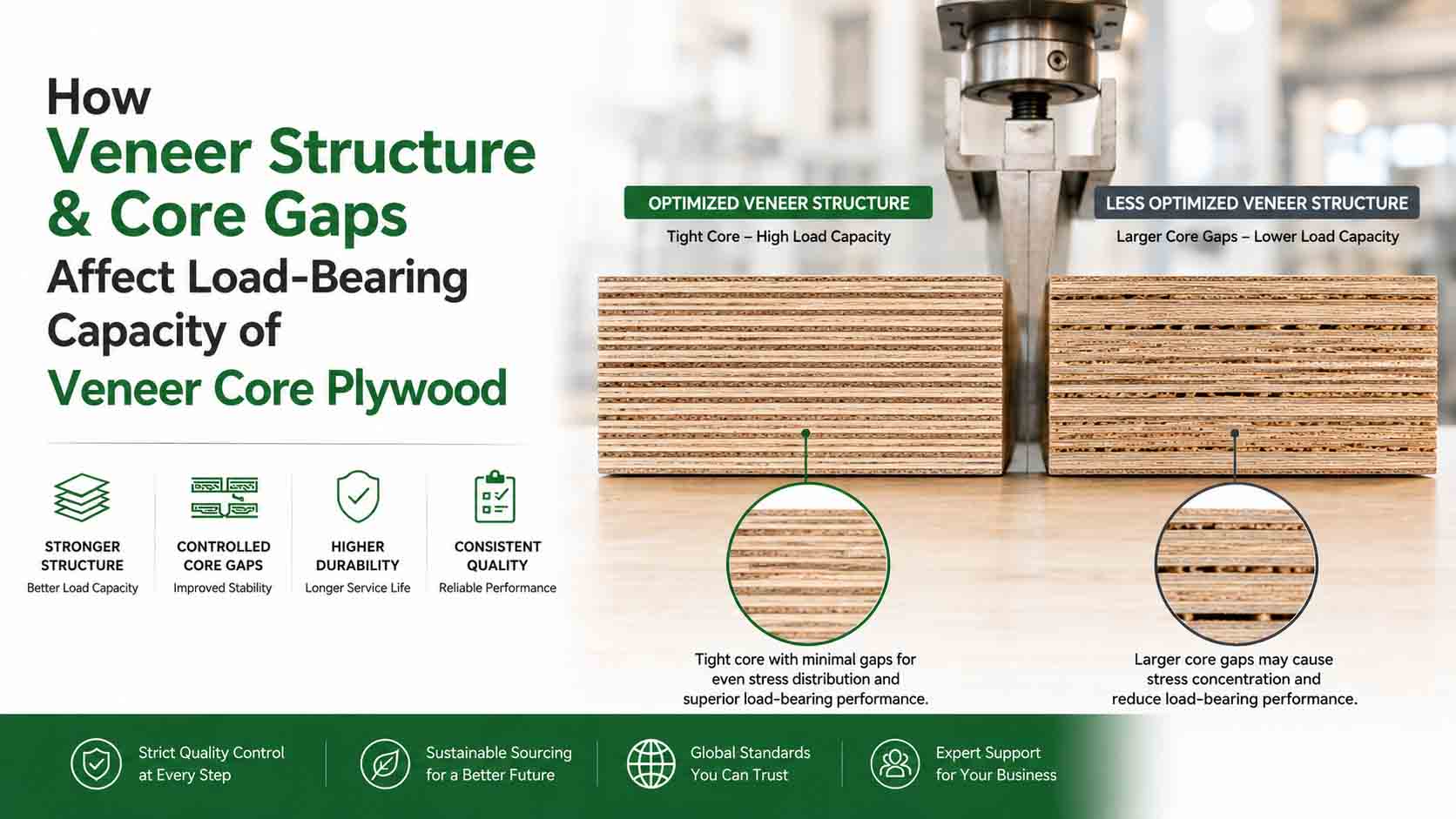
Not all veneers inside a panel are equal. Knot size, splits, overlaps, open joints, core gaps and patches all influence how the panel behaves under bending, shear and impact. Internal defects that are invisible on the surface can still weaken the structure.

Common Internal Defects

  • Knots and knot holes: Natural features that create local weak points in bending and shear.
  • Splits and checks: Cracks in the veneer that can propagate under load or moisture changes.
  • Overlaps and open joints: Poorly fitted veneer edges that reduce uniform load transfer.
  • Core gaps and voids: Empty spaces inside the core where glue and wood are missing.
  • Patches and repairs: Local corrections that can be acceptable when well executed, but problematic if excessive or poorly bonded.

When these defects are controlled and distributed properly, the panel still performs within grade specifications. When they are excessive or concentrated in critical zones, they can significantly reduce bending strength, stiffness and impact resistance.

Grain Direction and Cross-Lamination

Veneer grain direction is one of the core design elements in plywood. Layers with grain running in the long direction provide high bending strength and stiffness along that axis, while cross-layers with perpendicular grain improve stability and reduce splitting.

Parallel vs Perpendicular Grain Layers

If all veneers were oriented in the same direction (parallel grain), plywood would behave more like solid wood: strong along the grain but weak across it, and more prone to warping. By alternating grain directions, cross-lamination balances mechanical properties in both directions, improving shear capacity and dimensional stability.

Why Cross-Lamination Improves Stability

Wood expands and contracts mostly across the grain, not along it. When one veneer wants to shrink or swell, the cross-layer restrains that movement. This internal “push-pull” reduces overall movement, helping the panel stay flatter and reducing the risk of cracking or cupping as humidity changes.

Core Construction Types

The way veneers are arranged in the core also affects load-bearing capacity, screw holding and long-term durability. Buyers often hear terms like “full core”, “combi core” or “mixed hardwood” and need to understand what these mean in practice.

Full Core vs Combi Core vs Mixed Hardwood

  • Full core (single species core): All core veneers are from the same species or similar species group, providing consistent density and mechanical behaviour through the thickness.
  • Combi core: Combination of different species in the core, for example softwood plus hardwood, to balance cost, weight and performance.
  • Mixed hardwood core: Blend of hardwood species available in the region, with performance depending on the mix and veneer quality.

Impact on Load-Bearing Capacity and Screw Holding

Denser, more uniform cores generally provide better bending strength and screw holding. Well-made mixed hardwood cores can deliver strong performance; poorly controlled mixes with variable density and large voids weaken the panel, especially at fastener locations and high-stress areas such as supports and joints.

Core Type Typical Characteristics Strength & Screw Holding (Indicative) Common Uses
Full core (single species) Consistent density and behaviour, easier to predict High and uniform Structural, high-end furniture, demanding formwork
Combi core Mix of species to balance cost and performance Medium–High (depends on design) General construction, commercial furniture, some formwork
Mixed hardwood core Varied species blend; requires good QC Medium–High when well controlled, lower if gaps/voids Export plywood, formwork, packing, general use

Thickness Balance and Symmetry

Veneer structure is not only about species and defects; thickness balance and symmetry across the panel are just as important. A well-designed plywood layup is symmetrical around its central plane.

Balanced Construction (Face vs Back)

In a balanced panel, the face and back veneers have similar thickness and stiffness, and the core layers are arranged symmetrically. This keeps internal stresses equal on both sides, helping the panel remain flat under changing moisture conditions.

How Unbalanced Layup Leads to Warping

If one side has significantly thicker or stiffer veneers than the other, the panel may bend towards the weaker side when moisture or temperature changes. This unbalanced layup is a common cause of permanent bowing, especially in large panels or when one side is exposed to a different environment than the other (for example, one side facing indoors, the other facing outdoors).

What Importers Should Check About Veneer Structure

Importers cannot see every veneer inside each sheet, but they can use specifications, sampling and visual inspection to gain confidence in veneer structure quality.

Spec Sheet Details to Confirm

  • Core type and species: full core vs combi vs mixed hardwood.
  • Number of plies for a given thickness (e.g., 9, 11 or more layers).
  • Face/back species, grade and nominal veneer thickness.
  • Stated tolerances and any mention of maximum core gap size or quality standards.

Visual Checks at Factory and After Delivery

  • Inspect cross-sections at the panel edge: look for regular veneer thickness, minimal gaps, and consistent layup.
  • Check for excessive core voids or large repairs near edges and corners.
  • Look for repeating patterns of defects (for example, same defect in every sheet of a bundle), which may indicate process issues.
  • Monitor warping and bowing after panels are acclimatised at the destination warehouse.

Need Support Evaluating Veneer Structure?

FOMEX GREENWOOD can provide detailed layup information, cross-section photos and sampling plans to help importers assess veneer structure quality before and after shipment.

Contact FOMEX Technical Team →

Email: qc@fomexgroup.vn
☎ WhatsApp: +84 877 034 666

FAQs

Why does veneer grain direction matter in plywood?

Grain direction determines how strong each veneer is in bending and how much it expands or contracts with humidity. Alternating grain directions (cross-lamination) balances strength in both directions and reduces movement, helping plywood stay flatter and more stable than solid wood.

Can internal core gaps significantly reduce plywood strength?

Yes. Core gaps and voids interrupt load transfer between veneers, concentrating stress around those areas. A few small, well-distributed gaps may be acceptable within a grade, but large or frequent voids can noticeably reduce bending strength, stiffness and screw holding near edges or supports.

What is the difference between full core and mixed core plywood?

Full core panels use a single species or closely matched group of species in the core, giving more uniform density and mechanical properties. Mixed core or mixed hardwood panels combine different species, which can perform very well when controlled carefully, but may be less predictable if quality control is weak.

How can I know if my plywood has a balanced veneer structure?

A balanced structure is usually described on the spec sheet (symmetrical layup, similar face and back). In practice, you can inspect cross-sections for symmetry and monitor whether panels remain flat after acclimatisation. Frequent bowing in one direction may indicate unbalanced layup or inconsistent moisture content between layers.

by Admin Admin No Comments

Boiling Test Hours 8h–72h: What They Really Mean for Plywood Strength and Reuse Cycles

Boiling tests are one of the most important indicators of plywood bond durability. When you see 8h, 12h, 20h or even 72h boiling in specifications, those numbers tell you how the glue line behaves under extreme moisture and heat. This guide explains how boiling test hours relate to plywood strength, weather resistance and expected reuse cycles in real construction projects.

What Is a Boiling Test in Plywood Production?

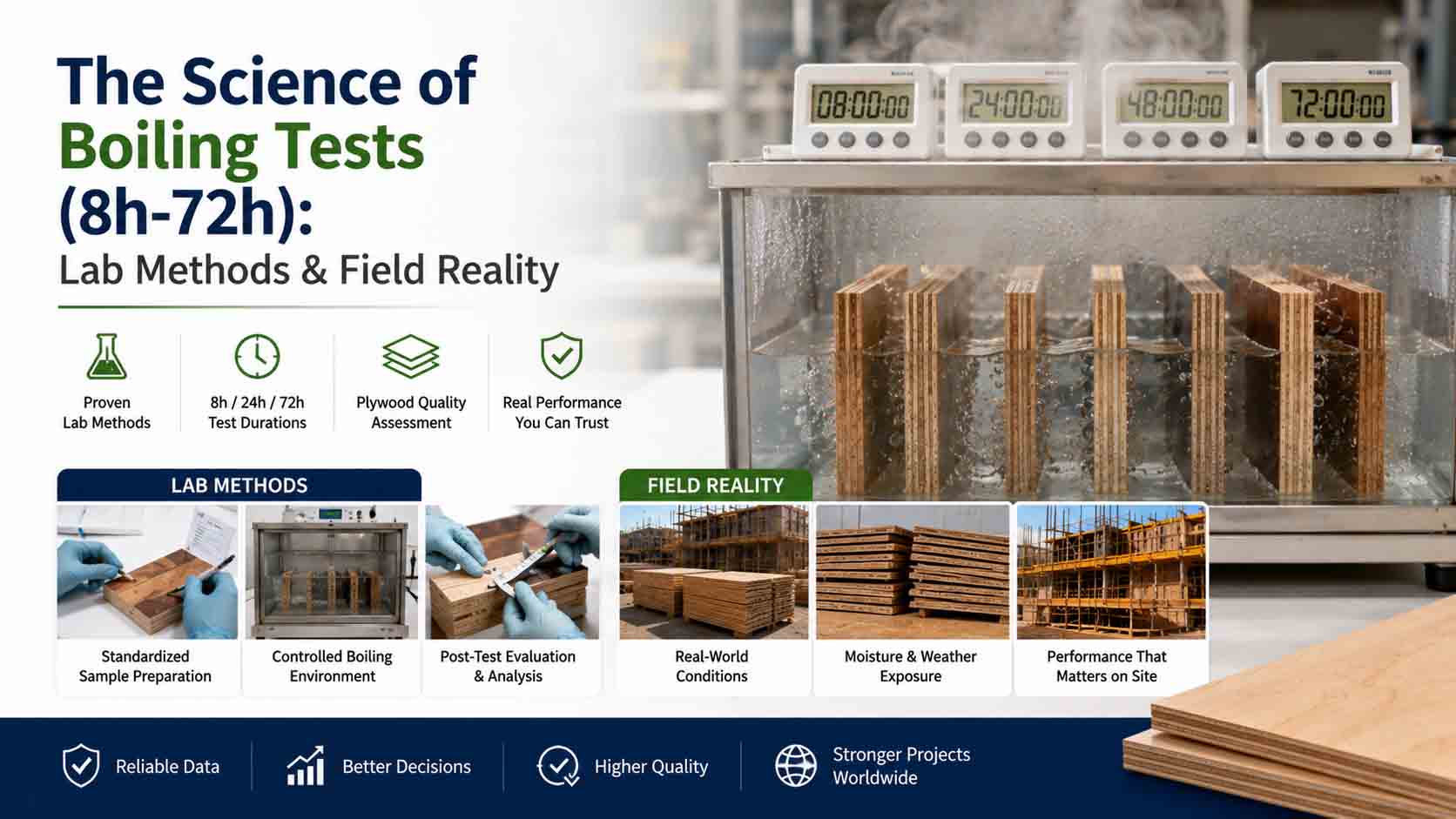
A boiling test is a laboratory method used to evaluate the durability of plywood glue lines under severe wet and heat conditions. It simulates accelerated ageing by exposing panels or test pieces to boiling water for a defined period, then cooling and inspecting them for bond failure.

While the exact procedures differ between standards, a typical cycle includes:

  • Cutting small test specimens from the panel with defined dimensions.
  • Boiling the specimens in water for a specified number of hours (for example 8–72 hours).
  • Drying or cooling them according to the standard (air-drying or oven-drying).
  • Visually checking and/or mechanically testing for delamination and bond strength.

The longer the boiling test and the stricter the acceptance criteria, the more demanding the performance requirement for the glue line.

Interpreting Boiling Hours: 8h, 10–12h, 15–20h, 36–48h, 72h

Boiling test “hours” describe the duration of exposure to boiling water. Longer times generally indicate stronger, more durable bonding systems, but they must be interpreted in the context of the standard and product grade.

Boiling Test Range Indicative Bond Durability Typical Plywood Grade Target
≈ 8 hours Entry-level exterior / WBP performance Lower-reuse film faced, cost-focused exterior commercial panels
10–12 hours Medium–high durability for general formwork and exterior Standard formwork plywood, many WBP commercial products
15–20 hours High durability for multi-reuse formwork Premium formwork plywood, demanding exterior applications
36–48 hours Very high durability, severe test regime High-reuse Promax-type formwork and heavy-duty exterior structures
72 hours (and beyond) Extreme exposure categories, top-end phenolic systems Specialised marine-related or highly critical structural uses

In simple terms, moving from an 8-hour glue line to a 36–48-hour or 72-hour glue line means moving from “basic exterior resistance” towards “maximum security under severe wet exposure”.

Boiling Test vs Real-World Performance

Boiling tests are laboratory tools, not a perfect replica of the jobsite. They provide a comparative indicator of bond durability but do not directly guarantee exact reuse cycles or service life.

Correlation with Reuse Cycles

  • Higher boiling hours usually correlate with higher potential reuse cycles in concrete formwork.
  • Panels designed for 15–20 hours or 36–48 hours generally survive more wet–dry cycles and aggressive cleaning than those designed for only 8 hours.
  • However, actual reuse depends heavily on handling, stripping tools, form oil, storage and climate.

Limitations of the Test

  • Boiling tests focus on glue line durability, not on face veneer quality, core gaps, edge sealing or mechanical impact resistance.
  • Panels with excellent boiling test results can still fail early if mishandled or if core construction is poor.
  • Conversely, panels with modest boiling hours may perform acceptably on short-term or well-managed projects.

Importers should treat boiling hours as one important data point, alongside veneer structure, film quality, moisture control and supplier QC.

Boiling Hours by Product Grade

Many suppliers position their formwork product range around typical boiling test ranges. Below is an indicative mapping for a Single / Standard / Premium / Promax type portfolio:

Product Grade Indicative Boiling Test Range* Typical Reuse Target (with good handling) Example Use Case
Single / Entry-level form ≈ 6–8 hours Up to 3 uses Small jobs, short-term or light-duty formwork
Standard form ≈ 10–12 hours Up to 8 uses General building formwork, moderate project duration
Premium form ≈ 15–20 hours Up to 12 uses Higher-spec formwork with repeated cycling and quality finish
Promax / high-performance form ≈ 36–48 hours (or higher phenolic systems) Up to 20 uses Long-term, high-reuse projects and demanding climates

*Actual boiling test ranges and reuse cycles depend on each manufacturer’s specification, glue system and QC.

For long-duration projects or contractors running panel fleets across multiple sites, grades designed for higher boiling hours offer more security and lower cost per use.

How Importers Should Read Boiling Test Data

Boiling test information often appears in technical sheets or lab reports, but it is not always easy to interpret. Importers should look beyond marketing slogans and examine what is actually tested.

What to Look For in Test Reports

  • Standard and method: Which standard was used (e.g., local or international), and what cycle did it require?
  • Boiling duration and cycle: Number of hours at boiling, any additional dry cycles, and total number of cycles.
  • Sample size and result: How many samples were tested, and what was the pass/fail criteria for delamination or strength?
  • Traceability: Does the report clearly link to a specific product, glue type and production batch?

Common Misinterpretations and Marketing Claims

  • Assuming “boiling test passed” always means the same thing, regardless of hours or standard.
  • Confusing occasional test results (R&D) with regular production performance.
  • Using boiling hours alone as a guarantee of reuse cycles without considering handling practices.

A disciplined review of boiling test data helps buyers distinguish between solid technical documentation and generic marketing statements.

Need Boiling Test Data for Your Market?

FOMEX GREENWOOD can provide boiling test reports and grade-specific targets for formwork plywood, helping you match product selection to your reuse and risk expectations.

Contact FOMEX Technical Team →

Email: qc@fomexgroup.vn
☎ WhatsApp: +84 877 034 666

by Admin Admin No Comments

Choosing the Right Glue Type: MUF vs WBP Melamine vs Phenolic for Export Plywood

Glue type is one of the main drivers of plywood performance in export markets. The right choice between MUF, WBP melamine and phenolic glue determines water and heat resistance, reuse cycles and compliance with international standards. This guide helps importers match glue systems to applications, climates and project requirements.

Compare MUF, WBP melamine and phenolic glue systems for export plywood from Vietnam and choose the right option for your application and climate.

Why Glue Type Matters in Export Plywood

Glue lines hold plywood veneers together; their performance controls how the panel behaves under water, heat and load. If the glue system is not suitable for the application, panels can swell, delaminate or fail structurally, even if the veneers themselves are high quality.

For export plywood, glue type has a direct impact on:

  • Water and heat resistance: How well the panel survives wet–dry cycles, boiling tests and temperature changes.
  • Structural integrity and reuse cycles: How many times formwork can be reused or how long panels last in service.
  • Compliance with international standards: Meeting requirements for exterior, formwork, marine or low-emission interior use in EU, US, Middle East and Asia-Pacific markets.

Choosing the wrong glue may still pass initial inspection but creates high claim risk after installation or after a few months of use.

Overview of Main Glue Systems

The three main glue systems used in export plywood are MUF, WBP melamine and phenolic. Each has its own strengths, limitations and ideal applications.

MUF (Melamine Urea Formaldehyde)

MUF is a modified urea-formaldehyde system with melamine added to improve water and heat resistance. It offers:

  • Better durability than pure urea-formaldehyde (UF).
  • Good bond strength for many interior and semi-protected uses.
  • Cost-effective performance where full exterior resistance is not required.

Limitations: MUF is generally not recommended for continuous wet or fully exterior exposure without additional protection. It performs best in controlled environments or where occasional moisture is expected but can dry out between cycles.

WBP Melamine Glue (Weather and Boil Proof)

WBP melamine glue systems are designed to meet “Weather and Boil Proof” criteria under standard tests. They provide:

  • Good resistance to wet conditions and short-term boiling tests.
  • Suitability for many exterior and formwork applications.
  • A balance between cost and performance for multi-use panels.

WBP melamine is widely used for film faced formwork plywood, exterior-grade commercial plywood and certain structural applications where panels face intermittent wetting but not constant immersion.

Phenolic Glue

Phenolic glue is the benchmark for high durability and long-term performance under severe conditions. It offers:

  • Excellent water and heat resistance, passing long boiling tests.
  • Very strong, stable bonds for high-reuse formwork and demanding exterior uses.
  • Good resistance in marine-related or highly exposed environments when combined with suitable veneers.

Phenolic systems are more expensive but deliver the highest level of security where failure is not acceptable and long service life is required.

Technical Comparison: MUF vs WBP Melamine vs Phenolic

The table below summarises key differences between the main glue systems. Exact performance depends on formulation, glue spread, pressing and veneer quality, but the relative ranking remains similar across producers.

Glue Type Water & Heat Resistance Typical Boiling Test Range* Typical Uses Relative Cost Level
MUF Medium – improved over UF, limited for long-term exterior Shorter boiling durations or cyclic tests Interior furniture, semi-protected structures, lower-reuse formwork in mild climates Low–Medium
WBP Melamine High – designed to meet WBP criteria Commonly used for 6–20 hour boiling tests depending on grade Film faced formwork, exterior commercial plywood, structural sheathing in many markets Medium
Phenolic Very High – best-in-class for severe wet and heat conditions Long boiling tests (often 24–72 hours) depending on specification High-reuse formwork, marine-related applications, heavily exposed exterior structures Medium–High

*Boiling test ranges vary by standard and specification; values are indicative only.

Matching glue type to the expected boiling test or exposure category is essential. A panel designed for 6–8 hours of boiling cannot be treated as equivalent to one designed for 36–48 or 72 hours.

Matching Glue to Application and Destination

Export buyers should not specify glue type in isolation. The correct choice depends on whether the panel will be used indoors or outdoors, in formwork or furniture, and in cold/humid or hot/dry climates.

Interior vs Exterior vs Formwork

  • Interior furniture and cabinetry: MUF or appropriate interior-grade systems can be sufficient, especially when panels are used in climate-controlled spaces.
  • Exterior cladding, structural sheathing, exposed decks: WBP melamine or phenolic glue systems are typically required to withstand weather and wetting.
  • Concrete formwork: WBP melamine is widely used; phenolic glue is preferred for high-reuse or demanding formwork operations.

Cold vs Hot, Dry vs Humid Climates

In cold, humid environments, panels cycle through wetting and drying with temperature swings, stressing glue lines. In hot, dry climates, high temperatures and rapid drying can also stress bonds. Phenolic and high-quality WBP melamine systems handle these cycles better than basic systems.

Project Duration and Reuse Expectations

Short-term projects or one-off uses may accept lower-cost glue systems if safety and performance requirements are still met. For long-term or high-reuse applications, the economics usually favour WBP melamine or phenolic due to improved durability and lower cost per use.

Glue Type and Compliance Requirements

Glue systems also influence formaldehyde emissions and must be considered alongside emission standards and certification requirements in target markets.

Formaldehyde Emission Classes (E0/E1/E2, CARB-P2)

Different glue systems and formulations can be tailored to meet specific emission classes such as E0, E1, E2 or CARB-P2. Buyers should clearly state:

  • The required emission class (e.g., E0/E1/E2).
  • Whether CARB-P2 or other local regulations apply.
  • Whether products will be used in sensitive indoor environments (schools, hospitals, homes).

Documentation and Test Reports

Importers should request:

  • Formal test reports for bond strength and boiling tests (where relevant).
  • Formaldehyde emission test reports corresponding to the emission class claimed.
  • Certificates or declarations of conformity for specific standards or markets.

Documentation should be traceable to the specific product, glue system and production batch to be meaningful in audits or customs checks.

Glue Options in FOMEX GREENWOOD Product Lines

In a diversified plywood portfolio, not every product uses the same glue. Different applications and markets call for different configurations.

  • Film faced formwork plywood: Typically uses WBP melamine or phenolic-based systems designed to match targeted reuse cycles and boiling test requirements.
  • Anti-slip flooring panels: Use exterior-grade WBP systems suitable for wet environments and heavy wear.
  • Furniture plywood: Uses glue systems tuned to interior performance and emission requirements (E0/E1/E2, CARB-P2 as needed).
  • Packing and industrial plywood: May use cost-effective exterior or MR/WBP systems, depending on customer requirements and exposure conditions.

For EU, US, Middle East and Asia-Pacific markets, FOMEX GREENWOOD can align glue systems with local standards, customer specifications and typical climate conditions to reduce post-delivery surprises.

Need Help Choosing the Right Glue for Your Market?

FOMEX GREENWOOD engineers can recommend MUF, WBP melamine or phenolic glue configurations based on your application, reuse targets and destination regulations.

Contact FOMEX Technical Team →

Email: qc@fomexgroup.vn
☎ WhatsApp: +84 877 034 666

FAQs

Is WBP glue always waterproof?

WBP glue is designed to meet specific weather and boil proof standards, making it suitable for many wet or exterior uses. However, “waterproof” performance still depends on formulation, veneer quality, pressing and panel design. Buyers should match WBP grade and test results to the actual exposure conditions expected.

When should I choose phenolic glue over melamine?

Phenolic glue is the better choice for high-reuse formwork, long-term exterior exposure, marine-related applications or projects where failure would be extremely costly. When you need maximum durability, long boiling resistance and the lowest risk under severe conditions, phenolic is typically recommended over melamine.

Can MUF glue meet exterior performance requirements?

MUF glue offers improved performance over basic UF systems and can be suitable for semi-protected or short-term exterior uses in some designs. However, for fully exposed or critical exterior applications, WBP melamine or phenolic glue is usually preferred and more consistent with relevant standards.

Does glue type affect formaldehyde emissions?

Yes. Glue formulation and resin type play a major role in formaldehyde emission levels. Emission-optimised MUF, melamine or phenolic systems can be used to meet E0/E1/E2 or CARB-P2 limits, but buyers must specify the required class and request supporting test reports to confirm compliance.

by Admin Admin No Comments

Plywood Damage at Sea: Causes, Prevention and Best Practices

International shipping is one of the riskiest stages in the plywood supply chain. Edge crush, warping, mould and stains can turn a profitable shipment into a loss. This guide explains why plywood gets damaged inside containers and how correct stuffing, lashing and moisture control can dramatically reduce claims.

Common Types of Shipping Damage to Plywood

Plywood can suffer several types of damage between factory and destination warehouse. Understanding these patterns is the first step to preventing them.

  • Edge crush and corner damage: Crushed, chipped or broken edges and corners caused by impact, shifting inside the container or rough forklift handling.
  • Warping and bowing: Panels that arrive curved instead of flat, making them difficult to use for formwork, furniture or flooring applications.
  • Delamination: Veneers separating at the edges or within the panel, often linked to moisture and mechanical stress during transit.
  • Mould and fungal growth: Black or white spots, fuzzy patches or odours caused by high humidity and poor ventilation.
  • Stains and rust marks: Discoloration from contact with wet steel, container walls, or contaminated packing materials.

Many of these issues can be traced back to how plywood is packed, loaded, secured and protected from moisture before the container doors are closed.

Root Causes Inside the Container

Even when the product quality at the factory is good, poor container practices can destroy value in transit. The main root causes are related to stuffing, lashing, load distribution and blocking.

Poor Stuffing and Lashing Practices

If bundles are not tightly packed or secured, they can move during transport. Ship motion, braking and cornering on trucks and cranes create forces that crush corners, damage edges and deform panels. Leaving gaps between stacks or failing to lock them against the container walls invites movement.

Overloading and Uneven Weight Distribution

Concentrating too much weight in one area can cause bundles at the bottom to crush and deform under the load. Uneven distribution also increases the stress on container floors and handling equipment, raising the risk of damage during lifting and transport.

Insufficient Dunnage and Blocking

Without proper dunnage, blocks and bracing, bundles can slide or tilt during ocean swell or road vibration. Simple details like wooden blocks, friction mats, and cross-bracing with timber or straps can make the difference between a stable load and a container full of damaged panels.

Moisture-Related Damage

Moisture is one of the biggest threats to plywood during international transport. It can come from the panels themselves, the air, the container or external conditions.

Condensation (“Container Rain”) and Humidity Changes

When warm, humid air inside the container cools during the voyage, moisture condenses on the steel roof and walls and drips onto the cargo. This “container rain” can wet plywood surfaces and edges, leading to stains, mould and swelling, especially if airflow is poor and panels stay wet for long periods.

High Moisture Content Before Loading

If plywood is loaded with moisture content above recommended levels, the panels can continue to release moisture inside the closed container. Combined with temperature changes at sea, this creates an ideal environment for condensation and mould growth. Proper drying and conditioning before loading is essential.

Lack of Desiccants and Ventilation

Without desiccant bags or appropriate liners, the container has no system to absorb excess moisture. On long voyages or routes with big temperature swings, this significantly increases the risk of humidity-related damage.

Best Practices for Container Stuffing and Lashing

Good stuffing and lashing discipline can reduce mechanical damage dramatically. The priority is to treat each container as a structural system, not just “space to fill”.

Pallets vs Loose Loading

Palletized loading provides better forklift handling and consistent spacing but can reduce the number of panels per container and add cost. Loose loading (bundles directly on the floor) can maximise volume but requires very careful stacking and blocking to prevent movement.

The best choice depends on product type, destination handling equipment and claim history. For high-value or high-risk shipments, pallets may be worth the extra cost for better protection and easier unloading.

Using Belts, Blocks and Corner Protectors

Straps or belts should be used to lock bundles together and anchor them to lashing points. Wooden blocks and braces at the front, back and sides prevent sliding, while corner protectors spread strap pressure and protect edges from crushing. These small details significantly reduce the risk of impact damage during transit.

Stacking Patterns to Minimise Movement

Plywood bundles should be stacked in a way that locks them together—no big gaps, “loose” stacks or unstable columns. Heavy bundles should go at the bottom, with lighter ones on top. Mixed sizes must be arranged so that they do not create unsupported overhangs that can break during movement.

Moisture Control Strategies for Plywood

Managing moisture is as important as mechanical protection. A few proactive steps can slash the risk of warping, mould and stains.

Pre-Loading Moisture Checks

Plywood should be checked for moisture content before packing. If moisture is above agreed levels, panels should be dried or conditioned before shipment. Recording these measurements in a pre-shipment report helps in case of later claims.

Desiccant Bags and Container Liners

Desiccant bags placed along container walls and on top of the cargo absorb excess moisture in the air. In higher-risk routes, container liners or roof liners can provide an extra barrier between condensation and the panels, reducing “container rain” contact.

Storage Conditions at Origin and Destination

Containers should be stuffed in dry, covered areas, with panels that have not been exposed to direct rain. At destination, bundles should be unloaded promptly and stored off the ground, under cover, with enough airflow to avoid trapped humidity.

How FOMEX GLOBAL Manages Packing & Loading

A strong supplier treats packing and loading as part of quality, not an afterthought. Standard packing specifications, labelling and supervised loading minimise risk before the container leaves the yard.

  • Standard packing specs: Defined bundle sizes, protective wrapping, corner boards and strapping patterns for each product line.
  • Clear labelling: Bundle labels with product name, grade, size, thickness, quantity and production batch for easy inspection and stock management.
  • QC during loading: Visual checks for damage, correct stacking pattern and lashing before doors are sealed.
  • Photo and documentation reports: Loading photos and packing lists shared with buyers to provide transparency and support in case of claims.

Need a Lower-Risk Packing & Loading Plan?

FOMEX GLOBAL can work with your logistics team to define packing specs, loading methods and moisture control measures tailored to your routes and claim history.

Contact FOMEX Logistics Team →

Email: qc@fomexgroup.vn
☎ WhatsApp: +84 877 034 666

FAQs

Why does plywood warp after ocean shipping?

Warping is usually caused by uneven moisture exposure and stress during transport. One side of the panel absorbs more moisture or dries faster than the other, leading to tension differences and curvature. High initial moisture content, condensation and poor storage at destination all contribute.

How can I prevent mould and stains on plywood panels?

Keep moisture content within specification before loading, use desiccants or liners on riskier routes, and ensure containers are clean and dry. At destination, unload quickly and store bundles in a ventilated, covered area, away from direct contact with wet floors or walls.

Are pallets better than loose loading for plywood?

Pallets usually provide better protection and easier handling, reducing edge and corner damage. However, they take space and add cost. For high-value or sensitive products, pallets are often the safer choice; for commodity grades with strong packing, loose loading can

by Admin Admin No Comments

Why Plywood Shipments Get Rejected at Customs – and How to Avoid It

Customs rejections are one of the most expensive problems in international plywood sourcing. This guide breaks down the real reasons plywood shipments get rejected at customs—documentation mistakes, compliance gaps, spec mismatches, and phytosanitary issues—and shows how importers can build a “customs-safe” shipment process.

Why Plywood Shipments Get Rejected at Customs

The Real Cost of a Rejected Plywood Shipment

A rejected shipment rarely ends at “customs says no.” It typically triggers port delays, storage charges, demurrage/detention fees, re-export costs, and emergency rebooking—often exceeding the original profit margin on the container.

Just as damaging is reputation risk. When a buyer’s warehouse runs out of stock due to a blocked container, the importer may lose shelf space, contractor accounts, or long-term supply contracts—even if the problem was caused by a paperwork detail.

That’s why importers should treat customs clearance as a system: correct documents, correct specs, correct markings, and correct packaging—every shipment, every time.

Documentation-Related Rejection Reasons

Missing or Incorrect Commercial Invoice & Packing List

The most common reason for customs delays is basic document inconsistency: invoice data doesn’t match the packing list, container number is wrong, quantities don’t reconcile, or product descriptions are vague. Even small mismatches can trigger inspection or additional paperwork requests.

Wrong HS Code or Product Description

Misclassification (HS code) or unclear descriptions (e.g., not specifying film-faced plywood vs. commercial plywood, glue type, or intended use) can lead to incorrect duties, compliance checks, and rejection risk. Always align HS code and description with your broker’s guidance and the supplier’s spec sheet.

Incomplete Certificates (FSC, CARB-P2, CE, EUDR/EUTR Links)

Some markets or customers require proof of origin, chain-of-custody, or emissions compliance. If documents are missing, expired, not traceable to a shipment/batch, or inconsistent with the invoice description, customs may hold the cargo while verifying legitimacy.

Compliance and Certification Issues

Missing Certificates or Invalid Copies

A certificate file that looks “correct” is not always acceptable. Customs and buyers may check certificate number validity, scope, name matching (company/site), dates, and product coverage. If any element fails verification, clearance can be delayed or denied.

Formaldehyde Emission Standards Not Met

For interior-grade plywood, formaldehyde emissions can be a compliance hotspot. If the destination market requires low-emission standards (e.g., CARB-P2 / E0 / E1) and test reports are missing or the goods fail testing, the shipment may be rejected or forced into costly corrective action.

Non-Compliant Labelling and Markings

Incorrect marking (bundle labels, pallet marks, product stamping), missing language elements, or non-compliant CE/standard references can trigger inspection. Buyers may also reject goods if labeling doesn’t match the spec sheet and contract terms.

Quality and Specification Mismatches

Spec Sheet vs. Actual Product Delivered

Customs and end buyers increasingly treat the spec sheet as a “truth document.” If the shipment arrives with different face/back grade, different film, different core composition, or different glue class than what was declared, it can trigger disputes and inspections.

Moisture Content, Thickness, or Face Defects Outside Tolerance

Common claim triggers include thickness out of tolerance, excessive warping, delamination, or surface defects beyond agreed grade. Even if customs clears the shipment, the buyer may reject the container commercially, creating the same cost impact as a customs rejection.

Mismatch Type Typical Root Cause Prevention Method
Thickness / tolerance mismatch Unclear tolerance on PO; weak final inspection Confirm tolerance in writing; measure during PSI
Wrong grade / appearance Grade standards not aligned by market Reference sample + photo defect guide + acceptance criteria
Glue / performance mismatch Supplier substitutes spec due to shortage Pre-production confirmation + batch traceability
Packing/marking mismatch No packing SOP; last-minute changes Packing spec sheet + loading supervision + photo report

Fumigation and Phytosanitary Problems

ISPM-15 Requirements for Pallets

If your shipment includes wooden pallets or wood packaging material, many destinations require ISPM-15 compliant treatment and marking. Missing marks, unclear marks, or the wrong pallet type can trigger inspection and delays.

Incorrect or Missing Fumigation Certificate

Some routes and destinations require fumigation or phytosanitary documentation depending on packaging and cargo type. If the certificate is missing, mismatched (dates, container number, consignee), or issued incorrectly, customs can hold or reject the shipment.

Contamination or Pest Findings

Dust, bark residue, live insects, or visible contamination inside the container can trigger quarantine actions. Clean packing areas, proper wrapping, and correct pallet sourcing reduce this risk significantly.

How to Build a “Customs-Safe” Plywood Shipment

The most reliable method is to build a repeatable checklist that combines compliance, quality control, and documentation discipline—before the container leaves the factory.

Pre-Shipment Checklist (Importer + Supplier)

Category What to Check Proof / Output
Documents Invoice, packing list, BL draft, COO, insurance (if any) Final PDF set aligned with container details
Compliance FSC-COC / emissions / CE (as required by market & customer) Valid certificates + traceable shipment reference
Quality Thickness, moisture, face/back grade, delamination, warping PSI report + photos + measurement logs
Packing Bundle protection, corner guards, strapping, labels Packing photos + packing spec confirmation
Phytosanitary ISPM-15 pallets, fumigation requirements if applicable ISPM-15 marks + fumigation certificate (if needed)

Work With a Supplier That Controls QC + Documentation

The fastest clearance outcomes usually happen when the supplier has a controlled supply chain, pre-shipment inspection routines, and transparent, traceable documentation—because customs questions can be answered quickly with evidence.

In the FOMEX ecosystem, the workflow is designed to reduce buyer risk through requirement analysis, technical specification & compliance confirmation, production coordination & QC control, documentation export preparation, delivery/logistics coordination, and post-shipment support.

FOMEX Global highlights dedicated QC and inspection before shipment, plus transparent documentation and traceable origin, to help international buyers avoid compliance surprises.

Read More

Want a Customs-Safe Document Pack for Your Next Shipment?

FOMEX GLOBAL supports importers with application-based specs, pre-shipment inspection coordination, and export documentation preparation to reduce customs risk and stabilize supply.

Contact FOMEX Team →

Email: qc@fomexgroup.vn
☎ WhatsApp: +84 877 034 666

FAQs

What documents are essential for plywood customs clearance?

Most shipments need a commercial invoice, packing list, bill of lading (or airway bill), and any required certificates requested by the destination country or your end customer (for example origin, emissions, or chain-of-custody documents). Always confirm exact requirements with your customs broker for your route and HS code.

Can missing FSC certificates cause shipment rejection?

Yes—if FSC documentation is required by your customer contract, government procurement rules, or your compliance program. Even when customs does not require FSC, buyers may reject the shipment commercially if the promised certificate is missing or cannot be verified.

How do I ensure my plywood shipment meets formaldehyde regulations?

Specify the emissions standard clearly on the PO and spec sheet, request valid test reports/certificates tied to your product and batch, and use pre-shipment inspection to confirm labeling and documentation match the goods. For high-risk destinations, discuss additional third-party testing with your broker and customer.

Who is responsible if customs rejects the shipment?

Responsibility depends on contract terms (Incoterms), purchase agreement, and which party prepared documentation. In practice, importers reduce risk by aligning responsibilities in writing and working with suppliers who can provide complete, accurate documents and verifiable QC records.